Haworth Claire M A, Nelson S Katherine, Layous Kristin, Carter Kathryn, Jacobs Bao Katherine, Lyubomirsky Sonja, Plomin Robert
MRC Integrative Epidemiology Unit, School of Experimental Psychology & School of Social and Community Medicine, University of Bristol, Bristol, United Kingdom.
Department of Psychology, Sewanee: The University of the South, Sewanee, United States of America.
PLoS One. 2016 May 26;11(5):e0155538. doi: 10.1371/journal.pone.0155538. eCollection 2016.
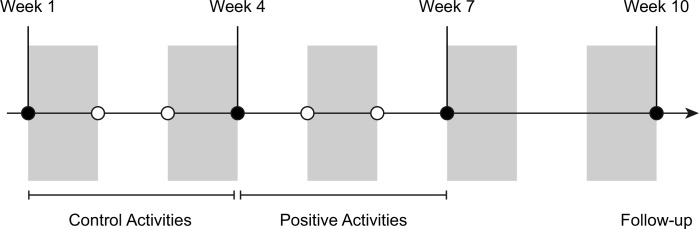
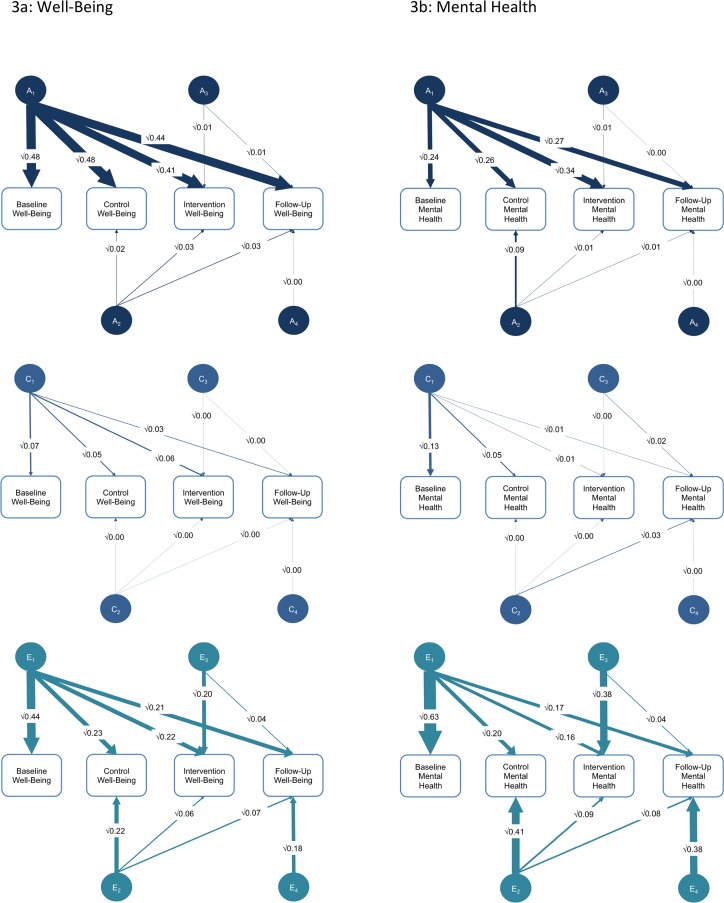
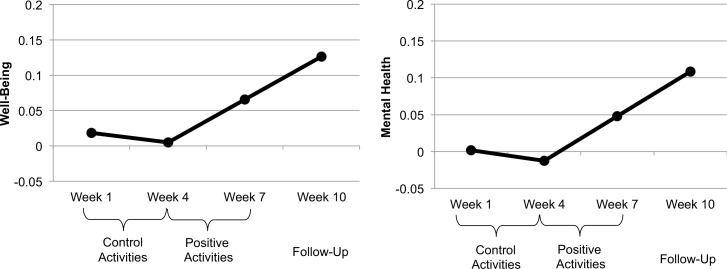
Genetic and environmental influences on complex traits can change in response to developmental and environmental contexts. Here we explore the impact of a positive activity intervention on the genetic and environmental influences on well-being and mental health in a sample of 750 adolescent twins. Twins completed a 10-week online well-being intervention, consisting of kindness and gratitude tasks and matched control activities. The results showed significant improvements both in well-being and in internalizing symptoms in response to the intervention activities. We used multivariate twin analyses of repeated measures, tracking stability and change in genetic and environmental influences, to assess the impact of this environmental intervention on these variance components. The heritability of well-being remained high both before and after the intervention, and the same genetic effects were important at each stage, even as well-being increased. The overall magnitude of environmental influences was also stable across the intervention; however, different non-shared environmental influences emerged during the intervention. Our study highlights the value of exploring the innovations in non-shared environmental influences that could provide clues to the mechanisms behind improvements in well-being. The findings also emphasize that even traits strongly influenced by genetics, like well-being, are subject to change in response to environmental interventions.
对复杂性状的遗传和环境影响会随着发育和环境背景的变化而改变。在此,我们在750名青少年双胞胎样本中,探究积极活动干预对幸福和心理健康的遗传及环境影响。双胞胎们完成了一项为期10周的在线幸福干预,包括友善和感恩任务以及匹配的对照活动。结果显示,对干预活动的反应中,幸福和内化症状均有显著改善。我们使用重复测量的多变量双胞胎分析,追踪遗传和环境影响的稳定性及变化,以评估这种环境干预对这些方差成分的影响。干预前后,幸福的遗传度均保持较高水平,即便幸福度有所提高,相同的遗传效应在每个阶段都很重要。环境影响的总体程度在整个干预过程中也保持稳定;然而,干预期间出现了不同的非共享环境影响。我们的研究强调了探索非共享环境影响创新的价值,这些创新可为幸福改善背后的机制提供线索。研究结果还强调,即使像幸福这样受遗传强烈影响的性状,也会因环境干预而发生变化。