• 文献检索
  • 文档翻译
  • 深度研究
  • 学术资讯
  • Suppr Zotero 插件Zotero 插件
  • 邀请有礼
  • 套餐&价格
  • 历史记录
应用&插件
Suppr Zotero 插件Zotero 插件浏览器插件Mac 客户端Windows 客户端微信小程序
定价
高级版会员购买积分包购买API积分包
服务
文献检索文档翻译深度研究API 文档MCP 服务
关于我们
关于 Suppr公司介绍联系我们用户协议隐私条款
关注我们

Suppr 超能文献

核心技术专利:CN118964589B侵权必究
粤ICP备2023148730 号-1Suppr @ 2026

文献检索

告别复杂PubMed语法,用中文像聊天一样搜索,搜遍4000万医学文献。AI智能推荐,让科研检索更轻松。

立即免费搜索

文件翻译

保留排版,准确专业,支持PDF/Word/PPT等文件格式,支持 12+语言互译。

免费翻译文档

深度研究

AI帮你快速写综述,25分钟生成高质量综述,智能提取关键信息,辅助科研写作。

立即免费体验

拟南芥中的高渗胁迫记忆由基因组中不同的表观遗传不稳定位点介导,并在雄性生殖系中受DNA糖基化酶活性的限制。

Hyperosmotic stress memory in Arabidopsis is mediated by distinct epigenetically labile sites in the genome and is restricted in the male germline by DNA glycosylase activity.

作者信息

Wibowo Anjar, Becker Claude, Marconi Gianpiero, Durr Julius, Price Jonathan, Hagmann Jorg, Papareddy Ranjith, Putra Hadi, Kageyama Jorge, Becker Jorg, Weigel Detlef, Gutierrez-Marcos Jose

机构信息

School of Life Sciences, University of Warwick, Coventry, United Kingdom.

Department of Molecular Biology, Max Planck Institute for Developmental Biology, Tübingen, Germany.

出版信息

Elife. 2016 May 31;5:e13546. doi: 10.7554/eLife.13546.

DOI:10.7554/eLife.13546
PMID:27242129
原文链接:https://pmc.ncbi.nlm.nih.gov/articles/PMC4887212/
Abstract

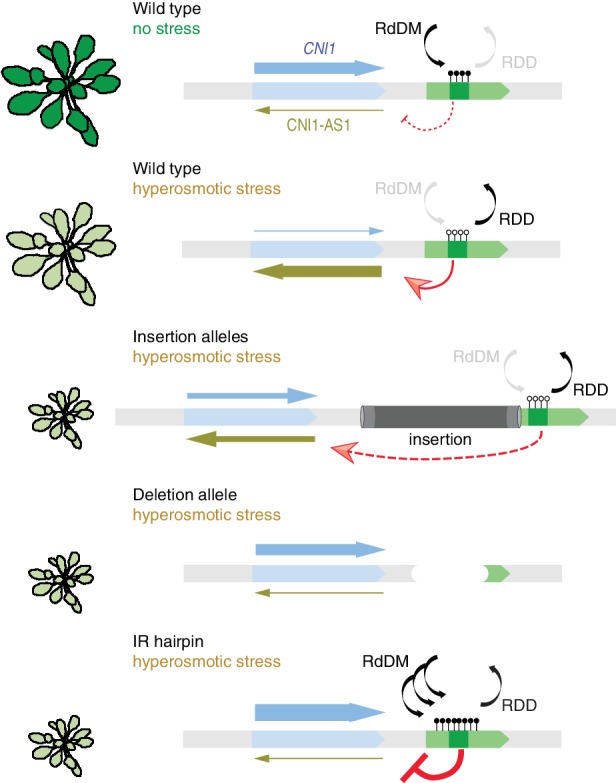
Inducible epigenetic changes in eukaryotes are believed to enable rapid adaptation to environmental fluctuations. We have found distinct regions of the Arabidopsis genome that are susceptible to DNA (de)methylation in response to hyperosmotic stress. The stress-induced epigenetic changes are associated with conditionally heritable adaptive phenotypic stress responses. However, these stress responses are primarily transmitted to the next generation through the female lineage due to widespread DNA glycosylase activity in the male germline, and extensively reset in the absence of stress. Using the CNI1/ATL31 locus as an example, we demonstrate that epigenetically targeted sequences function as distantly-acting control elements of antisense long non-coding RNAs, which in turn regulate targeted gene expression in response to stress. Collectively, our findings reveal that plants use a highly dynamic maternal 'short-term stress memory' with which to respond to adverse external conditions. This transient memory relies on the DNA methylation machinery and associated transcriptional changes to extend the phenotypic plasticity accessible to the immediate offspring.

摘要

真核生物中可诱导的表观遗传变化被认为能够使其快速适应环境波动。我们发现拟南芥基因组的不同区域在高渗胁迫下易发生DNA(去)甲基化。胁迫诱导的表观遗传变化与条件可遗传的适应性表型胁迫反应相关。然而,由于雄性生殖系中广泛存在的DNA糖基化酶活性,这些胁迫反应主要通过雌性谱系传递给下一代,并且在没有胁迫的情况下会大量重置。以CNI1/ATL31基因座为例,我们证明表观遗传靶向序列作为反义长链非编码RNA的远距离作用控制元件,进而响应胁迫调节靶向基因表达。总体而言,我们的研究结果表明植物利用高度动态的母本“短期胁迫记忆”来应对不利的外部条件。这种短暂的记忆依赖于DNA甲基化机制和相关的转录变化,以扩展直接后代可获得的表型可塑性。
https://cdn.ncbi.nlm.nih.gov/pmc/blobs/68a0/4887212/6e59af87361e/elife-13546-fig7.jpg
https://cdn.ncbi.nlm.nih.gov/pmc/blobs/68a0/4887212/df93c5e0772d/elife-13546-fig1.jpg
https://cdn.ncbi.nlm.nih.gov/pmc/blobs/68a0/4887212/f9b356d29f44/elife-13546-fig1-figsupp1.jpg
https://cdn.ncbi.nlm.nih.gov/pmc/blobs/68a0/4887212/397b0520874c/elife-13546-fig2.jpg
https://cdn.ncbi.nlm.nih.gov/pmc/blobs/68a0/4887212/368d51f6b1e7/elife-13546-fig2-figsupp1.jpg
https://cdn.ncbi.nlm.nih.gov/pmc/blobs/68a0/4887212/9c6d3621f029/elife-13546-fig2-figsupp2.jpg
https://cdn.ncbi.nlm.nih.gov/pmc/blobs/68a0/4887212/23e2d112e569/elife-13546-fig2-figsupp3.jpg
https://cdn.ncbi.nlm.nih.gov/pmc/blobs/68a0/4887212/838a689b9272/elife-13546-fig2-figsupp4.jpg
https://cdn.ncbi.nlm.nih.gov/pmc/blobs/68a0/4887212/f83d0bf40c39/elife-13546-fig2-figsupp5.jpg
https://cdn.ncbi.nlm.nih.gov/pmc/blobs/68a0/4887212/7e2c9eaae5e9/elife-13546-fig3.jpg
https://cdn.ncbi.nlm.nih.gov/pmc/blobs/68a0/4887212/732d78b079fd/elife-13546-fig3-figsupp1.jpg
https://cdn.ncbi.nlm.nih.gov/pmc/blobs/68a0/4887212/a62545194a7e/elife-13546-fig3-figsupp2.jpg
https://cdn.ncbi.nlm.nih.gov/pmc/blobs/68a0/4887212/52f411ee4064/elife-13546-fig4.jpg
https://cdn.ncbi.nlm.nih.gov/pmc/blobs/68a0/4887212/71ade5806601/elife-13546-fig4-figsupp1.jpg
https://cdn.ncbi.nlm.nih.gov/pmc/blobs/68a0/4887212/adf5b06ed31f/elife-13546-fig4-figsupp2.jpg
https://cdn.ncbi.nlm.nih.gov/pmc/blobs/68a0/4887212/3f7b1ea973fb/elife-13546-fig5.jpg
https://cdn.ncbi.nlm.nih.gov/pmc/blobs/68a0/4887212/dfad600955c6/elife-13546-fig5-figsupp1.jpg
https://cdn.ncbi.nlm.nih.gov/pmc/blobs/68a0/4887212/454cef193d77/elife-13546-fig5-figsupp2.jpg
https://cdn.ncbi.nlm.nih.gov/pmc/blobs/68a0/4887212/f8c073ef3dea/elife-13546-fig5-figsupp3.jpg
https://cdn.ncbi.nlm.nih.gov/pmc/blobs/68a0/4887212/a6a5e8546f3b/elife-13546-fig5-figsupp4.jpg
https://cdn.ncbi.nlm.nih.gov/pmc/blobs/68a0/4887212/a0a02610db9d/elife-13546-fig6.jpg
https://cdn.ncbi.nlm.nih.gov/pmc/blobs/68a0/4887212/e709cb0fd1ce/elife-13546-fig6-figsupp1.jpg
https://cdn.ncbi.nlm.nih.gov/pmc/blobs/68a0/4887212/9169b19a9d60/elife-13546-fig6-figsupp2.jpg
https://cdn.ncbi.nlm.nih.gov/pmc/blobs/68a0/4887212/34e5db6da28f/elife-13546-fig6-figsupp3.jpg
https://cdn.ncbi.nlm.nih.gov/pmc/blobs/68a0/4887212/6e59af87361e/elife-13546-fig7.jpg
https://cdn.ncbi.nlm.nih.gov/pmc/blobs/68a0/4887212/df93c5e0772d/elife-13546-fig1.jpg
https://cdn.ncbi.nlm.nih.gov/pmc/blobs/68a0/4887212/f9b356d29f44/elife-13546-fig1-figsupp1.jpg
https://cdn.ncbi.nlm.nih.gov/pmc/blobs/68a0/4887212/397b0520874c/elife-13546-fig2.jpg
https://cdn.ncbi.nlm.nih.gov/pmc/blobs/68a0/4887212/368d51f6b1e7/elife-13546-fig2-figsupp1.jpg
https://cdn.ncbi.nlm.nih.gov/pmc/blobs/68a0/4887212/9c6d3621f029/elife-13546-fig2-figsupp2.jpg
https://cdn.ncbi.nlm.nih.gov/pmc/blobs/68a0/4887212/23e2d112e569/elife-13546-fig2-figsupp3.jpg
https://cdn.ncbi.nlm.nih.gov/pmc/blobs/68a0/4887212/838a689b9272/elife-13546-fig2-figsupp4.jpg
https://cdn.ncbi.nlm.nih.gov/pmc/blobs/68a0/4887212/f83d0bf40c39/elife-13546-fig2-figsupp5.jpg
https://cdn.ncbi.nlm.nih.gov/pmc/blobs/68a0/4887212/7e2c9eaae5e9/elife-13546-fig3.jpg
https://cdn.ncbi.nlm.nih.gov/pmc/blobs/68a0/4887212/732d78b079fd/elife-13546-fig3-figsupp1.jpg
https://cdn.ncbi.nlm.nih.gov/pmc/blobs/68a0/4887212/a62545194a7e/elife-13546-fig3-figsupp2.jpg
https://cdn.ncbi.nlm.nih.gov/pmc/blobs/68a0/4887212/52f411ee4064/elife-13546-fig4.jpg
https://cdn.ncbi.nlm.nih.gov/pmc/blobs/68a0/4887212/71ade5806601/elife-13546-fig4-figsupp1.jpg
https://cdn.ncbi.nlm.nih.gov/pmc/blobs/68a0/4887212/adf5b06ed31f/elife-13546-fig4-figsupp2.jpg
https://cdn.ncbi.nlm.nih.gov/pmc/blobs/68a0/4887212/3f7b1ea973fb/elife-13546-fig5.jpg
https://cdn.ncbi.nlm.nih.gov/pmc/blobs/68a0/4887212/dfad600955c6/elife-13546-fig5-figsupp1.jpg
https://cdn.ncbi.nlm.nih.gov/pmc/blobs/68a0/4887212/454cef193d77/elife-13546-fig5-figsupp2.jpg
https://cdn.ncbi.nlm.nih.gov/pmc/blobs/68a0/4887212/f8c073ef3dea/elife-13546-fig5-figsupp3.jpg
https://cdn.ncbi.nlm.nih.gov/pmc/blobs/68a0/4887212/a6a5e8546f3b/elife-13546-fig5-figsupp4.jpg
https://cdn.ncbi.nlm.nih.gov/pmc/blobs/68a0/4887212/a0a02610db9d/elife-13546-fig6.jpg
https://cdn.ncbi.nlm.nih.gov/pmc/blobs/68a0/4887212/e709cb0fd1ce/elife-13546-fig6-figsupp1.jpg
https://cdn.ncbi.nlm.nih.gov/pmc/blobs/68a0/4887212/9169b19a9d60/elife-13546-fig6-figsupp2.jpg
https://cdn.ncbi.nlm.nih.gov/pmc/blobs/68a0/4887212/34e5db6da28f/elife-13546-fig6-figsupp3.jpg
https://cdn.ncbi.nlm.nih.gov/pmc/blobs/68a0/4887212/6e59af87361e/elife-13546-fig7.jpg

相似文献

1
Hyperosmotic stress memory in Arabidopsis is mediated by distinct epigenetically labile sites in the genome and is restricted in the male germline by DNA glycosylase activity.拟南芥中的高渗胁迫记忆由基因组中不同的表观遗传不稳定位点介导,并在雄性生殖系中受DNA糖基化酶活性的限制。
Elife. 2016 May 31;5:e13546. doi: 10.7554/eLife.13546.
2
Stable transgenerational epigenetic inheritance requires a DNA methylation-sensing circuit.稳定的跨代表观遗传遗传需要一个 DNA 甲基化感应回路。
Nat Commun. 2017 Dec 14;8(1):2124. doi: 10.1038/s41467-017-02219-3.
3
Environmental heat and salt stress induce transgenerational phenotypic changes in Arabidopsis thaliana.环境热和盐胁迫会导致拟南芥的跨代表型变化。
PLoS One. 2013 Apr 9;8(4):e60364. doi: 10.1371/journal.pone.0060364. Print 2013.
4
Hyperosmotic priming of Arabidopsis seedlings establishes a long-term somatic memory accompanied by specific changes of the epigenome.拟南芥幼苗的高渗引发建立了一种长期的体细胞记忆,并伴随着表观基因组的特定变化。
Genome Biol. 2013 Jun 14;14(6):R59. doi: 10.1186/gb-2013-14-6-r59.
5
Establishing epigenetic variation during genome reprogramming.在基因组重编程过程中建立表观遗传变异。
RNA Biol. 2013 Apr;10(4):490-4. doi: 10.4161/rna.24085.
6
The chloroplast triggers developmental reprogramming when mutS HOMOLOG1 is suppressed in plants.当植物中 mutS HOMOLOG1 被抑制时,叶绿体会引发发育重编程。
Plant Physiol. 2012 Jun;159(2):710-20. doi: 10.1104/pp.112.196055. Epub 2012 Apr 9.
7
Arabidopsis ANAC069 binds to C[A/G]CG[T/G] sequences to negatively regulate salt and osmotic stress tolerance.拟南芥ANAC069与C[A/G]CG[T/G]序列结合,以负向调节盐胁迫和渗透胁迫耐受性。
Plant Mol Biol. 2017 Mar;93(4-5):369-387. doi: 10.1007/s11103-016-0567-3. Epub 2016 Dec 14.
8
DNA demethylases target promoter transposable elements to positively regulate stress responsive genes in Arabidopsis.DNA去甲基化酶靶向启动子转座元件以正向调控拟南芥中的胁迫响应基因。
Genome Biol. 2014 Sep 17;15(9):458. doi: 10.1186/s13059-014-0458-3.
9
Environmentally responsive genome-wide accumulation of de novo Arabidopsis thaliana mutations and epimutations.拟南芥从头突变和表观突变在全基因组范围内对环境的响应性积累
Genome Res. 2014 Nov;24(11):1821-9. doi: 10.1101/gr.177659.114. Epub 2014 Oct 14.
10
Effect of Salt Stress on Cytosine Methylation within GL2, An Gene Involved in Root Epidermal Cell Differentiation. Absence of Inheritance in the Unstressed Progeny.盐胁迫对参与根表皮细胞分化的 GL2 基因内胞嘧啶甲基化的影响。在未受胁迫的后代中不存在遗传。
Int J Mol Sci. 2019 Sep 10;20(18):4446. doi: 10.3390/ijms20184446.

引用本文的文献

1
Maternal environmental effects and climate-smart seeds: unlocking epigenetic inheritance for crop innovation in the seed industry.母体环境效应与气候智能型种子:开启种子产业作物创新的表观遗传遗传机制
Plant J. 2025 Aug;123(3):e70407. doi: 10.1111/tpj.70407.
2
Molecular Mechanisms of Plant Stress Memory: Roles of Non-Coding RNAs and Alternative Splicing.植物胁迫记忆的分子机制:非编码RNA和可变剪接的作用
Plants (Basel). 2025 Jul 2;14(13):2021. doi: 10.3390/plants14132021.
3
Gaining insights into epigenetic memories through artificial intelligence and omics science in plants.

本文引用的文献

1
Inositol transporters AtINT2 and AtINT4 regulate arsenic accumulation in Arabidopsis seeds.肌醇转运蛋白 AtINT2 和 AtINT4 调节拟南芥种子中砷的积累。
Nat Plants. 2015 Dec 21;2(1):15202. doi: 10.1038/nplants.2015.202. eCollection 2016 Jan.
2
Reconsidering plant memory: Intersections between stress recovery, RNA turnover, and epigenetics.重新思考植物的记忆:压力恢复、RNA 周转和表观遗传学之间的交集。
Sci Adv. 2016 Feb 19;2(2):e1501340. doi: 10.1126/sciadv.1501340. eCollection 2016 Feb.
3
Regulatory evolution of innate immunity through co-option of endogenous retroviruses.
通过人工智能和植物组学科学深入了解表观遗传记忆。
J Integr Plant Biol. 2025 Sep;67(9):2320-2349. doi: 10.1111/jipb.13953. Epub 2025 Jun 24.
4
Heat Priming and Heat Stress Enhance Transgenerational Heat Tolerance in the Early Growth Stages of L. Progeny.热引发和热胁迫增强了L.后代早期生长阶段的跨代耐热性。
Plants (Basel). 2025 May 23;14(11):1593. doi: 10.3390/plants14111593.
5
The Good, the Bad, and the Epigenetic: Stress-Induced Metabolite Regulation and Transgenerational Effects.善、恶与表观遗传:应激诱导的代谢物调节及跨代效应
Epigenomes. 2025 Mar 29;9(2):10. doi: 10.3390/epigenomes9020010.
6
Heat stress response and transposon control in plant shoot stem cells.植物茎尖干细胞中的热应激反应与转座子调控
Plant Physiol. 2025 Mar 28;197(4). doi: 10.1093/plphys/kiaf110.
7
Genetic and Epigenetic Changes in Exposed to Ultraviolet-C Radiation Stress for 25 Generations.连续25代暴露于紫外线C辐射胁迫下的遗传和表观遗传变化。
Life (Basel). 2025 Mar 20;15(3):502. doi: 10.3390/life15030502.
8
The molecular mechanism by which heat stress during the grain filling period inhibits maize grain filling and reduces yield.灌浆期热胁迫抑制玉米籽粒灌浆并降低产量的分子机制。
Front Plant Sci. 2025 Jan 17;15:1533527. doi: 10.3389/fpls.2024.1533527. eCollection 2024.
9
Enhancing aphid resistance in horticultural crops: a breeding prospective.增强园艺作物的蚜虫抗性:育种前景
Hortic Res. 2024 Sep 28;11(12):uhae275. doi: 10.1093/hr/uhae275. eCollection 2024 Dec.
10
Insights into the Epigenetic Basis of Plant Salt Tolerance.植物耐盐性的表观遗传学基础研究进展
Int J Mol Sci. 2024 Oct 31;25(21):11698. doi: 10.3390/ijms252111698.
通过内源性逆转录病毒的适应性改变实现固有免疫的调控进化
Science. 2016 Mar 4;351(6277):1083-7. doi: 10.1126/science.aad5497.
4
Parental effects and the evolution of phenotypic memory.亲代效应与表型记忆的进化
J Evol Biol. 2016 Feb;29(2):265-76. doi: 10.1111/jeb.12778. Epub 2015 Nov 25.
5
Stress induced gene expression drives transient DNA methylation changes at adjacent repetitive elements.应激诱导的基因表达驱动相邻重复元件处的瞬时DNA甲基化变化。
Elife. 2015 Jul 21;4:e09343. doi: 10.7554/eLife.09343.
6
Salt-induced transcription factor MYB74 is regulated by the RNA-directed DNA methylation pathway in Arabidopsis.盐诱导转录因子MYB74受拟南芥中RNA介导的DNA甲基化途径调控。
J Exp Bot. 2015 Sep;66(19):5997-6008. doi: 10.1093/jxb/erv312. Epub 2015 Jul 2.
7
When is incomplete epigenetic resetting in germ cells favoured by natural selection?生殖细胞中不完全的表观遗传重设何时会受到自然选择的青睐?
Proc Biol Sci. 2015 Jul 22;282(1811). doi: 10.1098/rspb.2015.0682.
8
Salinity Is an Agent of Divergent Selection Driving Local Adaptation of Arabidopsis to Coastal Habitats.盐度是驱动拟南芥对沿海栖息地进行局部适应的趋异选择因子。
Plant Physiol. 2015 Jul;168(3):915-29. doi: 10.1104/pp.15.00427. Epub 2015 Jun 1.
9
Minimal evidence for consistent changes in maize DNA methylation patterns following environmental stress.环境胁迫后玉米DNA甲基化模式持续变化的证据极少。
Front Plant Sci. 2015 May 6;6:308. doi: 10.3389/fpls.2015.00308. eCollection 2015.
10
Methylation-sensitive expression of a DNA demethylase gene serves as an epigenetic rheostat.一种DNA去甲基化酶基因的甲基化敏感性表达充当一种表观遗传变阻器。
PLoS Genet. 2015 Mar 31;11(3):e1005142. doi: 10.1371/journal.pgen.1005142. eCollection 2015 Mar.