Olsen Aaron, Chen Yong, Ji Qingzhou, Zhu Guofeng, De Silva Aruna Dharshan, Vilchèze Catherine, Weisbrod Torin, Li Weimin, Xu Jiayong, Larsen Michelle, Zhang Jinghang, Porcelli Steven A, Jacobs William R, Chan John
Department of Medicine, Albert Einstein College of Medicine, Bronx, New York, USA Department of Microbiology and Immunology, Albert Einstein College of Medicine, Bronx, New York, USA.
Department of Microbiology and Immunology, Albert Einstein College of Medicine, Bronx, New York, USA Howard Hughes Medical Institute, Albert Einstein College of Medicine, Bronx, New York, USA.
mBio. 2016 May 31;7(3):e01023-15. doi: 10.1128/mBio.01023-15.
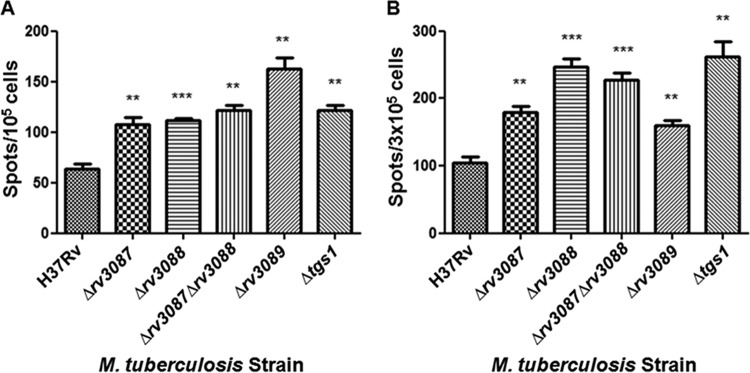
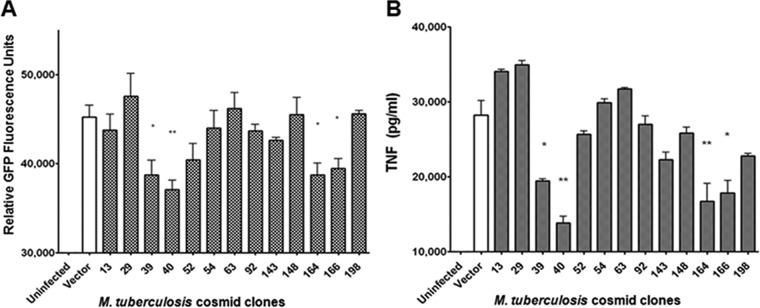
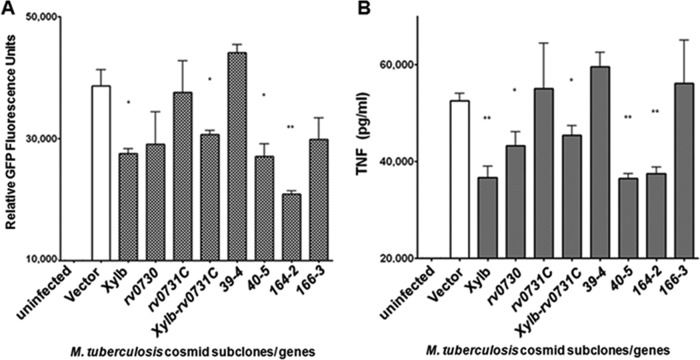
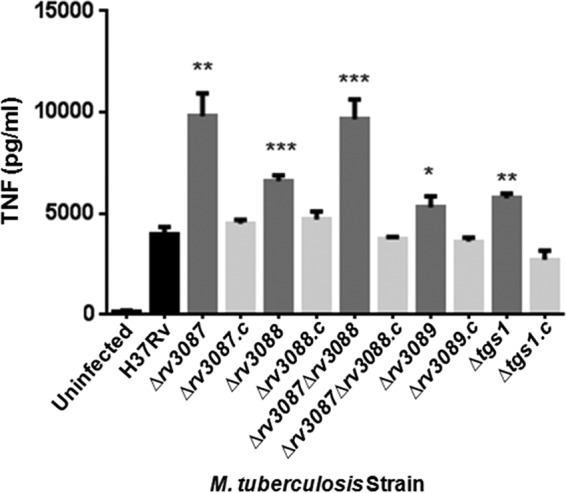
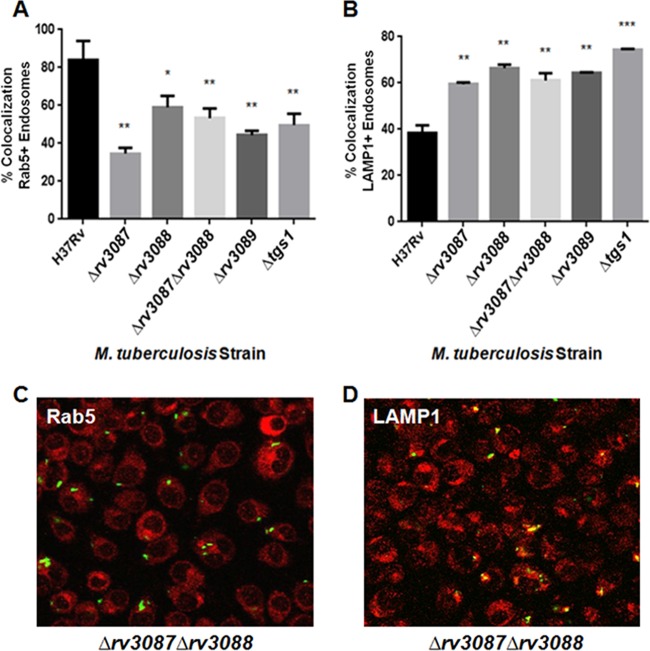
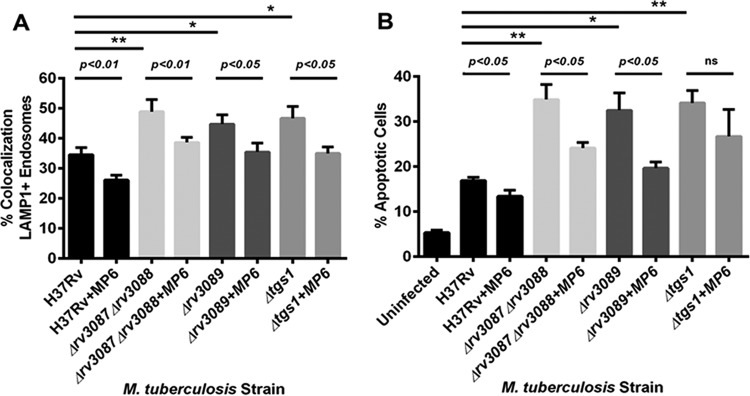
Tumor necrosis factor alpha (TNF) plays a critical role in the control of Mycobacterium tuberculosis, in part by augmenting T cell responses through promoting macrophage phagolysosomal fusion (thereby optimizing CD4(+) T cell immunity by enhancing antigen presentation) and apoptosis (a process that can lead to cross-priming of CD8(+) T cells). M. tuberculosis can evade antituberculosis (anti-TB) immunity by inhibiting host cell TNF production via expression of specific mycobacterial components. We hypothesized that M. tuberculosis mutants with an increased capacity to induce host cell TNF production (TNF-enhancing mutants) and thus with enhanced immunogenicity can be useful for vaccine development. To identify mycobacterial genes that regulate host cell TNF production, we used a TNF reporter macrophage clone to screen an H37Rv M. tuberculosis cosmid library constructed in M. smegmatis The screen has identified a set of TNF-downregulating mycobacterial genes that, when deleted in H37Rv, generate TNF-enhancing mutants. Analysis of mutants disrupted for a subset of TNF-downregulating genes, annotated to code for triacylglycerol synthases and fatty acyl-coenzyme A (acyl-CoA) synthetase, enzymes that concern lipid biosynthesis and metabolism, has revealed that these strains can promote macrophage phagolysosomal fusion and apoptosis better than wild-type (WT) bacilli. Immunization of mice with the TNF-enhancing M. tuberculosis mutants elicits CD4(+) and CD8(+) T cell responses that are superior to those engendered by WT H37Rv. The results suggest that TNF-upregulating M. tuberculosis genes can be targeted to enhance the immunogenicity of mycobacterial strains that can serve as the substrates for the development of novel anti-TB vaccines.
One way to control tuberculosis (TB), which remains a major global public health burden, is by immunization with an effective vaccine. The efficacy of Mycobacterium bovis BCG, the only currently approved TB vaccine, is inconsistent. Tumor necrosis factor alpha (TNF) is a cytokine that plays an important role in controlling TB. M. tuberculosis, the causative agent of TB, can counter this TNF-based defense by decreasing host cell TNF production. This study identified M. tuberculosis genes that can mediate inhibition of TNF production by macrophage (an immune cell critical to the control of TB). We have knocked out a number of these genes to generate M. tuberculosis mutants that can enhance macrophage TNF production. Immunization with these mutants in mice triggered a T cell response stronger than that elicited by the parental bacillus. Since T cell immunity is pivotal in controlling M. tuberculosis, the TNF-enhancing mutants can be used to develop novel TB vaccines.
肿瘤坏死因子α(TNF)在结核分枝杆菌的控制中起关键作用,部分是通过促进巨噬细胞吞噬溶酶体融合来增强T细胞反应(从而通过增强抗原呈递来优化CD4⁺T细胞免疫)以及诱导凋亡(这一过程可导致CD8⁺T细胞的交叉致敏)。结核分枝杆菌可通过表达特定的分枝杆菌成分抑制宿主细胞TNF的产生,从而逃避抗结核免疫。我们推测,具有增强宿主细胞TNF产生能力(TNF增强突变体)且因此具有增强免疫原性的结核分枝杆菌突变体可用于疫苗开发。为了鉴定调节宿主细胞TNF产生的分枝杆菌基因,我们使用了一个TNF报告基因巨噬细胞克隆来筛选在耻垢分枝杆菌中构建的H37Rv结核分枝杆菌黏粒文库。该筛选鉴定出了一组下调TNF的分枝杆菌基因,这些基因在H37Rv中缺失时会产生TNF增强突变体。对一组下调TNF基因被破坏的突变体进行分析,这些基因被注释为编码三酰甘油合酶和脂肪酰辅酶A(酰基辅酶A)合成酶,这两种酶与脂质生物合成和代谢有关,结果表明这些菌株比野生型(WT)杆菌能更好地促进巨噬细胞吞噬溶酶体融合和凋亡。用TNF增强的结核分枝杆菌突变体免疫小鼠可引发比WT H37Rv更强的CD4⁺和CD8⁺T细胞反应。结果表明,上调TNF的结核分枝杆菌基因可作为靶点,以增强分枝杆菌菌株的免疫原性,这些菌株可作为新型抗结核疫苗开发的底物。
控制结核病(TB)仍是全球主要的公共卫生负担,一种方法是接种有效的疫苗。目前唯一获批的TB疫苗牛分枝杆菌卡介苗(BCG)的疗效并不稳定。肿瘤坏死因子α(TNF)是一种在控制TB中起重要作用的细胞因子。TB的病原体结核分枝杆菌可通过减少宿主细胞TNF的产生来对抗这种基于TNF的防御。本研究鉴定了可介导巨噬细胞(对控制TB至关重要的免疫细胞)TNF产生抑制的结核分枝杆菌基因。我们敲除了其中一些基因以产生可增强巨噬细胞TNF产生的结核分枝杆菌突变体。用这些突变体免疫小鼠引发的T细胞反应比亲本杆菌引发的更强。由于T细胞免疫在控制结核分枝杆菌中起关键作用,TNF增强突变体可用于开发新型TB疫苗。