Hu Xiang-Shun, Liu Ying-Jie, Wang Yu-Han, Wang Zhe, Yu Xin-Lin, Wang Bo, Zhang Gai-Sheng, Liu Xiao-Feng, Hu Zu-Qing, Zhao Hui-Yan, Liu Tong-Xian
State Key Laboratory for Crop Stress Biology in Arid Areas, Northwest A&F University, Yangling, Shaanxi, 712100, China.
Key Laboratory of Crop Pest Management on the Northwest Loess Plateau, Ministry of Agriculture, Northwest A&F University, Yangling, Shaanxi, 712100, China.
PLoS One. 2016 Jun 1;11(6):e0156158. doi: 10.1371/journal.pone.0156158. eCollection 2016.
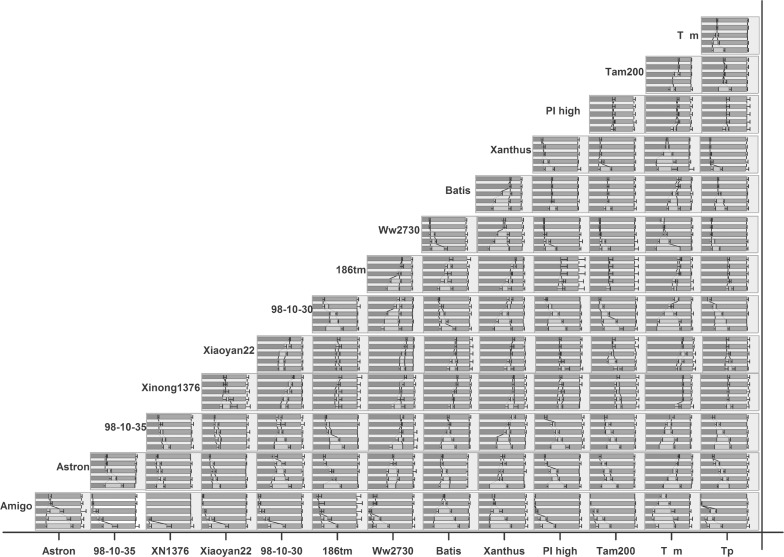
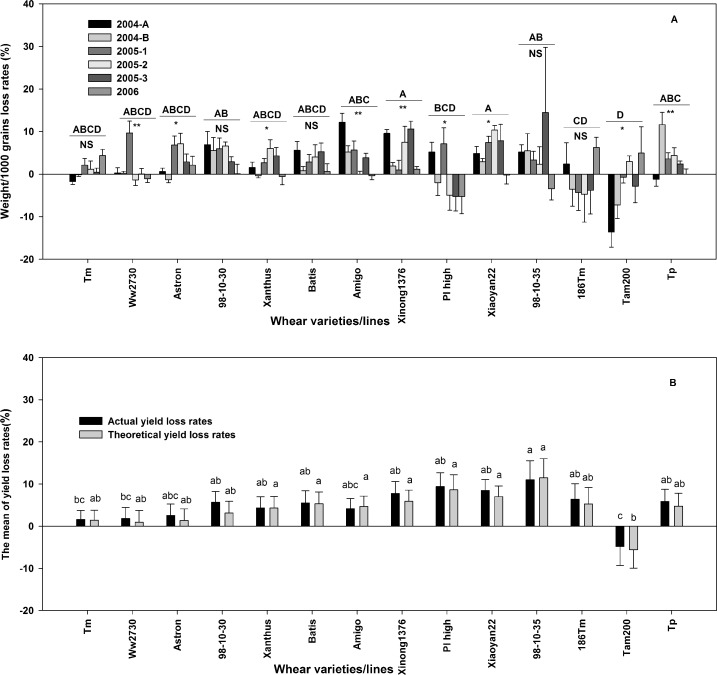
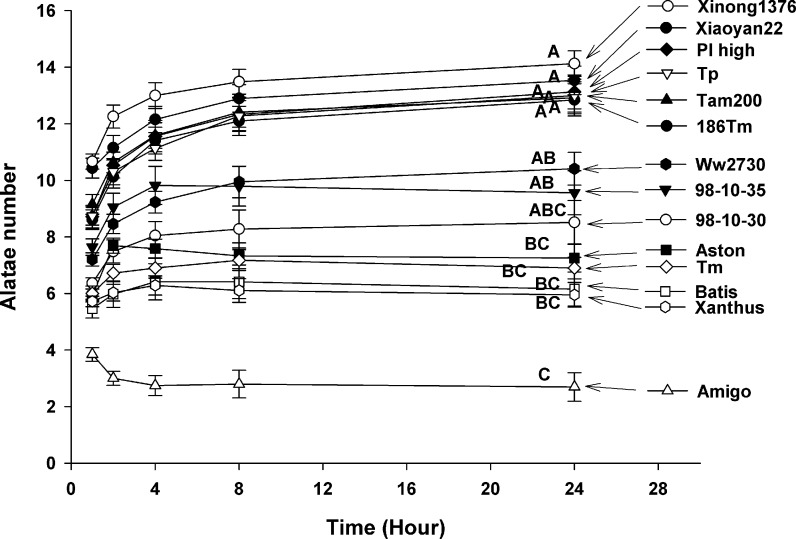
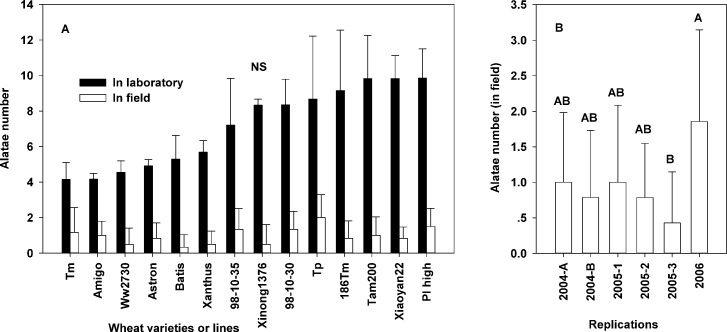
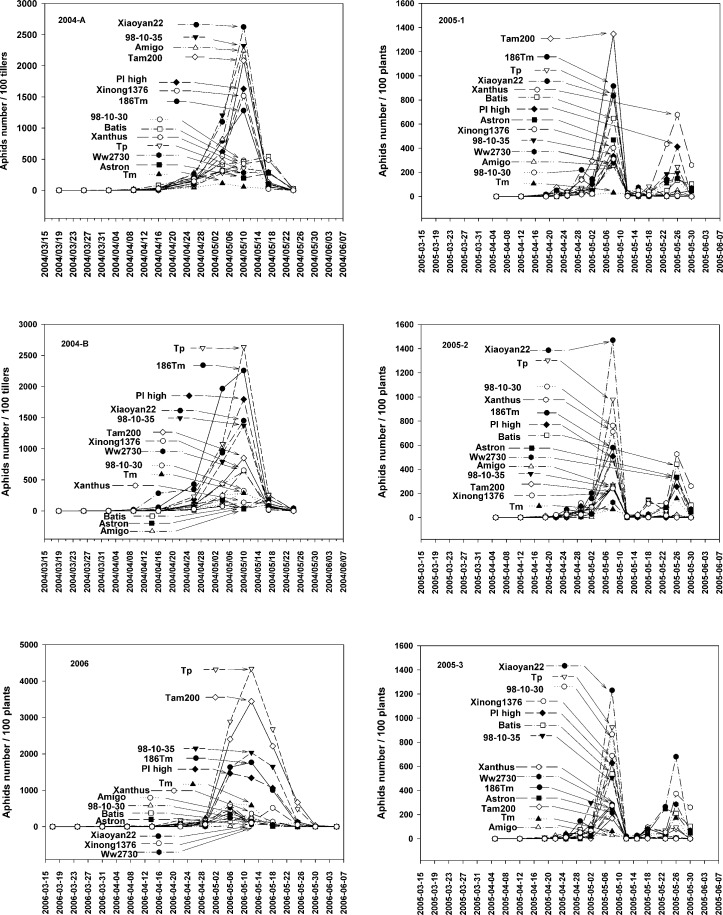
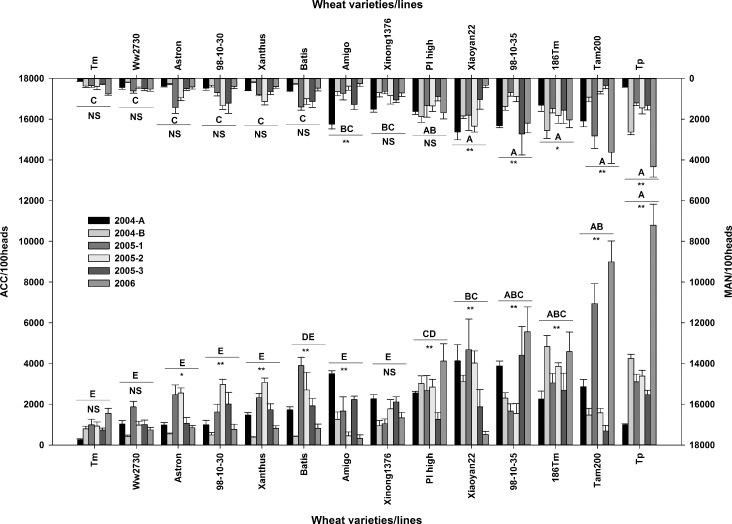
The English grain aphid, Sitobion avenae, is a major pest species of wheat crops; however, certain varieties may have stronger resistance to infestation than others. Here, we investigated 3 classical resistance mechanisms (antixenosis, antibiosis, and tolerance) by 14 wheat varieties/lines to S. avenae under laboratory and field conditions. Under laboratory conditions, alatae given the choice between 2 wheat varieties, strongly discriminated against certain varieties. Specifically, the 'Amigo' variety had the lowest palatability to S. avenae alatae of all varieties. 'Tm' (Triticum monococcum), 'Astron,' 'Xanthus,' 'Ww2730,' and 'Batis' varieties also had lower palatability than other varieties. Thus, these accessions may use antibiosis as the resistant mechanism. In contrast, under field conditions, there were no significant differences in the number of alatae detected on the 14 wheat varieties. One synthetic line (98-10-30, a cross between of Triticum aestivum (var. Chris) and Triticum turgidum (var. durum) hybridization) had low aphid numbers but high yield loss, indicating that it has high antibiosis, but poor tolerance. In comparison, 'Amigo,' 'Xiaoyan22,' and some '186Tm' samples had high aphid numbers but low yield loss rates, indicating they have low antibiosis, but good tolerance. Aphid population size and wheat yield loss rates greatly varied in different fields and years for '98-10-35,' 'Xiaoyan22,' 'Tp,' 'Tam200,' 'PI high,' and other '186Tm' samples, which were hybrid offspring of T. aestivum and wheat related species. Thus, these germplasm should be considered for use in future studies. Overall, S. avenae is best adapted to 'Xinong1376,' because it was the most palatable variety, with the greatest yield loss rates of all 14 wheat varieties. However, individual varieties/lines influenced aphid populations differently in different years. Therefore, we strongly recommend a combination of laboratory and long-term field experiments in targeted planting regions to identify varieties/lines that consistently show high resistance to S. avenae infestation.
麦长管蚜(Sitobion avenae)是小麦作物的主要害虫;然而,某些品种可能比其他品种对虫害具有更强的抗性。在此,我们在实验室和田间条件下,研究了14个小麦品种/品系对麦长管蚜的3种经典抗性机制(抗生性、抗虫性和耐害性)。在实验室条件下,有翅蚜在两种小麦品种之间进行选择时,会强烈区分某些品种。具体而言,“Amigo”品种对麦长管蚜有翅蚜的适口性在所有品种中最低。“Tm”(一粒小麦)、“Astron”、“Xanthus”、“Ww2730”和“Batis”品种的适口性也低于其他品种。因此,这些种质可能利用抗生性作为抗性机制。相比之下,在田间条件下,在14个小麦品种上检测到的有翅蚜数量没有显著差异。一个合成品系(98 - 10 - 30,普通小麦(Chris变种)和硬粒小麦(durum变种)杂交后代)的蚜虫数量少但产量损失高,表明它具有高抗生性,但耐害性差。相比之下,“Amigo”、“小偃22”和一些“186Tm”样本的蚜虫数量多但产量损失率低,表明它们抗生性低,但耐害性好。对于“98 - 10 - 35”、“小偃22”、“Tp”、“Tam200”、“PI high”和其他“186Tm”样本(它们是普通小麦与小麦近缘种的杂交后代),不同田间和年份的蚜虫种群规模和小麦产量损失率差异很大。因此,这些种质应考虑用于未来的研究。总体而言,麦长管蚜最适应“西农1376”,因为它是所有14个小麦品种中适口性最好、产量损失率最高的品种。然而,不同年份单个品种/品系对蚜虫种群的影响不同。因此,我们强烈建议在目标种植区域结合实验室和长期田间试验,以鉴定对麦长管蚜虫害始终表现出高抗性的品种/品系。