Pruett W Andrew, Hester Robert L
Department of Physiology and Biophysics, Center for Computational Medicine, University of Mississippi Medical Center, Jackson, Mississippi, United States of America, 39215.
PLoS One. 2016 Jun 3;11(6):e0156574. doi: 10.1371/journal.pone.0156574. eCollection 2016.
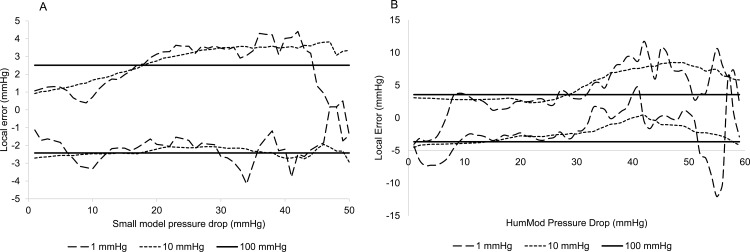
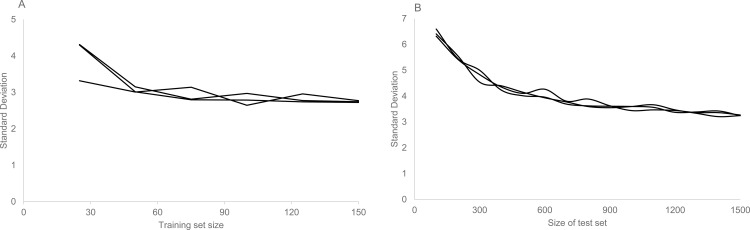
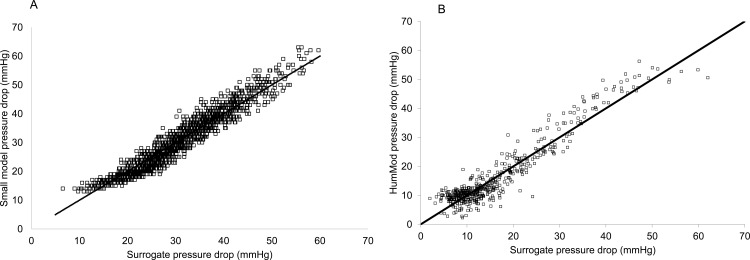
A surrogate model is a black box model that reproduces the output of another more complex model at a single time point. This is to be distinguished from the method of surrogate data, used in time series. The purpose of a surrogate is to reduce the time necessary for a computation at the cost of rigor and generality. We describe a method of constructing surrogates in the form of support vector machine (SVM) regressions for the purpose of exploring the parameter space of physiological models. Our focus is on the methodology of surrogate creation and accuracy assessment in comparison to the original model. This is done in the context of a simulation of hemorrhage in one model, "Small", and renal denervation in another, HumMod. In both cases, the surrogate predicts the drop in mean arterial pressure following the intervention. We asked three questions concerning surrogate models: (1) how many training examples are necessary to obtain an accurate surrogate, (2) is surrogate accuracy homogeneous, and (3) how much can computation time be reduced when using a surrogate. We found the minimum training set size that would guarantee maximal accuracy was widely variable, but could be algorithmically generated. The average error for the pressure response to the protocols was -0.05±2.47 in Small, and -0.3 +/- 3.94 mmHg in HumMod. In the Small model, error grew with actual pressure drop, and in HumMod, larger pressure drops were overestimated by the surrogates. Surrogate use resulted in a 6 order of magnitude decrease in computation time. These results suggest surrogate modeling is a valuable tool for generating predictions of an integrative model's behavior on densely sampled subsets of its parameter space.
替代模型是一种黑箱模型,它在单个时间点再现另一个更复杂模型的输出。这与时间序列中使用的替代数据方法不同。替代模型的目的是以严谨性和通用性为代价减少计算所需的时间。我们描述了一种以支持向量机(SVM)回归形式构建替代模型的方法,用于探索生理模型的参数空间。我们关注的是替代模型创建的方法以及与原始模型相比的准确性评估。这是在一个模型(“Small”)中的出血模拟以及另一个模型(HumMod)中的肾去神经支配模拟的背景下进行的。在这两种情况下,替代模型都预测干预后平均动脉压的下降。我们提出了三个关于替代模型的问题:(1)获得准确的替代模型需要多少训练示例,(2)替代模型的准确性是否均匀,以及(3)使用替代模型时计算时间可以减少多少。我们发现保证最大准确性所需的最小训练集大小差异很大,但可以通过算法生成。在Small模型中,对方案的压力响应的平均误差为-0.05±2.47,在HumMod模型中为-0.3±3.94 mmHg。在Small模型中,误差随着实际压力下降而增加,在HumMod模型中,替代模型高估了较大的压力下降。使用替代模型使计算时间减少了6个数量级。这些结果表明,替代模型是一种有价值的工具,可用于在其参数空间的密集采样子集上生成综合模型行为的预测。