Bujarski Spencer, Ray Lara A
Department of Psychology, University of California, Los Angeles, United States.
Department of Psychology, University of California, Los Angeles, United States; Department of Psychiatry and Biobehavioral Sciences, University of California, Los Angeles, United States.
Behav Res Ther. 2016 Nov;86:11-22. doi: 10.1016/j.brat.2016.05.008. Epub 2016 May 28.
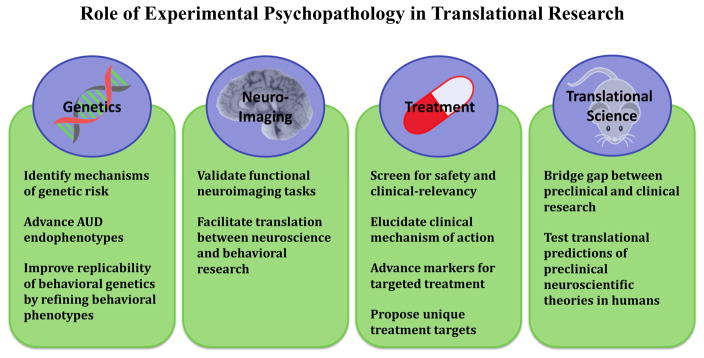
In spite of high prevalence and disease burden, scientific consensus on the etiology and treatment of Alcohol Use Disorder (AUD) has yet to be reached. The development and utilization of experimental psychopathology paradigms in the human laboratory represents a cornerstone of AUD research. In this review, we describe and critically evaluate the major experimental psychopathology paradigms developed for AUD, with an emphasis on their implications, strengths, weaknesses, and methodological considerations. Specifically we review alcohol administration, self-administration, cue-reactivity, and stress-reactivity paradigms. We also provide an introduction to the application of experimental psychopathology methods to translational research including genetics, neuroimaging, pharmacological and behavioral treatment development, and translational science. Through refining and manipulating key phenotypes of interest, these experimental paradigms have the potential to elucidate AUD etiological factors, improve the efficiency of treatment developments, and refine treatment targets thus advancing precision medicine.
尽管酒精使用障碍(AUD)的患病率和疾病负担很高,但在其病因和治疗方面尚未达成科学共识。在人类实验室中开发和应用实验性精神病理学范式是AUD研究的基石。在本综述中,我们描述并批判性地评估了为AUD开发的主要实验性精神病理学范式,重点关注它们的意义、优势、劣势和方法学考量。具体而言,我们回顾了酒精给药、自我给药、线索反应性和应激反应性范式。我们还介绍了实验性精神病理学方法在转化研究中的应用,包括遗传学、神经影像学、药物和行为治疗开发以及转化科学。通过细化和操纵感兴趣的关键表型,这些实验范式有可能阐明AUD的病因因素,提高治疗开发的效率,并优化治疗靶点,从而推动精准医学的发展。