Dagget Tadesse, Molla Ashagre, Belachew Tefera
School of Nursing, Bahir Dar University, PO Box 79, Bahir Dar, Ethiopia.
School of Graduate Studies, Jimma University, Jimma, Ethiopia.
BMC Nurs. 2016 Jun 16;15:39. doi: 10.1186/s12912-016-0158-2. eCollection 2016.
Occupational stress exists in every profession, nevertheless, the nursing profession appears to experience more stress at work compared to other health care workers. Unmanaged stress leads to high levels of employee dissatisfaction, illness, absenteeism, high turnover, and decreased productivity that compromise provision of quality service to clients. However, there is a scarcity of information about nurses' job stress in Jimma zone public hospital nurses. The aim of the present study was to assess job related stress and its predictors among nurses working in Jimma Zone public hospitals, South-West Ethiopia in 2014.
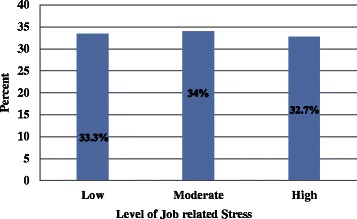
An institution based cross sectional study was conducted from March 10 to April 10, 2014 through a census of nurses who are working in Jimma Zone public hospitals using a structured self-administered questionnaire. SPSS Statistics Version 20 used. For the outcome variable: overall job related stress, the participant's responses on each item score summed: a stress score ranging from a minimum of 26 and maximum score of 116. The higher the sum the more the stressed the nurse. The level of stress calculated through tertial the lower to low stress, the middle to moderate & the higher to high stress. Moreover, bivariate and multivariable linear regressions done to see the association between the predictor (sex, age, mutual understanding at work, Job satisfaction and working unit/department) and the outcome variable (Job related stress).
A total of 341 nurses working in Jimma Zone public hospitals were given the questionnaire, and the response rate was 92.3 % (315). This study indicated an average overall job related stress level of 58.46 ± 12.62. The highest level of job related stress was on the sub scale of dealing with death & dying mean score of 62.94 % followed by uncertainty regarding patient treatment 57.72 % and workload 57.6 %. While job related stress from sexual harassment had the lowest mean score of 46.19 %.
Overall job related stress varies across working unit. Working in a chronic illness follow up clinic, the mutual understanding at work between nurse & physician and job satisfaction were negatively associated predictors of job related stress.
职业压力存在于各个行业,然而,与其他医护人员相比,护理行业在工作中似乎承受着更多压力。未得到妥善管理的压力会导致员工高度不满、生病、旷工、高离职率以及生产力下降,进而影响为客户提供优质服务。然而,关于吉马地区公立医院护士工作压力的信息却很匮乏。本研究的目的是评估2014年在埃塞俄比亚西南部吉马地区公立医院工作的护士的工作相关压力及其预测因素。
2014年3月10日至4月10日,通过对吉马地区公立医院工作的护士进行普查,采用结构化自填问卷进行了一项基于机构的横断面研究。使用SPSS Statistics 20版本。对于结果变量:总体工作相关压力,将参与者对每个项目的得分相加:压力得分范围从最低26分到最高116分。得分越高,护士压力越大。压力水平通过三分位数计算,较低为低压力,中间为中度压力,较高为高压力。此外,进行了双变量和多变量线性回归,以观察预测因素(性别、年龄、工作中的相互理解、工作满意度和工作单位/部门)与结果变量(工作相关压力)之间的关联。
共向吉马地区公立医院的341名护士发放了问卷,回复率为92.3%(315人)。本研究表明,总体工作相关压力平均水平为58.46±12.62。工作相关压力最高的是应对死亡和临终子量表,平均得分62.94%,其次是患者治疗的不确定性,为57.72%,工作量为57.6%。而来自性骚扰的工作相关压力平均得分最低,为46.19%。
总体工作相关压力因工作单位而异。在慢性病随访诊所工作、护士与医生之间的工作相互理解以及工作满意度是工作相关压力的负相关预测因素。