Jagannathan A, Juvva S
Department of Psychiatric Social Work, National Institute of Mental Health and Neurosciences (NIMHANS), Bengaluru, Karnataka, India.
Centre for Disability Studies and Action, School of Social Work, Tata Institute of Social Sciences, Mumbai, Maharashtra, India.
J Postgrad Med. 2016 Jul-Sep;62(3):143-9. doi: 10.4103/0022-3859.184273.
Patients suffering with head and neck cancers are observed to have a relatively high risk of developing emotional disturbances after diagnosis and treatment. These emotional concerns can be best understood and explored through the method of content analysis or qualitative data. Though a number of qualitative studies have been conducted in the last few years in the field of psychosocial oncology, none have looked at the emotions experienced and the coping by head and neck cancer patients.
Seventy-five new cases of postsurgery patients of head and neck cancers were qualitatively interviewed regarding the emotions experienced and coping strategies after diagnosis.
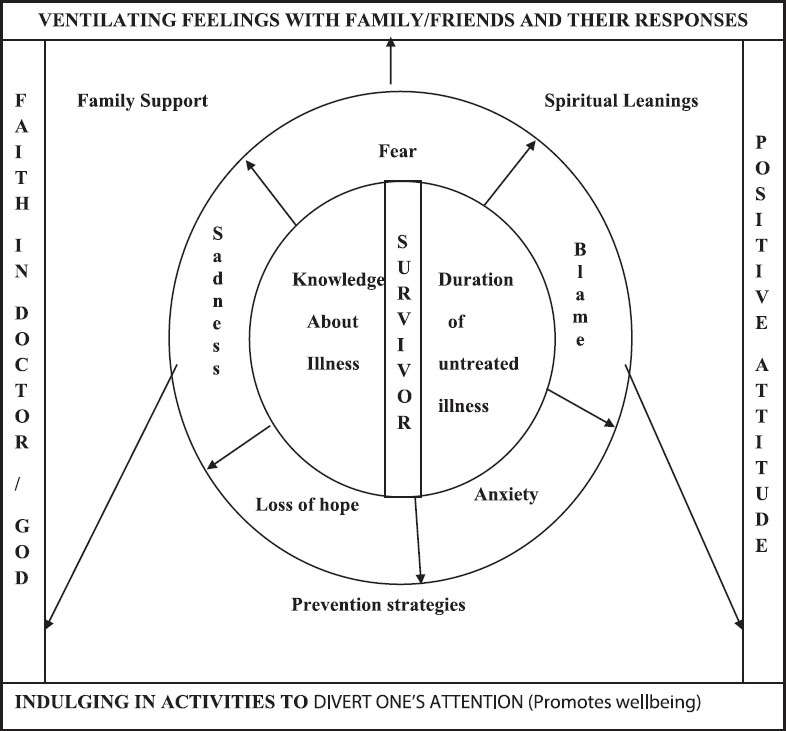
Qualitative content analysis of the in-depth interviews brought out that patients experienced varied emotions on realizing that they were suffering from cancer, the cause of which could be mainly attributed to three themes: 1) knowledge of their illness; 2) duration of untreated illness; and 3) object of blame. They coped with their emotions by either: 1) inculcating a positive attitude and faith in the doctor/treatment, 2) ventilating their emotions with family and friends, or 3) indulging in activities to divert attention.
The results brought out a conceptual framework, which showed that an in-depth understanding of the emotions - Their root cause, coping strategies, and spiritual and cultural orientations of the cancer survivor - Is essential to develop any effective intervention program in India.
据观察,头颈癌患者在诊断和治疗后出现情绪障碍的风险相对较高。通过内容分析或定性数据的方法能够最好地理解和探究这些情绪问题。尽管在过去几年里,心理肿瘤学领域已经开展了一些定性研究,但尚无研究关注头颈癌患者所经历的情绪以及应对方式。
对75例头颈癌术后患者进行了定性访谈,询问他们在诊断后的情绪体验和应对策略。
对深入访谈的定性内容分析表明,患者在意识到自己患有癌症时会经历多种情绪,其原因主要可归结为三个主题:1)对自身疾病的认知;2)疾病未治疗的时长;3)可归咎的对象。他们通过以下方式应对情绪:1)培养对医生/治疗的积极态度和信心;2)向家人和朋友宣泄情绪;3)通过参与活动转移注意力。
研究结果得出了一个概念框架,表明深入了解癌症幸存者的情绪——其根源、应对策略以及精神和文化取向——对于在印度制定任何有效的干预计划至关重要。