Livingston Kara A, Chung Mei, Sawicki Caleigh M, Lyle Barbara J, Wang Ding Ding, Roberts Susan B, McKeown Nicola M
U.S. Department of Agriculture, Jean Mayer Human Nutrition Research Center on Aging, Tufts University, Boston, Massachusetts, United States of America.
Nutrition/Infection Unit, Department of Public Health and Community Medicine, Tufts University School of Medicine, Boston, Massachusetts, United States of America.
PLoS One. 2016 Jun 27;11(6):e0156961. doi: 10.1371/journal.pone.0156961. eCollection 2016.
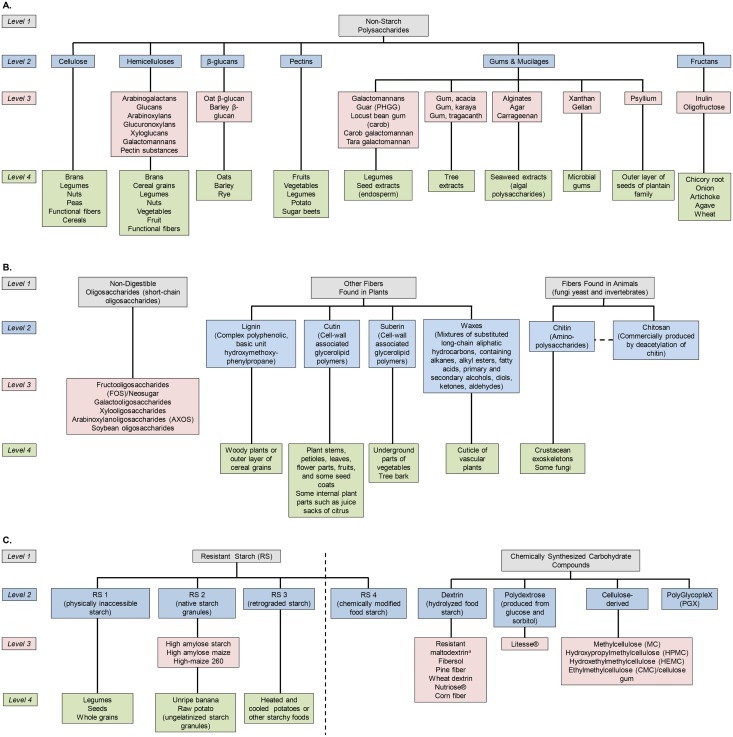
Dietary fiber is a broad category of compounds historically defined as partially or completely indigestible plant-based carbohydrates and lignin with, more recently, the additional criteria that fibers incorporated into foods as additives should demonstrate functional human health outcomes to receive a fiber classification. Thousands of research studies have been published examining fibers and health outcomes.
(1) Develop a database listing studies testing fiber and physiological health outcomes identified by experts at the Ninth Vahouny Conference; (2) Use evidence mapping methodology to summarize this body of literature. This paper summarizes the rationale, methodology, and resulting database. The database will help both scientists and policy-makers to evaluate evidence linking specific fibers with physiological health outcomes, and identify missing information.
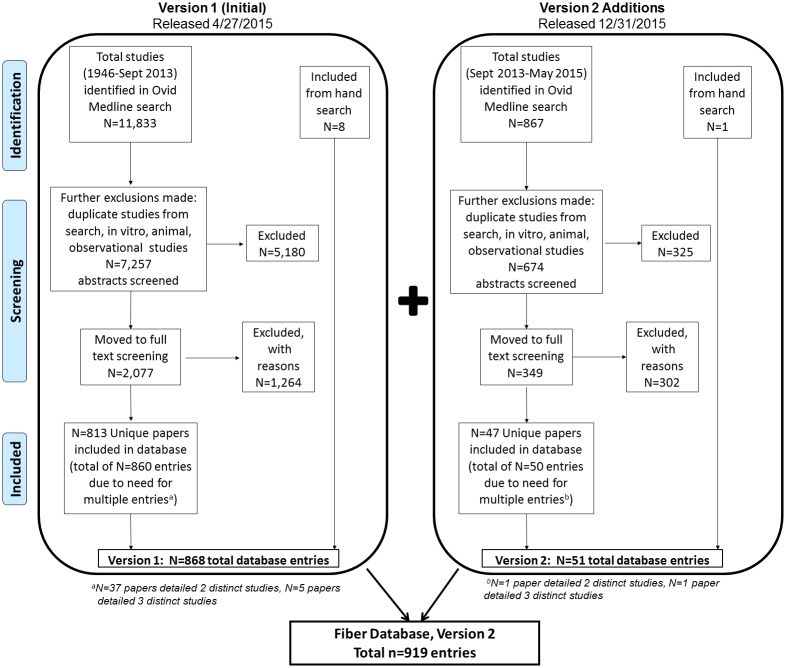
To build this database, we conducted a systematic literature search for human intervention studies published in English from 1946 to May 2015. Our search strategy included a broad definition of fiber search terms, as well as search terms for nine physiological health outcomes identified at the Ninth Vahouny Fiber Symposium. Abstracts were screened using a priori defined eligibility criteria and a low threshold for inclusion to minimize the likelihood of rejecting articles of interest. Publications then were reviewed in full text, applying additional a priori defined exclusion criteria. The database was built and published on the Systematic Review Data Repository (SRDR™), a web-based, publicly available application.
A fiber database was created. This resource will reduce the unnecessary replication of effort in conducting systematic reviews by serving as both a central database archiving PICO (population, intervention, comparator, outcome) data on published studies and as a searchable tool through which this data can be extracted and updated.
膳食纤维是一大类化合物,历史上被定义为部分或完全不可消化的植物性碳水化合物和木质素,最近又增加了一些标准,即作为添加剂添加到食品中的纤维应能证明对人类健康有功能性益处才能被归类为纤维。已经发表了数千项关于纤维与健康结果的研究。
(1)建立一个数据库,列出第九届瓦洪尼会议专家确定的测试纤维与生理健康结果的研究;(2)使用证据图谱方法总结这一文献体系。本文总结了基本原理、方法和由此产生的数据库。该数据库将有助于科学家和政策制定者评估将特定纤维与生理健康结果联系起来的证据,并识别缺失的信息。
为建立该数据库,我们对1946年至2015年5月以英文发表的人体干预研究进行了系统的文献检索。我们的检索策略包括对纤维检索词的广泛定义,以及第九届瓦洪尼纤维研讨会确定的九种生理健康结果的检索词。使用预先定义的纳入标准和较低的纳入阈值对摘要进行筛选,以尽量减少拒绝感兴趣文章的可能性。然后对出版物进行全文审查,应用额外的预先定义的排除标准。该数据库在基于网络的公开可用应用程序系统评价数据存储库(SRDR™)上建立并发布。
创建了一个纤维数据库。该资源将减少系统评价中不必要的重复工作,它既是一个中央数据库,存档已发表研究的PICO(人群、干预措施、对照、结果)数据,又是一个可搜索工具,通过它可以提取和更新这些数据。