Jha Pawan K, Foppen Ewout, Kalsbeek Andries, Challet Etienne
Department of Endocrinology and Metabolism, Academic Medical Center (AMC), University of Amsterdam, Amsterdam, the Netherlands Hypothalamic Integration Mechanisms, Netherlands Institute for Neuroscience, Amsterdam, the Netherlands Regulation of Circadian Clocks team, Institute of Cellular and Integrative Neurosciences UPR3212 Centre National de la Recherche Scientifique (CNRS) University of Strasbourg, Strasbourg, France International Associated Laboratory LIA1061 Understanding the Neural Basis of Diurnality, CNRS, France and the Netherlands
Department of Endocrinology and Metabolism, Academic Medical Center (AMC), University of Amsterdam, Amsterdam, the Netherlands.
Physiol Rep. 2016 Jun;4(12). doi: 10.14814/phy2.12839.
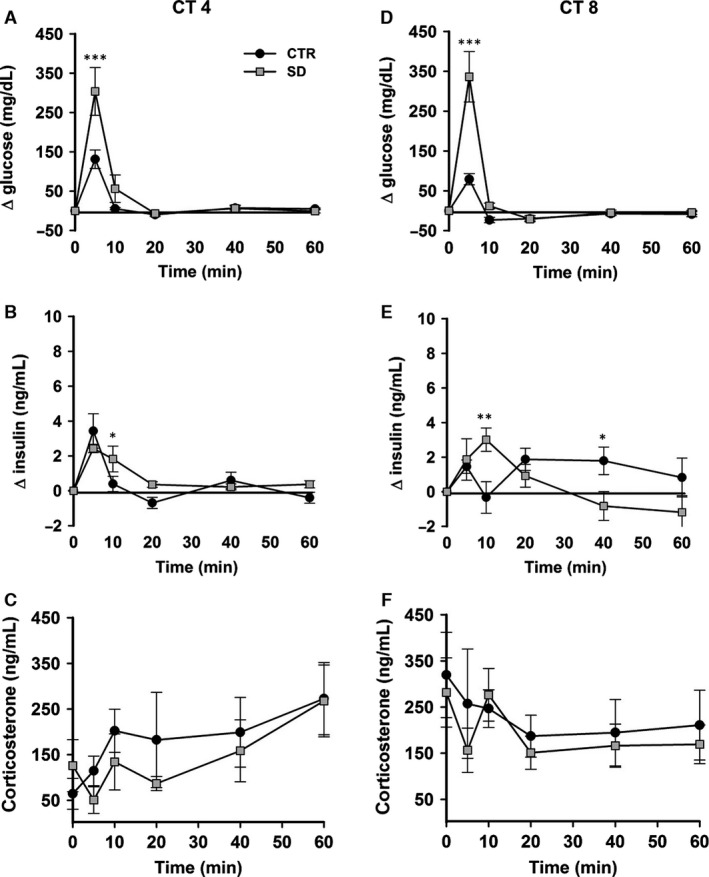
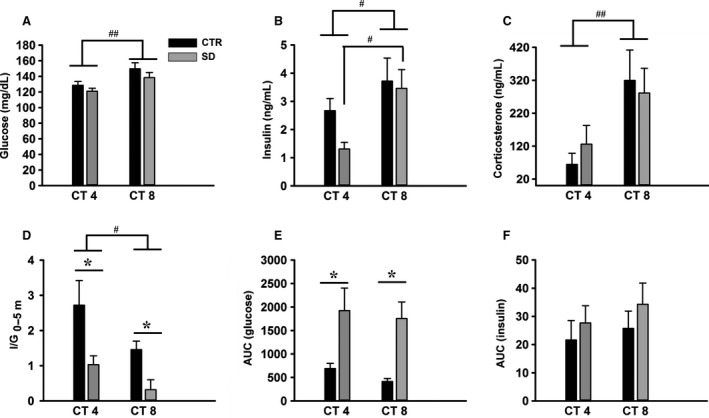
Chronic sleep curtailment in humans has been related to impairment of glucose metabolism. To better understand the underlying mechanisms, the purpose of the present study was to investigate the effect of acute sleep deprivation on glucose tolerance in rats. A group of rats was challenged by 4-h sleep deprivation in the early rest period, leading to prolonged (16 h) wakefulness. Another group of rats was allowed to sleep during the first 4 h of the light period and sleep deprived in the next 4 h. During treatment, food was withdrawn to avoid a postmeal rise in plasma glucose. An intravenous glucose tolerance test (IVGTT) was performed immediately after the sleep deprivation period. Sleep deprivation at both times of the day similarly impaired glucose tolerance and reduced the early-phase insulin responses to a glucose challenge. Basal concentrations of plasma glucose, insulin, and corticosterone remained unchanged after sleep deprivation. Throughout IVGTTs, plasma corticosterone concentrations were not different between the control and sleep-deprived group. Together, these results demonstrate that independent of time of day and sleep pressure, short sleep deprivation during the resting phase favors glucose intolerance in rats by attenuating the first-phase insulin response to a glucose load. In conclusion, this study highlights the acute adverse effects of only a short sleep restriction on glucose homeostasis.
人类长期睡眠不足与葡萄糖代谢受损有关。为了更好地理解其潜在机制,本研究旨在探讨急性睡眠剥夺对大鼠葡萄糖耐量的影响。一组大鼠在休息初期接受4小时的睡眠剥夺,导致清醒时间延长(16小时)。另一组大鼠在光照期的前4小时允许睡眠,随后的4小时进行睡眠剥夺。在治疗期间,禁食以避免餐后血糖升高。在睡眠剥夺期结束后立即进行静脉葡萄糖耐量试验(IVGTT)。一天中两个时间段的睡眠剥夺同样损害了葡萄糖耐量,并降低了对葡萄糖挑战的早期胰岛素反应。睡眠剥夺后,血浆葡萄糖、胰岛素和皮质酮的基础浓度保持不变。在整个IVGTT过程中,对照组和睡眠剥夺组之间的血浆皮质酮浓度没有差异。总之,这些结果表明,与一天中的时间和睡眠压力无关,休息期的短期睡眠剥夺通过减弱对葡萄糖负荷的第一阶段胰岛素反应,使大鼠出现葡萄糖不耐受。综上所述,本研究强调了仅短期睡眠限制对葡萄糖稳态的急性不良影响。