Department of Mathematics, Imperial College, London SW7 2AZ, UK.
Department of Medicine, Imperial College, London SW7 2AZ, UK.
J R Soc Interface. 2018 Jan;15(138). doi: 10.1098/rsif.2017.0736. Epub 2018 Jan 24.
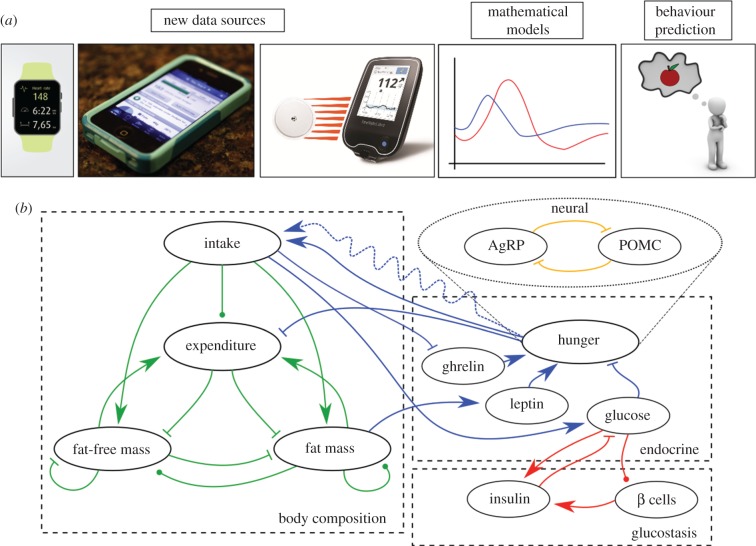
Obesity is a major global public health problem. Understanding how energy homeostasis is regulated, and can become dysregulated, is crucial for developing new treatments for obesity. Detailed recording of individual behaviour and new imaging modalities offer the prospect of medically relevant models of energy homeostasis that are both understandable and individually predictive. The profusion of data from these sources has led to an interest in applying machine learning techniques to gain insight from these large, relatively unstructured datasets. We review both physiological models and machine learning results across a diverse range of applications in energy homeostasis, and highlight how modelling and machine learning can work together to improve predictive ability. We collect quantitative details in a comprehensive mathematical supplement. We also discuss the prospects of forecasting homeostatic behaviour and stress the importance of characterizing stochasticity within and between individuals in order to provide practical, tailored forecasts and guidance to combat the spread of obesity.
肥胖是一个全球性的重大公共卫生问题。了解能量平衡是如何调节的,以及如何失调,对于开发肥胖的新治疗方法至关重要。对个体行为的详细记录和新的成像方式为能量平衡提供了有医学意义的模型,这些模型既易于理解,又具有个体预测性。这些来源的大量数据导致人们对应用机器学习技术从这些大型、相对非结构化的数据集中获得深入了解产生了兴趣。我们回顾了能量平衡中各种应用的生理模型和机器学习结果,并强调了建模和机器学习如何共同提高预测能力。我们在一个全面的数学补充中收集了定量细节。我们还讨论了预测体内平衡行为的前景,并强调了在个体内部和之间刻画随机性的重要性,以便为对抗肥胖的传播提供实用的、量身定制的预测和指导。