McMahon Dino P, Natsopoulou Myrsini E, Doublet Vincent, Fürst Matthias, Weging Silvio, Brown Mark J F, Gogol-Döring Andreas, Paxton Robert J
School of Biological Sciences, MBC, Queen's University Belfast, Belfast BT9 7BL, UK Institute of Biology, Free University Berlin, Schwendenerstrasse 1, 14195 Berlin, Germany Department for Materials and Environment, BAM Federal Institute for Materials Research and Testing, Unter den Eichen 87, 12205 Berlin, Germany
Institute for Biology, Martin Luther University Halle-Wittenberg, Hoher Weg 8, 06120 Halle (Saale), Germany.
Proc Biol Sci. 2016 Jun 29;283(1833). doi: 10.1098/rspb.2016.0811.
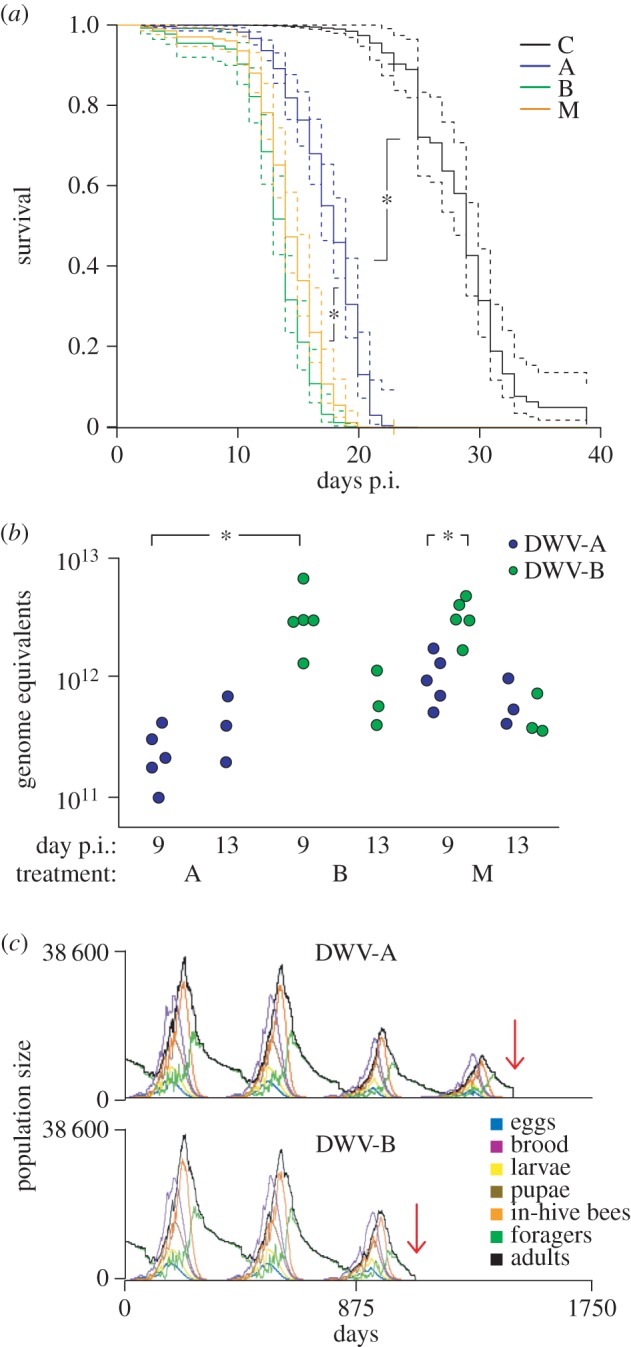
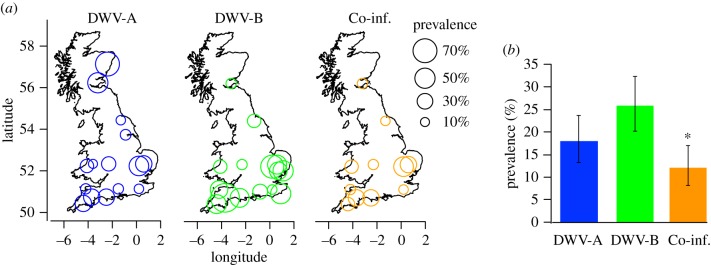
Emerging infectious diseases (EIDs) have contributed significantly to the current biodiversity crisis, leading to widespread epidemics and population loss. Owing to genetic variation in pathogen virulence, a complete understanding of species decline requires the accurate identification and characterization of EIDs. We explore this issue in the Western honeybee, where increasing mortality of populations in the Northern Hemisphere has caused major concern. Specifically, we investigate the importance of genetic identity of the main suspect in mortality, deformed wing virus (DWV), in driving honeybee loss. Using laboratory experiments and a systematic field survey, we demonstrate that an emerging DWV genotype (DWV-B) is more virulent than the established DWV genotype (DWV-A) and is widespread in the landscape. Furthermore, we show in a simple model that colonies infected with DWV-B collapse sooner than colonies infected with DWV-A. We also identify potential for rapid DWV evolution by revealing extensive genome-wide recombination in vivo The emergence of DWV-B in naive honeybee populations, including via recombination with DWV-A, could be of significant ecological and economic importance. Our findings emphasize that knowledge of pathogen genetic identity and diversity is critical to understanding drivers of species decline.
新发传染病(EIDs)对当前的生物多样性危机造成了重大影响,导致了广泛的流行病和种群数量减少。由于病原体毒力的基因变异,要全面了解物种数量下降的情况,就需要准确识别和鉴定新发传染病。我们在西方蜜蜂身上探讨了这个问题,北半球蜜蜂种群死亡率的上升引起了人们的高度关注。具体而言,我们研究了导致蜜蜂死亡的主要嫌疑病原体——残翅病毒(DWV)的基因特性在蜜蜂数量减少过程中的重要性。通过实验室实验和系统的实地调查,我们证明一种新出现的DWV基因型(DWV-B)比已有的DWV基因型(DWV-A)毒性更强,且在环境中广泛传播。此外,我们通过一个简单的模型表明,感染DWV-B的蜂群比感染DWV-A的蜂群更早崩溃。我们还通过揭示体内广泛的全基因组重组现象,发现了DWV快速进化的可能性。DWV-B在未感染过该病毒的蜜蜂种群中的出现,包括通过与DWV-A重组的方式出现,可能具有重大的生态和经济意义。我们的研究结果强调,了解病原体的基因特性和多样性对于理解物种数量下降的驱动因素至关重要。