Gadi Ghadah, Wali Siraj, Koshak Emad, Albar Mohammad, Fida Abdulkareem, Abdelaziz Muntasir, Alnoury Khaled, Alama Nabil
Department of Family and Community Medicine, Faculty of Medicine, King Abdulaziz University, Jeddah, Saudi Arabia.
Sleep Medicine and Research Center, King Abdulaziz University Hospital, Faculty of Medicine, King Abdulaziz University, Jeddah, Saudi Arabia.
J Epidemiol Glob Health. 2017 Mar;7(1):37-44. doi: 10.1016/j.jegh.2016.06.001. Epub 2016 Jun 27.
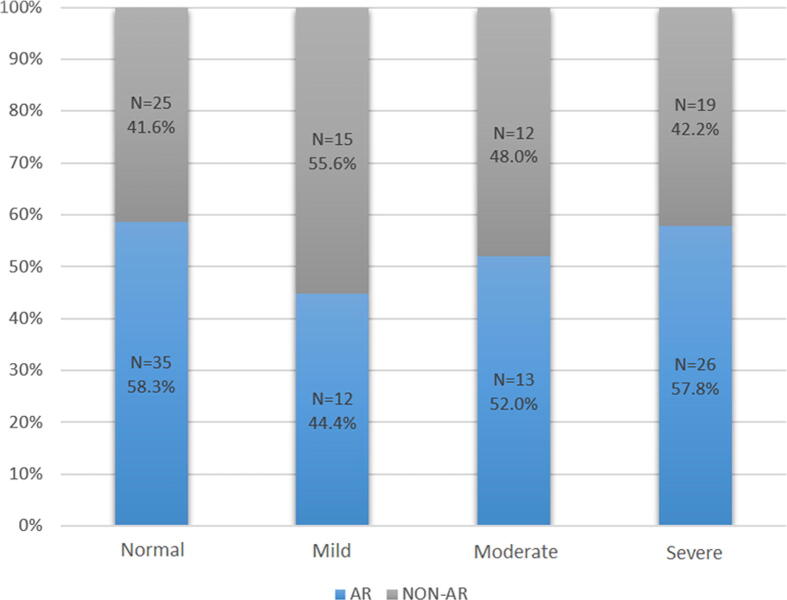
Allergic rhinitis (AR) related inflammation might worsen the severity of obstructive sleep apnea (OSA), however, the relationship between the two disorders remains controversial. Our aim was to determine the prevalence of AR and atopic markers in OSA. This cross-sectional study recruited participants with sleep-related complaints referred to a sleep center from February 2013 to June 2014. The diagnosis of OSA was based on the Berlin questionnaire (BQ) followed by confirmatory polysomnography (PSG). The diagnosis of AR was made via focused history and clinical examination and was confirmed by measuring atopic markers. OSA was diagnosed in 97 out of 157 adults attending the sleep clinic (61.8%). There was a high prevalence of AR (52.6%) among OSA individuals. This was not significantly different from the frequency in the non-OSA individuals (p=0.5). Elevated total immunoglobulin E (IgE; >100K/μL), eosinophil count, and positive Phadiatop tests were found in individuals with OSA to be 37.1%, 11.3%, and 41.2%, respectively. Individuals without OSA have shown similar percentages. In our cohort, there was no significant difference in frequency of AR and atopy among participants with OSA compared to those without OSA.
变应性鼻炎(AR)相关炎症可能会加重阻塞性睡眠呼吸暂停(OSA)的严重程度,然而,这两种疾病之间的关系仍存在争议。我们的目的是确定OSA中AR和特应性标志物的患病率。这项横断面研究招募了2013年2月至2014年6月期间因睡眠相关问题转诊至睡眠中心的参与者。OSA的诊断基于柏林问卷(BQ),随后进行多导睡眠图(PSG)确诊。AR的诊断通过详细的病史和临床检查做出,并通过测量特应性标志物得到证实。在157名前往睡眠诊所就诊的成年人中,有97人被诊断为OSA(61.8%)。OSA患者中AR的患病率较高(52.6%)。这与非OSA患者的频率没有显著差异(p=0.5)。在OSA患者中,总免疫球蛋白E升高(>100K/μL)、嗜酸性粒细胞计数升高和变应原筛查试验阳性的比例分别为37.1%、11.3%和41.2%。无OSA的个体也显示出类似的比例。在我们的队列中,与无OSA的参与者相比,有OSA的参与者中AR和特应性的频率没有显著差异。