Ilesanmi Olayinka, Alele Faith Osaretin
Department of Community Health, Federal Medical Centre, Owo, Ondo State, Nigeria.
PLoS Curr. 2016 Mar 4;8:ecurrents.outbreaks.c04b88cd5cd03cccb99e125657eecd76. doi: 10.1371/currents.outbreaks.c04b88cd5cd03cccb99e125657eecd76.
The first case of Ebola Virus Disease (EVD) in Nigeria was imported on 20th July 2014, by an air traveller. On 8th August, 2014, WHO declared the Ebola outbreak in West Africa a Public Health Emergency of International Concern (PHEIC). This study aimed at assessing the knowledge, perception and attitude of secondary school students towards EVD and adopting disease preventive behaviour.
A descriptive cross sectional study of 440 students from a mixed secondary school in Owo, Ondo State was done. Data was collected in October 2014 when Nigeria was yet to be declared EVD free.Simple random sampling was used to select the school while Systematic random sampling was used in the selection of participants. A semi-structured, interviewer administered questionnaire was used to collect data. Data was analyzed with SPSS version 21. Descriptive statistics and Chi-square test were done, level of statistical significant was 5%.
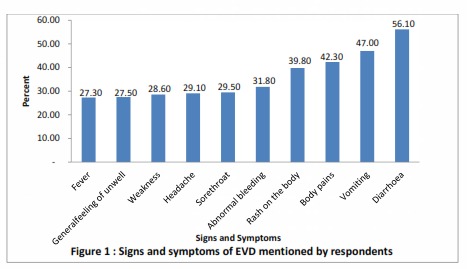
Mean age of respondents was 13.7±1.9 years. Females were 48.2%. Most of the respondents had heard of Ebola Virus Disease (95.4%). Female respondents (51.3%), those who were 15 years and above (51.1%) and in the senior class (54.1%), and had good general knowledge of EVD and across all domains. Being in the senior secondary class and seeking for health care in the hospital were positively associated with good general knowledge (p-value: 0.029, and <0.001 respectively). Three commonest modes of spread of EVD mentioned were contact between infected animals and men (74.8%), touching body fluids of a person who is sick of EVD (57.0%), and contact (55.2%). The top three signs of EVD mentioned were abnormal bleeding from any part of the body (56.10%), vomiting (47.0%) and fever (42.3%).
Our results revealed suboptimal EVD-related knowledge, attitude and practice among the students. Promotion of health messages and training of students on prevention of EVD to effectively control past and future outbreaks of EVD in Nigeria was immediately initiated in schools in Ondo State.
2014年7月20日,一名航空旅客将尼日利亚的首例埃博拉病毒病(EVD)输入该国。2014年8月8日,世界卫生组织宣布西非的埃博拉疫情为国际关注的突发公共卫生事件(PHEIC)。本研究旨在评估中学生对埃博拉病毒病的知识、认知和态度,并采取疾病预防行为。
对来自翁多州奥沃一所男女混合中学的440名学生进行了描述性横断面研究。数据于2014年10月收集,当时尼日利亚尚未宣布摆脱埃博拉病毒病。采用简单随机抽样选择学校,采用系统随机抽样选择参与者。使用半结构化、由访谈者管理的问卷收集数据。数据用SPSS 21版进行分析。进行了描述性统计和卡方检验,统计学显著性水平为5%。
受访者的平均年龄为13.7±1.9岁。女性占48.2%。大多数受访者听说过埃博拉病毒病(95.4%)。女性受访者(51.3%)、15岁及以上的受访者(51.1%)以及高年级的受访者(54.1%)对埃博拉病毒病在所有领域都有良好的常识。就读于高中以及在医院寻求医疗保健与良好的常识呈正相关(p值分别为0.029和<0.001)。提到的埃博拉病毒病最常见的三种传播方式是受感染动物与人之间的接触(74.8%)、接触埃博拉病毒病患者的体液(57.0%)以及接触(55.2%)。提到的埃博拉病毒病的前三个症状是身体任何部位异常出血(56.10%)、呕吐(47.0%)和发烧(42.3%)。
我们的结果显示,学生中与埃博拉病毒病相关的知识、态度和实践并不理想。在翁多州的学校立即启动了健康信息宣传和学生埃博拉病毒病预防培训,以有效控制尼日利亚过去和未来的埃博拉病毒病疫情。