Joubert Chandré, Young Philip R, Eyéghé-Bickong Hans A, Vivier Melané A
Department of Viticulture and Oenology, Stellenbosch University Stellenbosch, South Africa.
Department of Viticulture and Oenology, Stellenbosch UniversityStellenbosch, South Africa; Institute for Wine Biotechnology, Stellenbosch UniversityStellenbosch, South Africa.
Front Plant Sci. 2016 Jun 10;7:786. doi: 10.3389/fpls.2016.00786. eCollection 2016.
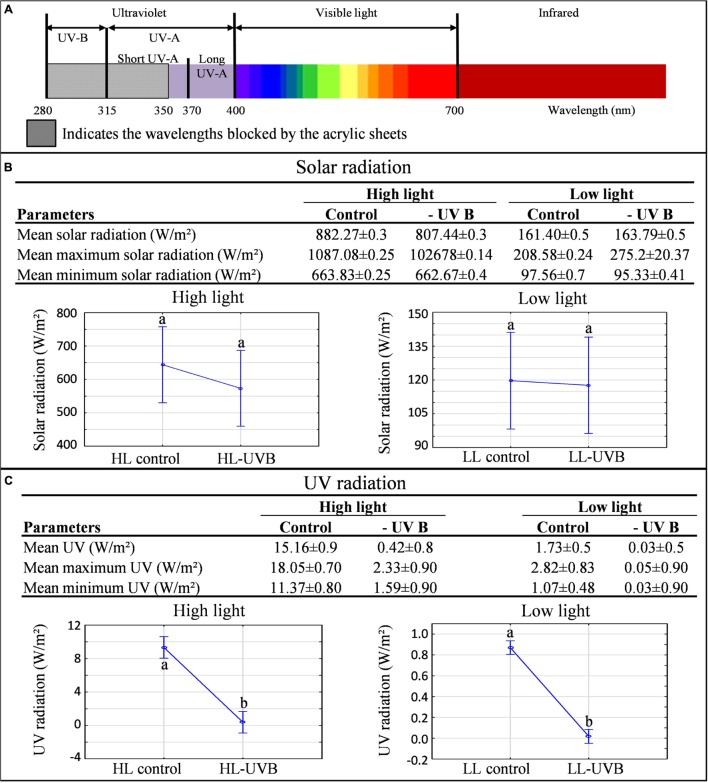
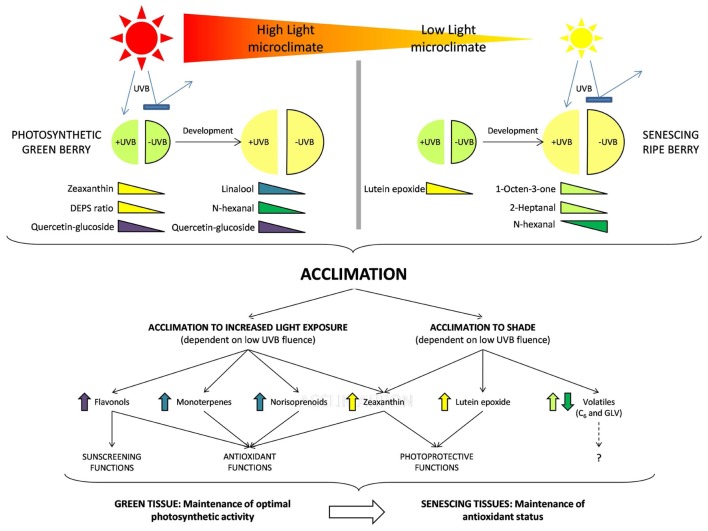
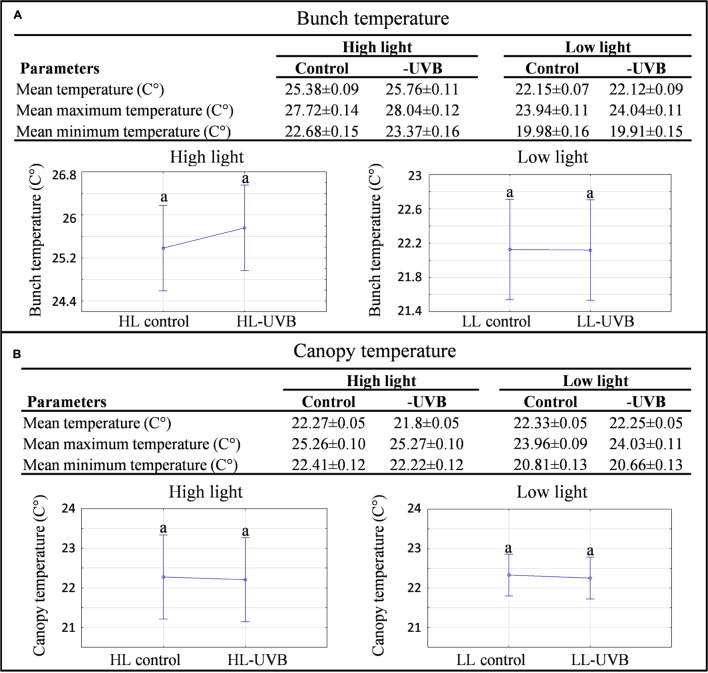
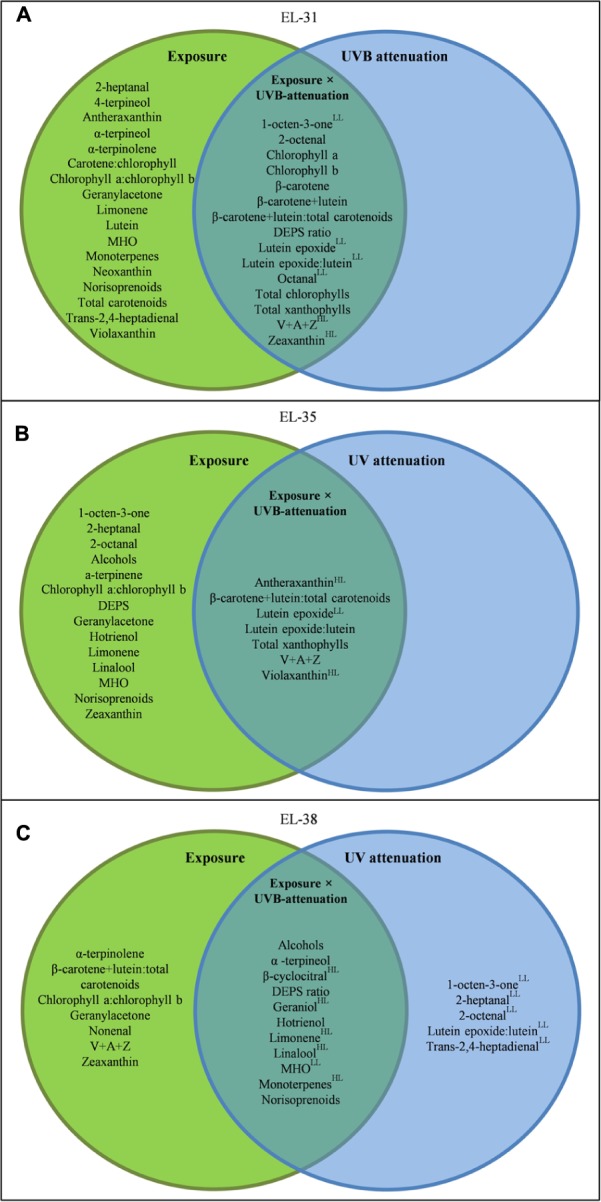
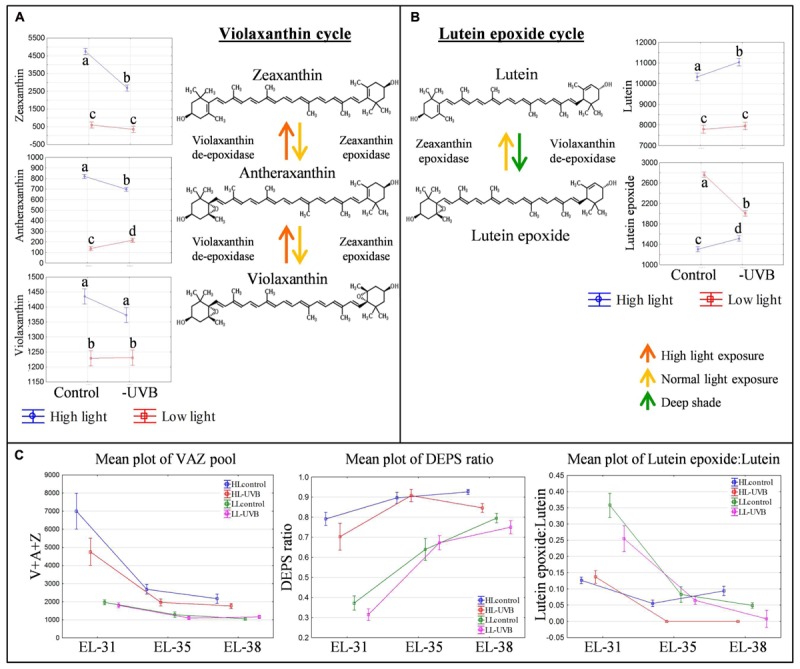
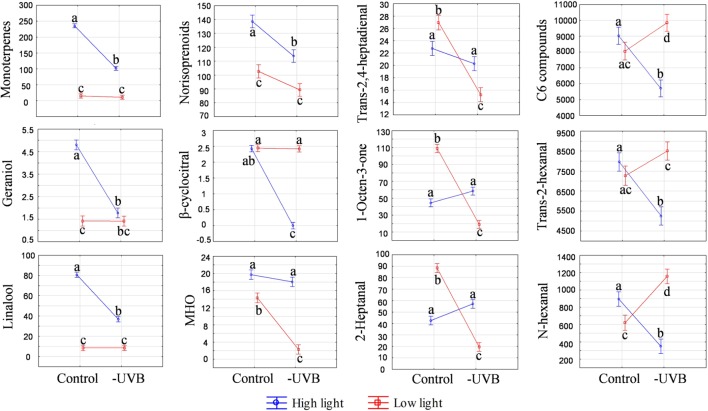
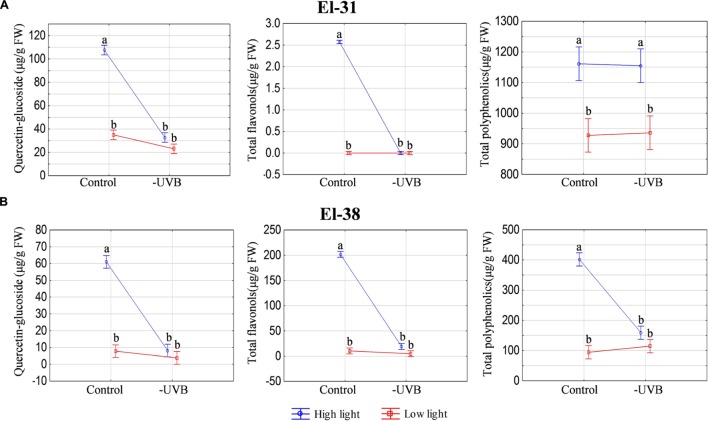
Light quantity and quality modulate grapevine development and influence berry metabolic processes. Here we studied light as an information signal for developing and ripening grape berries. A Vitis vinifera Sauvignon Blanc field experiment was used to identify the impacts of UVB on core metabolic processes in the berries under both high light (HL) and low light (LL) microclimates. The primary objective was therefore to identify UVB-specific responses on berry processes and metabolites and distinguish them from those responses elicited by variations in light incidence. Canopy manipulation at the bunch zone via early leaf removal, combined with UVB-excluding acrylic sheets installed over the bunch zones resulted in four bunch microclimates: (1) HL (control); (2) LL (control); (3) HL with UVB attenuation and (4) LL with UVB attenuation. Metabolite profiles of three berry developmental stages showed predictable changes to known UV-responsive compound classes in a typical UV acclimation (versus UV damage) response. Interestingly, the berries employed carotenoids and the associated xanthophyll cycles to acclimate to UV exposure and the berry responses differed between HL and LL conditions, particularly in the developmental stages where berries are still photosynthetically active. The developmental stage of the berries was an important factor to consider in interpreting the data. The green berries responded to the different exposure and/or UVB attenuation signals with metabolites that indicate that the berries actively managed its metabolism in relation to the exposure levels, displaying metabolic plasticity in the photosynthesis-related metabolites. Core processes such as photosynthesis, photo-inhibition and acclimation were maintained by differentially modulating metabolites under the four treatments. Ripe berries also responded metabolically to the light quality and quantity, but mostly formed compounds (volatiles and polyphenols) that have direct antioxidant and/or "sunscreening" abilities. The data presented for the green berries and those for the ripe berries conform to what is known for UVB and/or light stress in young, active leaves and older, senescing tissues respectively and provide scope for further evaluation of the sink/source status of fruits in relation to photosignalling and/or stress management.
光的数量和质量调节葡萄的生长发育,并影响浆果的代谢过程。在此,我们研究了光作为发育中和成熟中葡萄浆果的一种信息信号。利用一项酿酒葡萄长相思的田间试验,来确定在高光(HL)和低光(LL)微气候条件下,UVB对浆果核心代谢过程的影响。因此,主要目标是确定浆果过程和代谢物对UVB的特异性反应,并将它们与光照强度变化引起的反应区分开来。通过早期摘除叶片对果穗区域进行树冠操作,再结合安装在果穗区域上方的能阻挡UVB的丙烯酸板,产生了四种果穗微气候:(1)HL(对照);(2)LL(对照);(3)UVB衰减的HL和(4)UVB衰减的LL。三个浆果发育阶段的代谢物谱显示,在典型的UV适应(相对于UV损伤)反应中,对已知的UV响应化合物类别有可预测的变化。有趣的是,浆果利用类胡萝卜素和相关的叶黄素循环来适应UV照射,并且HL和LL条件下的浆果反应有所不同,特别是在浆果仍具有光合活性的发育阶段。浆果的发育阶段是解释数据时需要考虑的一个重要因素。绿色浆果对不同的照射和/或UVB衰减信号的反应所产生的代谢物表明,浆果根据照射水平积极调节其代谢,在与光合作用相关的代谢物中表现出代谢可塑性。在四种处理下,通过差异调节代谢物来维持光合作用、光抑制和适应等核心过程。成熟浆果在代谢上也对光的质量和数量做出反应,但大多形成具有直接抗氧化和/或“防晒”能力的化合物(挥发物和多酚)。绿色浆果和成熟浆果的数据分别与幼嫩、活跃叶片和衰老组织中已知的UVB和/或光胁迫情况相符,并为进一步评估果实相对于光信号传导和/或胁迫管理的库/源状态提供了空间。