Metwally Ammal M, Salah El-Din Ebtissam M, Shehata Manal A, Shaalan Ashraf, El Etreby Lobna A, Kandeel Wafaa A, Shaaban Sanaa Y, Rabah Thanaa M
Department of Community Medicine Research, Medical Division, National Research Centre, Giza, Egypt.
Child Health Department, Medical Division, National Research Centre, Giza, Egypt.
PLoS One. 2016 Jul 5;11(7):e0158086. doi: 10.1371/journal.pone.0158086. eCollection 2016.
Emotional problems are amongst the most critical concerns to be intentionally handled to enhance the wellbeing and development of children.
To determine the predictors of socio-emotional development of Egyptian infants related to infant feeding practices, aspects of infant and maternal health and socioeconomic status.
A cross-sectional comparative study included 322 breast fed, 240 bottle fed and 93 mixed fed infants, from 6-24 months of age, who were enrolled in the Well-Baby Clinic of the National Research Centre and from pediatric outpatient facilities in urban Cairo. Assessment of socio-emotional development was performed using Bayley Scales of Infant and Toddler Development (Bayley III). Detailed maternal and infant history was recorded. Levels of serum zinc, copper, iron, vitamin B12 and complete blood count (CBC) were assessed in a subsample of 193 infants.
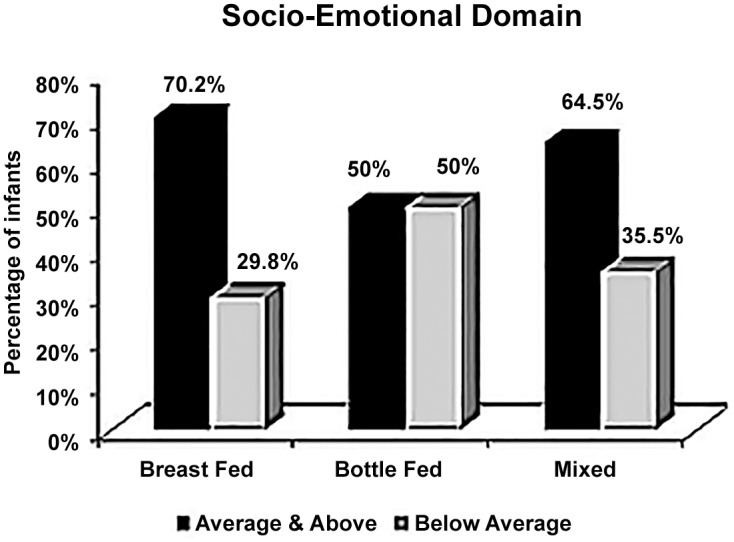
The risk of having below average socio-emotional composite score was nearly two and half times among formula-fed infants than among breast-fed infants. By binary logistical regression analysis, predictors of below average socio-emotional score were a lower serum zinc value, being formula fed during the first half-year and introduction of complementary food before the age of six months (p< 0.05).
Exclusive breastfeeding and to a lesser extent mixed feeding during the first half year is correlated with above average socio-emotional development. Maternal education and zinc status were also determinants of better infant mental health. Our endeavors ought to be directed towards integrated interventions addressing multiple risks to children's development.
情绪问题是为促进儿童福祉和发展而需特意处理的最关键问题之一。
确定与婴儿喂养方式、母婴健康状况及社会经济地位相关的埃及婴儿社会情感发展的预测因素。
一项横断面比较研究纳入了322名母乳喂养、240名奶瓶喂养和93名混合喂养的6至24个月大的婴儿,这些婴儿来自国家研究中心的母婴保健诊所及开罗市儿科门诊机构。使用贝利婴幼儿发展量表(贝利III)对社会情感发展进行评估。记录详细的母婴病史。在193名婴儿的子样本中评估血清锌、铜、铁、维生素B12水平及全血细胞计数(CBC)。
配方奶喂养婴儿社会情感综合得分低于平均水平的风险几乎是母乳喂养婴儿的2.5倍。通过二元逻辑回归分析,社会情感得分低于平均水平的预测因素为血清锌值较低、上半年采用配方奶喂养以及在6个月前引入辅食(p<0.05)。
在上半年纯母乳喂养以及程度稍低的混合喂养与高于平均水平的社会情感发展相关。母亲教育程度和锌水平也是婴儿心理健康状况较好的决定因素。我们的努力应指向针对儿童发展的多种风险的综合干预措施。