Yu Ching-Jung, Du Jung-Chieh, Chiou Hsien-Chih, Feng Chun-Cheng, Chung Ming-Yi, Yang Winnie, Chen Ying-Sheue, Chien Ling-Chu, Hwang Betau, Chen Mei-Lien
Institute of Environmental and Occupational Health Sciences, School of Medicine, National Yang Ming University, Taipei 11221, Taiwan.
Department of Pediatrics, Taipei City Hospital, Zhongxiao Branch, Taipei 11556, Taiwan.
Int J Environ Res Public Health. 2016 Jul 4;13(7):678. doi: 10.3390/ijerph13070678.
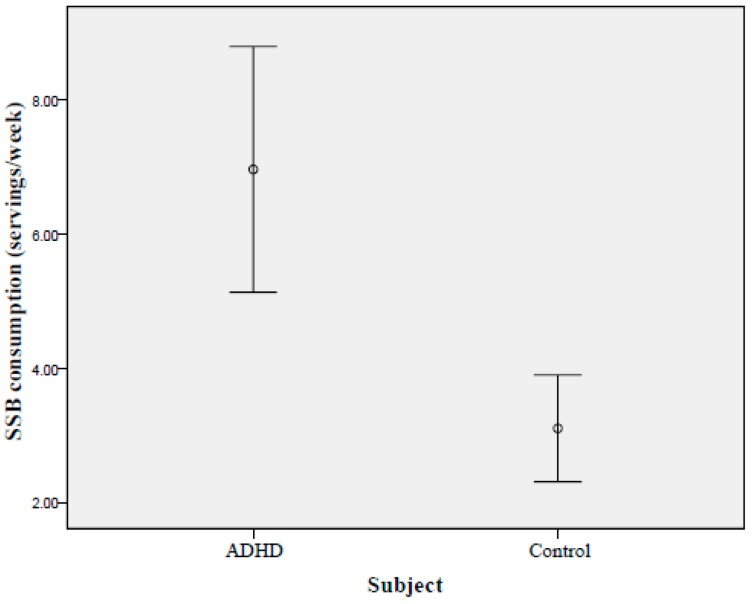
Attention deficit/hyperactivity disorder (ADHD) is one of the most common childhood neurobehavioral conditions. Evidence of the negative effects of sugar-sweetened beverages (SSBs) on mental health has not been convincing, although a few studies have found an association between high SSB levels and attention problems in children. This study aimed to test the hypothesis that SSB consumption is associated with ADHD among children. Doctor-diagnosed ADHD cases (n = 173) and non-ADHD controls (n = 159) between age 4 to 15 were recruited. SSB consumption, socio-demographic and lifestyle characteristics of the children, as well as of their mothers' characteristics during pregnancy, were collected using a questionnaire. Blood lead levels and polymorphisms of two commonly verified dopaminergic-related genes (the D4 dopamine receptor gene DRD4 and the dopamine transporter gene DAT1) were also analyzed. There was a dose-response relationship between SSB consumption and ADHD. After covariates were adjusted, children who consumed SSBs at moderate levels and high levels had 1.36 and 3.69 odds, respectively, of having ADHD, compared with those who did not consume SSBs (p for trend < 0.05). Similar results were obtained when females were excluded. Our findings highlighted the adverse correlation between SSB consumption and ADHD and indicated a dose-response effect even after covariates were adjusted.
注意缺陷多动障碍(ADHD)是最常见的儿童神经行为疾病之一。尽管有一些研究发现儿童高糖饮料(SSB)摄入量与注意力问题之间存在关联,但关于含糖饮料对心理健康产生负面影响的证据并不令人信服。本研究旨在验证儿童饮用含糖饮料与患ADHD之间存在关联这一假设。研究招募了173例经医生诊断为ADHD的病例和159例4至15岁的非ADHD对照儿童。通过问卷调查收集了儿童的含糖饮料摄入量、社会人口统计学和生活方式特征,以及他们母亲孕期的特征。同时分析了血铅水平和两个常见的多巴胺能相关基因(D4多巴胺受体基因DRD4和多巴胺转运体基因DAT1)的多态性。含糖饮料摄入量与ADHD之间存在剂量反应关系。在调整协变量后,与不饮用含糖饮料的儿童相比,中等摄入量和高摄入量含糖饮料的儿童患ADHD的几率分别为1.36和3.69(趋势p<0.05)。排除女性后也得到了类似结果。我们的研究结果突出了饮用含糖饮料与ADHD之间的不良相关性,并表明即使在调整协变量后仍存在剂量反应效应。