Ramsenthaler Christina, Osborne Thomas R, Gao Wei, Siegert Richard J, Edmonds Polly M, Schey Stephen A, Higginson Irene J
Department of Palliative Care, Policy and Rehabilitation, Cicely Saunders Institute, King's College London, School of Medicine, Bessemer Road, London, SE5 9PJ, UK.
Auckland University of Technology, Auckland, New Zealand.
BMC Cancer. 2016 Jul 7;16:427. doi: 10.1186/s12885-016-2410-2.
Multiple myeloma, the second most common haematological cancer, remains incurable. Its incidence is rising due to population ageing. Despite the impact of the disease and its treatment, not much is known on who is most in need of supportive and palliative care. This study aimed to (a) assess symptom severity, palliative care concerns and health-related quality of life (HRQOL) in patients with multiple myeloma, and (b) to determine which factors are associated with a lower quality of life. We further wanted to know (c) whether general symptom level has a stronger influence on HRQOL than disease characteristics.
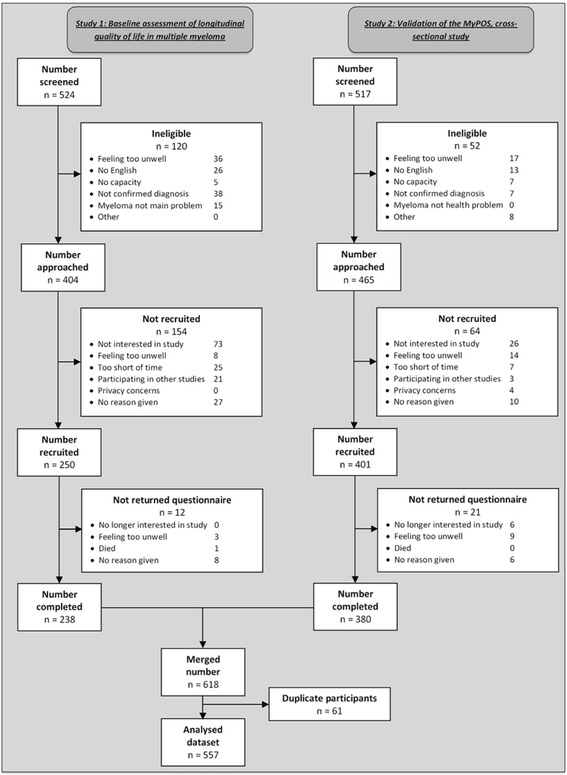
This multi-centre cross-sectional study sampled two cohorts of patients with multiple myeloma from 18 haematological cancer centres in the UK. The Myeloma Patient Outcome Scale (MyPOS) was used to measure symptoms and concerns. Measures of quality of life included the EORTC QLQ-C30, its myeloma module and the EuroQoL EQ-5D. Data were collected on socio-demographic, disease and treatment characteristics and phase of illness. Point prevalence of symptoms and concerns was determined. Multiple regression models quantified relationships between independent factors and the MyPOS, EORTC global quality of life item and EQ5D Index.
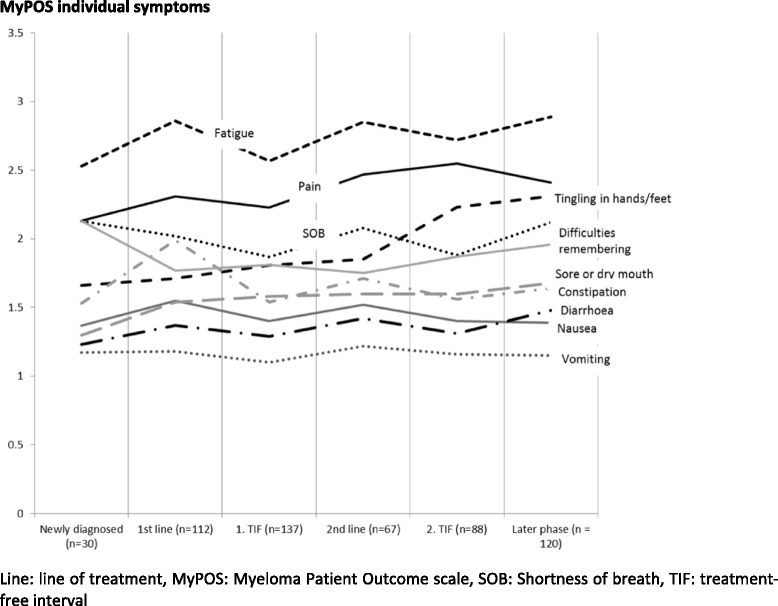
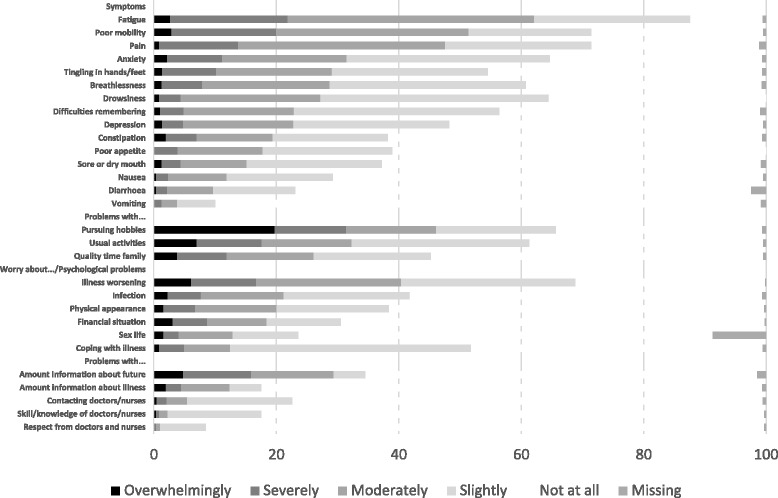
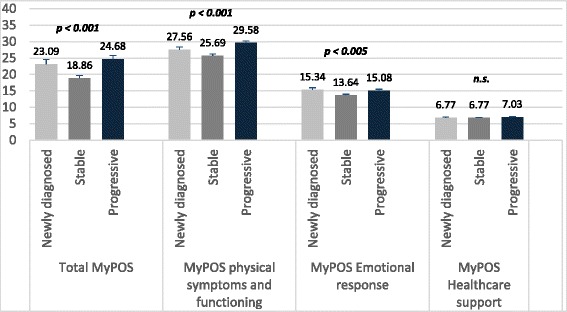
Five-hundred-fifty-seven patients, on average 3.5 years (SD: 3.4) post-diagnosis, were recruited. 18.2 % had newly diagnosed disease, 47.9 % were in a treatment-free interval and 32.7 % had relapsed/progressive disease phase. Patients reported a mean of 7.2 symptoms (SD: 3.3) out of 15 potential symptoms. The most common symptoms were pain (72 %), fatigue (88 %) and breathlessness (61 %). Those with relapsed/progressive disease reported the highest mean number of symptoms and the highest overall palliative care concerns (F = 9.56, p < 0.001). Factors associated with high palliative care concerns were a general high symptom level, presence of pain, anxiety, low physical function, younger age, and being in the advanced stages of disease.
Patients with multiple myeloma have a high symptom burden and low HRQOL, in the advanced and the earlier stages of disease. Identification of patients in need of supportive care should focus on assessing patient-reported outcomes such as symptoms and functioning regularly in clinical practice, complementary to traditional biomedical markers.
多发性骨髓瘤是第二常见的血液系统癌症,仍然无法治愈。由于人口老龄化,其发病率正在上升。尽管该疾病及其治疗有诸多影响,但对于谁最需要支持性和姑息性护理却知之甚少。本研究旨在:(a)评估多发性骨髓瘤患者的症状严重程度、姑息治疗关注点及健康相关生活质量(HRQOL);(b)确定哪些因素与较低的生活质量相关。我们还想了解:(c)一般症状水平对HRQOL的影响是否比疾病特征更强。
这项多中心横断面研究从英国18家血液系统癌症中心抽取了两组多发性骨髓瘤患者。使用骨髓瘤患者结局量表(MyPOS)来测量症状和关注点。生活质量测量包括欧洲癌症研究与治疗组织核心问卷(EORTC QLQ-C30)、其骨髓瘤模块以及欧洲五维度健康量表(EuroQoL EQ-5D)。收集了社会人口统计学、疾病和治疗特征以及疾病阶段的数据。确定了症状和关注点的时点患病率。多元回归模型量化了独立因素与MyPOS、EORTC总体生活质量项目和EQ5D指数之间的关系。
共招募了557例患者,诊断后平均3.5年(标准差:3.4年)。18.2%为新诊断疾病患者,47.9%处于无治疗间期,32.7%处于复发/进展期疾病阶段。患者报告在15种潜在症状中平均有7.2种症状(标准差:3.3种)。最常见的症状是疼痛(72%)、疲劳(88%)和呼吸困难(61%)。复发/进展期疾病患者报告的平均症状数量最多,总体姑息治疗关注点最高(F = 9.56,p < 0.001)。与高姑息治疗关注点相关的因素包括一般症状水平高、存在疼痛、焦虑、身体功能低下、年龄较小以及处于疾病晚期。
多发性骨髓瘤患者在疾病的晚期和早期阶段均有较高的症状负担和较低的HRQOL。在临床实践中,识别需要支持性护理的患者应注重评估患者报告的结局,如症状和功能,作为对传统生物医学指标的补充。