Gutierrez-Sigut Eva, Payne Heather, MacSweeney Mairéad
Deafness, Cognition & Language Research Centre, University College London, United Kingdom; Departamento de Metodología de las Ciencias del Comportamiento, Universitat de València, Spain.
Deafness, Cognition & Language Research Centre, University College London, United Kingdom; Institute of Cognitive Neuroscience, University College London, United Kingdom.
Brain Lang. 2016 Aug;159:109-17. doi: 10.1016/j.bandl.2016.06.004. Epub 2016 Jul 4.
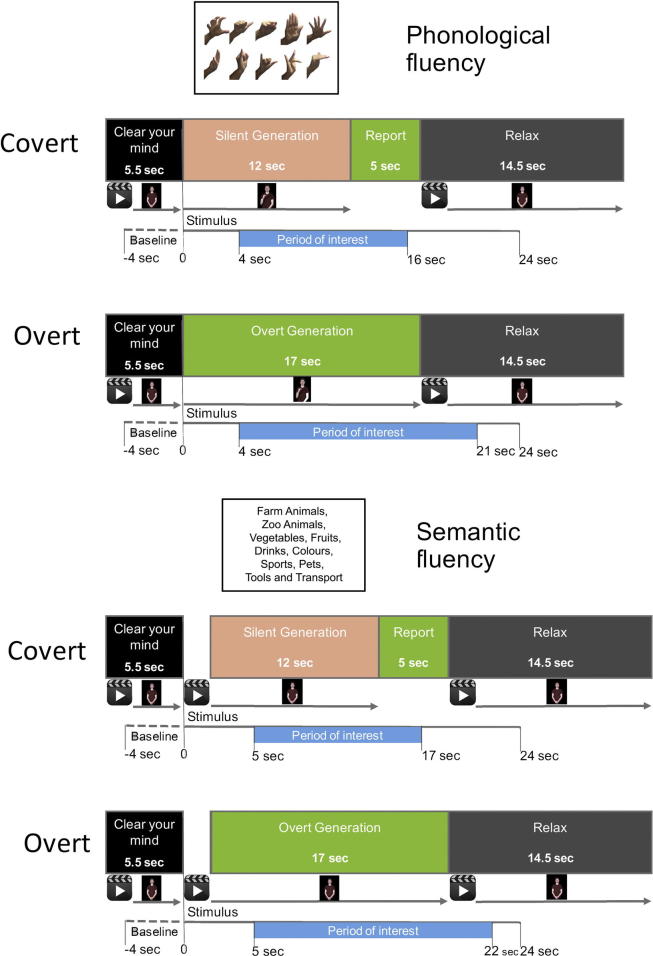
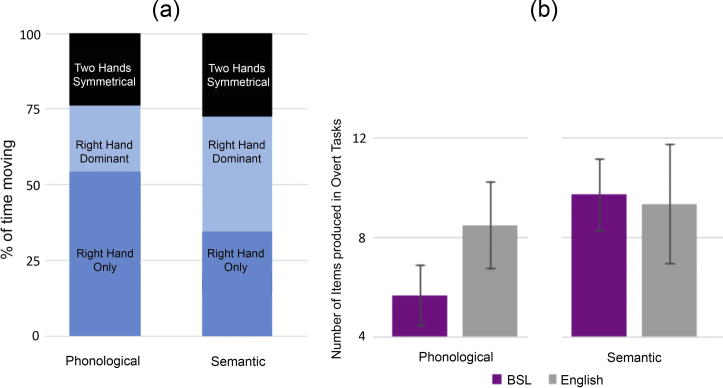
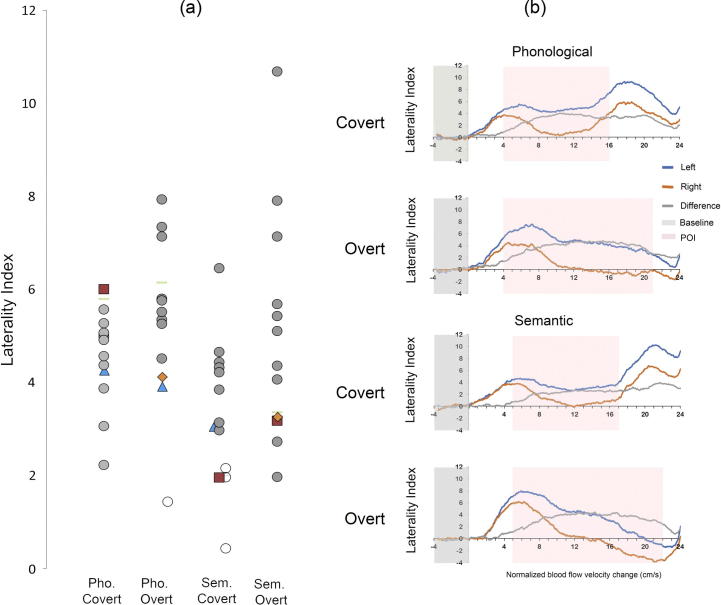
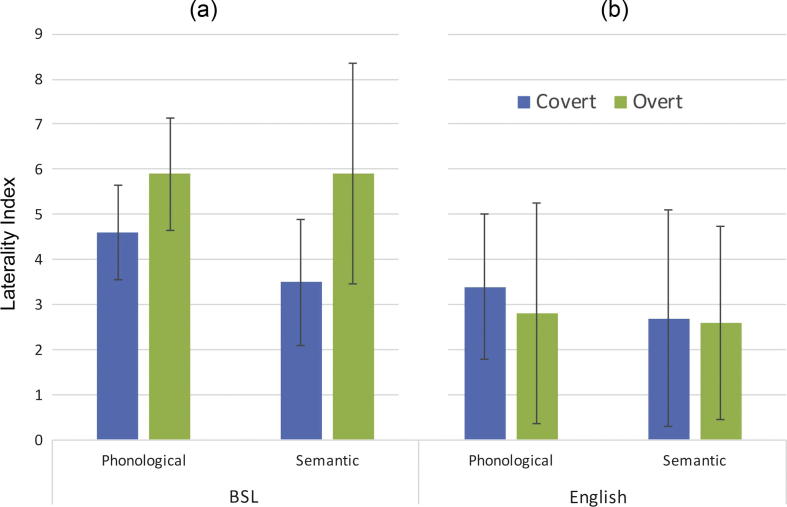
The neural systems supporting speech and sign processing are very similar, although not identical. In a previous fTCD study of hearing native signers (Gutierrez-Sigut, Daws, et al., 2015) we found stronger left lateralization for sign than speech. Given that this increased lateralization could not be explained by hand movement alone, the contribution of motor movement versus 'linguistic' processes to the strength of hemispheric lateralization during sign production remains unclear. Here we directly contrast lateralization strength of covert versus overt signing during phonological and semantic fluency tasks. To address the possibility that hearing native signers' elevated lateralization indices (LIs) were due to performing a task in their less dominant language, here we test deaf native signers, whose dominant language is British Sign Language (BSL). Signers were more strongly left lateralized for overt than covert sign generation. However, the strength of lateralization was not correlated with the amount of time producing movements of the right hand. Comparisons with previous data from hearing native English speakers suggest stronger laterality indices for sign than speech in both covert and overt tasks. This increased left lateralization may be driven by specific properties of sign production such as the increased use of self-monitoring mechanisms or the nature of phonological encoding of signs.
支持言语和手语处理的神经系统非常相似,尽管并非完全相同。在之前一项针对听力正常的手语使用者的经颅多普勒超声研究(古铁雷斯 - 西古特、道斯等人,2015年)中,我们发现手语的左侧化比言语更强。鉴于这种增强的左侧化不能仅由手部动作来解释,在手语产生过程中,运动动作与“语言”过程对半球侧化强度的贡献仍不清楚。在这里,我们在语音和语义流畅性任务中直接对比隐蔽手语与公开手语的侧化强度。为了解决听力正常的手语使用者侧化指数升高可能是由于用其不太熟练的语言执行任务这一可能性,我们在此测试以英国手语(BSL)为主语言的失聪手语使用者。对于公开手语生成,手语使用者的左侧化更强。然而,侧化强度与右手运动的时间量无关。与之前听力正常的以英语为母语者的数据比较表明,在隐蔽和公开任务中,手语的侧化指数都比言语更强。这种增强的左侧化可能是由手语产生的特定属性驱动的,比如自我监测机制使用的增加或手语语音编码的性质。