He Sisi, Li Xuefeng, Li Rongpeng, Fang Lizhu, Sun Lingyun, Wang Yongsheng, Wu Min
State Key Laboratory of Biotherapy and Cancer Center, West China Hospital, Sichuan University, and Collaborative Innovation Center for Biotherapy, Chengdu, Sichuan, P. R. China.
Department of Biomedical Sciences, University of North Dakota, Grand Forks, North Dakota, United States of America.
PLoS Pathog. 2016 Jul 7;12(7):e1005743. doi: 10.1371/journal.ppat.1005743. eCollection 2016 Jul.
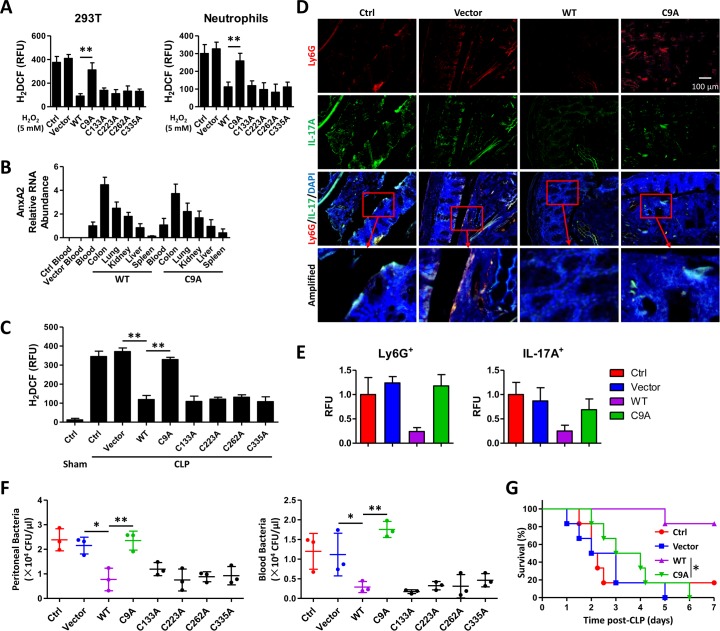
Sepsis is a progressive disease manifesting excessive inflammatory responses, severe tissue injury, organ dysfunction, and, ultimately, mortality. Since currently, there are limited therapeutic options for this disease, further understanding the molecular pathogenesis of sepsis may help develop effective treatments. Here we identify a novel role for Annexin A2 (AnxA2), a multi-compartmental protein, in inhibiting pro-inflammatory response by regulating reactive oxygen species (ROS) and IL-17 signaling during sepsis. In cecal ligation and puncture (CLP) sepsis models, anxa2-/- mice manifested increased pro-inflammatory cytokines and neutrophil infiltration, but decreased bacterial clearance and animal survival. In addition, AnxA2 deficiency led to intensified ROS and IL-17A. Using site directed mutagenesis, we uncovered that cysteine 9 of AnxA2 was the most important aa (site) for regulation of ROS levels. Furthermore, ROS appears to be responsible for elevated IL-17A levels and subsequently exaggerated inflammatory response. Depletion of IL-17 via CRISPR/Cas9 KO strategy down-regulated inflammation and conferred protection against sepsis in anxa2-/- mice. Our findings reveal a previously undemonstrated function for AnxA2 in inflammatory response in polymicrobial sepsis models via an AnxA2-ROS-IL-17 axis, providing insight into the regulation of pathophysiology of sepsis.
脓毒症是一种进行性疾病,表现为过度的炎症反应、严重的组织损伤、器官功能障碍,最终导致死亡。由于目前针对这种疾病的治疗选择有限,进一步了解脓毒症的分子发病机制可能有助于开发有效的治疗方法。在此,我们确定了膜联蛋白A2(AnxA2)这一多定位蛋白在脓毒症期间通过调节活性氧(ROS)和白细胞介素-17(IL-17)信号传导来抑制促炎反应中的新作用。在盲肠结扎和穿刺(CLP)脓毒症模型中,AnxA2基因敲除小鼠表现出促炎细胞因子增加和中性粒细胞浸润,但细菌清除率和动物存活率降低。此外,AnxA2缺乏导致ROS和IL-17A增强。通过定点诱变,我们发现AnxA2的半胱氨酸9是调节ROS水平的最重要氨基酸(位点)。此外,ROS似乎是IL-17A水平升高以及随后炎症反应加剧的原因。通过CRISPR/Cas9基因敲除策略去除IL-17可下调炎症反应,并为AnxA2基因敲除小鼠提供抗脓毒症保护。我们的研究结果揭示了AnxA2在多微生物脓毒症模型的炎症反应中通过AnxA2-ROS-IL-17轴发挥的先前未被证实的功能,为脓毒症病理生理学的调节提供了见解。