Rau Cheng-Shyuan, Wu Shao-Chun, Kuo Spencer C H, Pao-Jen Kuo, Shiun-Yuan Hsu, Chen Yi-Chun, Hsieh Hsiao-Yun, Hsieh Ching-Hua, Liu Hang-Tsung
Department of Neurosurgery, Kaohsiung Chang Gung Memorial Hospital and Chang Gung University College of Medicine, Kaohsiung City 833, Taiwan.
Department of Anesthesiology, Kaohsiung Chang Gung Memorial Hospital and Chang Gung University College of Medicine, Kaohsiung City 833, Taiwan.
Int J Environ Res Public Health. 2016 Jul 5;13(7):683. doi: 10.3390/ijerph13070683.
The shock index (SI) and its derivations, the modified shock index (MSI) and the age shock index (Age SI), have been used to identify trauma patients with unstable hemodynamic status. The aim of this study was to evaluate their use in predicting the requirement for massive transfusion (MT) in trauma patients upon arrival at the hospital.
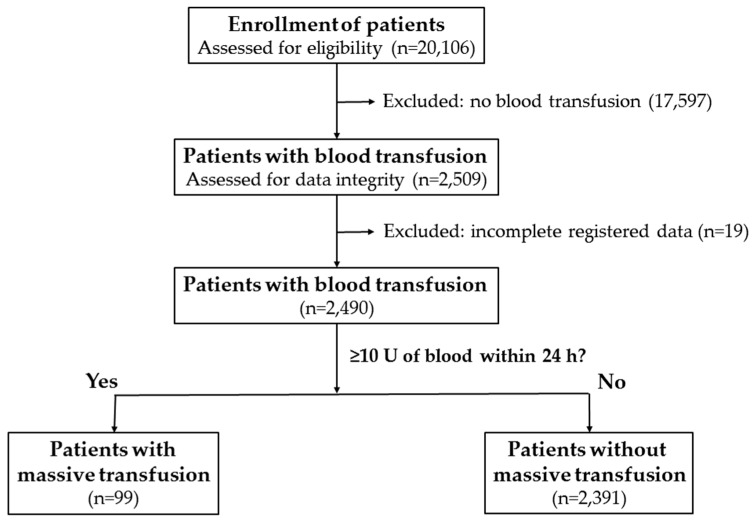
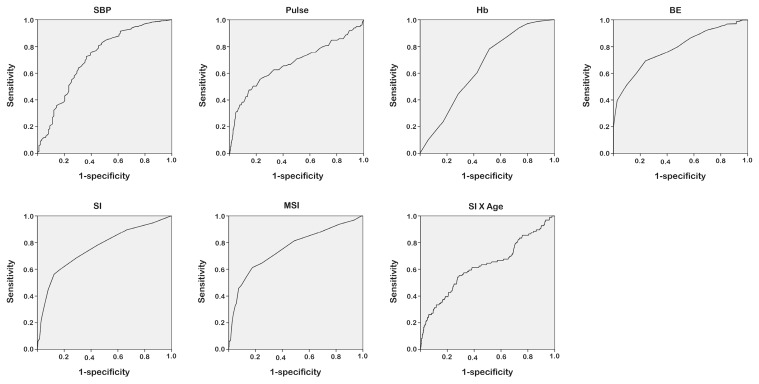
A patient receiving transfusion of 10 or more units of packed red blood cells or whole blood within 24 h of arrival at the emergency department was defined as having received MT. Detailed data of 2490 patients hospitalized for trauma between 1 January 2009, and 31 December 2014, who had received blood transfusion within 24 h of arrival at the emergency department, were retrieved from the Trauma Registry System of a level I regional trauma center. These included 99 patients who received MT and 2391 patients who did not. Patients with incomplete registration data were excluded from the study. The two-sided Fisher exact test or Pearson chi-square test were used to compare categorical data. The unpaired Student t-test was used to analyze normally distributed continuous data, and the Mann-Whitney U-test was used to compare non-normally distributed data. Parameters including systolic blood pressure (SBP), heart rate (HR), hemoglobin level (Hb), base deficit (BD), SI, MSI, and Age SI that could provide cut-off points for predicting the patients' probability of receiving MT were identified by the development of specific receiver operating characteristic (ROC) curves. High accuracy was defined as an area under the curve (AUC) of more than 0.9, moderate accuracy was defined as an AUC between 0.9 and 0.7, and low accuracy was defined as an AUC less than 0.7.
In addition to a significantly higher Injury Severity Score (ISS) and worse outcome, the patients requiring MT presented with a significantly higher HR and lower SBP, Hb, and BD, as well as significantly increased SI, MSI, and Age SI. Among these, only four parameters (SBP, BD, SI, and MSI) had a discriminating power of moderate accuracy (AUC > 0.7) as would be expected. A SI of 0.95 and a MSI of 1.15 were identified as the cut-off points for predicting the requirement of MT, with an AUC of 0.760 (sensitivity: 0.563 and specificity: 0.876) and 0.756 (sensitivity: 0.615 and specificity: 0.823), respectively. However, in the groups of patients with comorbidities such as hypertension, diabetes mellitus, or coronary artery disease, the discriminating power of these three indices in predicting the requirement of MT was compromised.
This study reveals that the SI is moderately accurate in predicting the need for MT. However, this predictive power may be compromised in patients with HTN, DM or CAD. Moreover, the more complex calculations of MSI and Age SI failed to provide better discriminating power than the SI.
休克指数(SI)及其衍生指标,即改良休克指数(MSI)和年龄休克指数(Age SI),已被用于识别血流动力学状态不稳定的创伤患者。本研究的目的是评估它们在预测创伤患者入院时大量输血(MT)需求方面的应用。
在急诊科就诊后24小时内接受10个或更多单位浓缩红细胞或全血输血的患者被定义为接受了MT。从一级区域创伤中心的创伤登记系统中检索了2009年1月1日至2014年12月31日期间因创伤住院且在急诊科就诊后24小时内接受输血的2490例患者的详细数据。其中包括99例接受MT的患者和2391例未接受MT的患者。登记数据不完整的患者被排除在研究之外。采用双侧Fisher精确检验或Pearson卡方检验比较分类数据。采用非配对学生t检验分析正态分布的连续数据,采用Mann-Whitney U检验比较非正态分布数据。通过绘制特定的受试者工作特征(ROC)曲线,确定了包括收缩压(SBP)、心率(HR)、血红蛋白水平(Hb)、碱缺失(BD)、SI、MSI和Age SI等能够为预测患者接受MT的概率提供截断点的参数。高准确性定义为曲线下面积(AUC)大于0.9,中等准确性定义为AUC在0.9和0.7之间,低准确性定义为AUC小于0.7。
除损伤严重程度评分(ISS)显著更高且预后更差外,需要MT的患者还表现出显著更高的HR以及更低的SBP、Hb和BD,同时SI、MSI和Age SI也显著升高。其中,只有四个参数(SBP、BD、SI和MSI)具有中等准确性的鉴别能力(AUC>0.7),这是预期的。SI为0.95和MSI为1.15被确定为预测MT需求的截断点,AUC分别为0.760(敏感性:0.563,特异性:0.876)和0.756(敏感性:0.615,特异性:0.823)。然而,在患有高血压、糖尿病或冠状动脉疾病等合并症的患者组中,这三个指标在预测MT需求方面的鉴别能力受到影响。
本研究表明,SI在预测MT需求方面具有中等准确性。然而,在高血压、糖尿病或冠心病患者中,这种预测能力可能会受到影响。此外,MSI和Age SI更复杂的计算未能提供比SI更好的鉴别能力。