Xue Haikuo, Ren Huijun, Zhang Lei, Sun Xiaoxu, Wang Wanhai, Zhang Shijie, Zhao Junwei, Ming Liang
Department of Clinical Laboratory, the First Affiliated Hospital of Zhengzhou University, Zhengzhou 450002, China; Key Clinical Laboratory Medicine of Henan Province, Zhengzhou 450002, China; Department of Laboratory Medicine, Zhengzhou University, Zhengzhou, Henan 450002, China; Key Laboratory of the First Affiliated Hospital of Zhengzhou University, Zhengzhou, Henan450002, China.
Department of Clinical Laboratory, the First Affiliated Hospital of Zhengzhou University, Zhengzhou 450002, China; Key Clinical Laboratory Medicine of Henan Province, Zhengzhou 450002, China.
Iran J Basic Med Sci. 2016 May;19(5):561-6.
Multiple sclerosis (MS) is a serious neurological autoimmune disease, it commonly affects young adults. Vitamin E (Vit E) is an important component of human diet with antioxidant activity, which protects the body's biological systems. In order to assess the effect of Vit E treatment on this autoimmune disease, we established experimental autoimmune encephalomyelitis (EAE), the animal model of MS, and treated EAE with α-tocopherol (AT) which is the main content of Vit E.
Twenty C57BL/6 adult female mice were used and divided into two groups randomly. EAE was induced with myelin oligodendrocyte glycoprotein (MOG), and one group was treated with AT, at a dose of 100 mg/kg on the 3(th) day post-immunization with MOG, the other group was treated with 1% alcohol. Mice were euthanized on day 14, post-immunization, spleens were removed for assessing splenocytes proliferation and cytokine profile, and spinal cords were dissected to assess the infiltration of inflammatory cells in spinal cord.
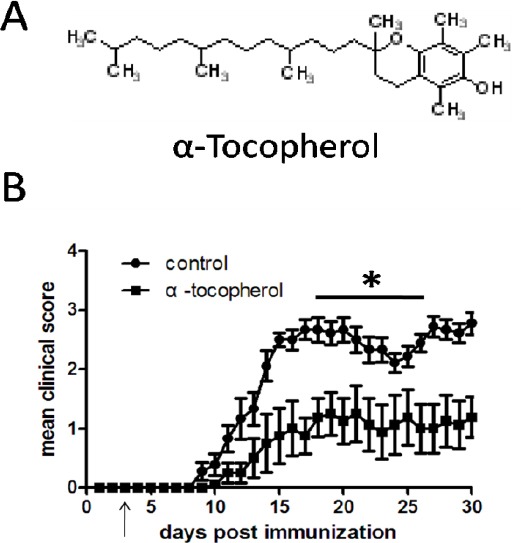
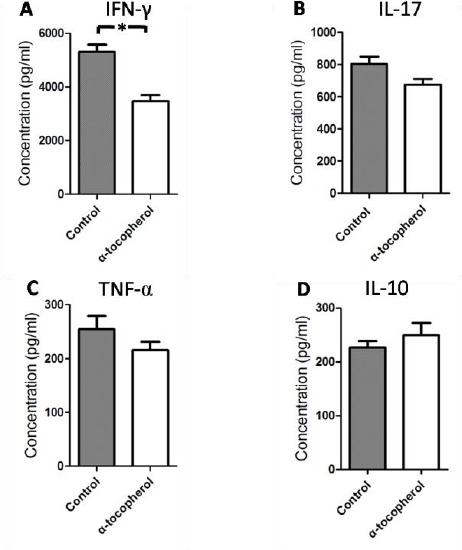
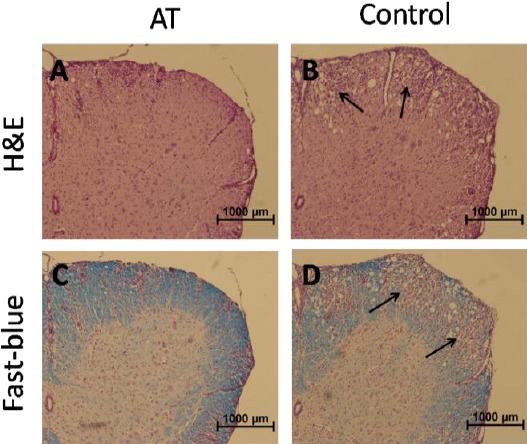
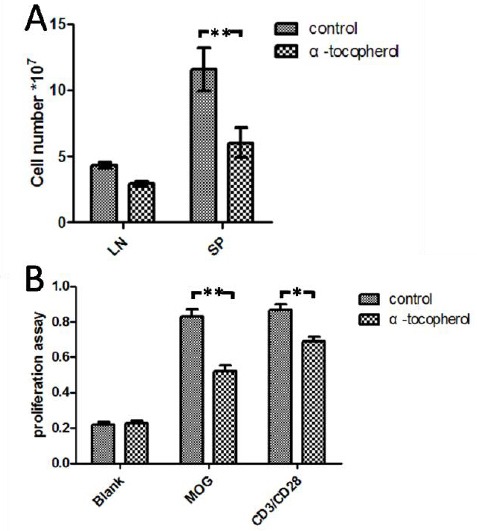
AT was able to attenuate the severity of EAE and delay the disease progression. H&E staining and fast blue staining indicated that AT reduced the inflammation and the demyelination reaction in the spinal cord. Treatment with AT significantly decreased the proliferation of splenocytes. AT also inhibited the production of IFN-γ (Th1 cytokine), though the other cytokines were only affected slightly.
According to the results, AT ameliorated EAE, through suppressing the proliferation of T cells and the Th1 response. AT may be used as a potential treatment for MS.
多发性硬化症(MS)是一种严重的神经自身免疫性疾病,通常影响年轻人。维生素E(Vit E)是人类饮食中的重要成分,具有抗氧化活性,可保护人体生物系统。为了评估Vit E治疗对这种自身免疫性疾病的影响,我们建立了实验性自身免疫性脑脊髓炎(EAE),即MS的动物模型,并用Vit E的主要成分α-生育酚(AT)对EAE进行治疗。
使用20只C57BL/6成年雌性小鼠,随机分为两组。用髓鞘少突胶质细胞糖蛋白(MOG)诱导EAE,一组在接种MOG后第3天用100 mg/kg的AT治疗,另一组用1%酒精治疗。免疫后第14天对小鼠实施安乐死,取出脾脏评估脾细胞增殖和细胞因子谱,并解剖脊髓评估脊髓中炎性细胞的浸润情况。
AT能够减轻EAE的严重程度并延缓疾病进展。苏木精-伊红染色和固蓝染色表明,AT减少了脊髓中的炎症和脱髓鞘反应。AT治疗显著降低了脾细胞的增殖。AT还抑制了IFN-γ(Th1细胞因子)的产生,不过其他细胞因子仅受到轻微影响。
根据结果,AT通过抑制T细胞增殖和Th1反应改善了EAE。AT可能用作MS的潜在治疗方法。