Elhenawy Wael, Bording-Jorgensen Michael, Valguarnera Ezequiel, Haurat M Florencia, Wine Eytan, Feldman Mario F
Department of Biological Sciences, University of Alberta, Edmonton, Alberta, Canada.
Department of Physiology, University of Alberta, Edmonton, Alberta, Canada.
mBio. 2016 Jul 12;7(4):e00940-16. doi: 10.1128/mBio.00940-16.
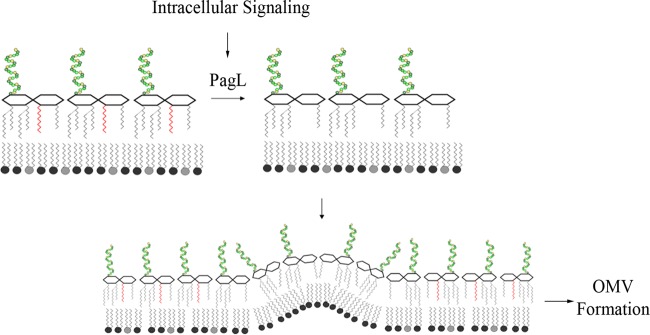
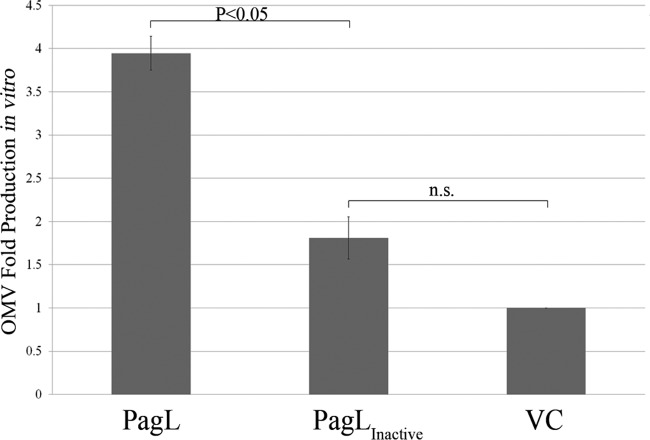
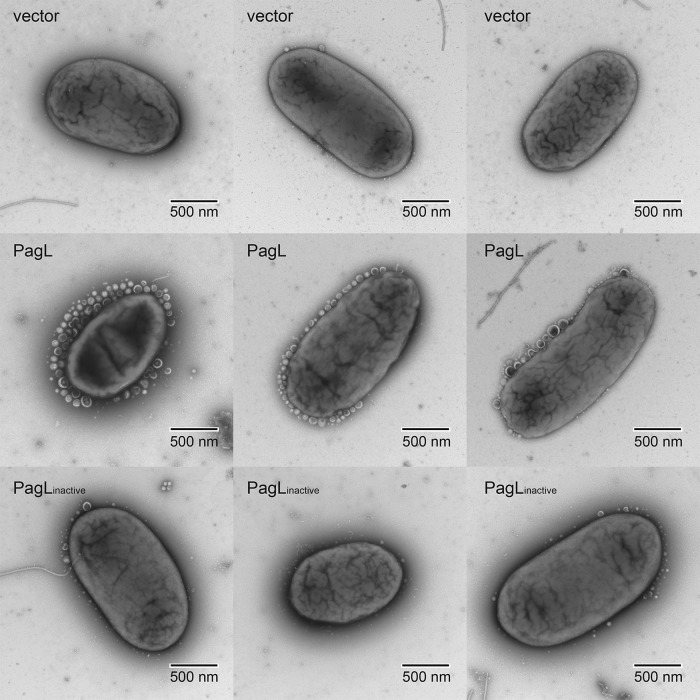
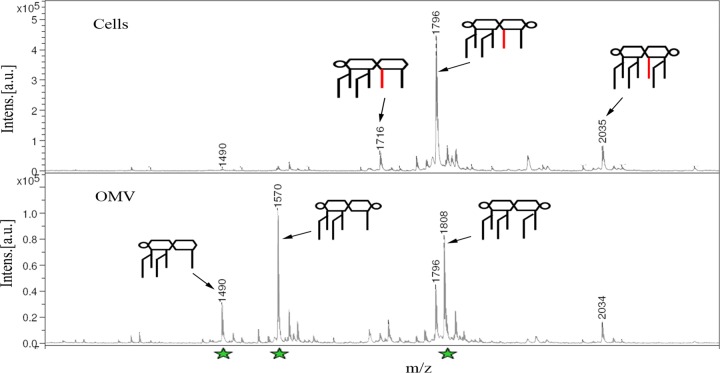
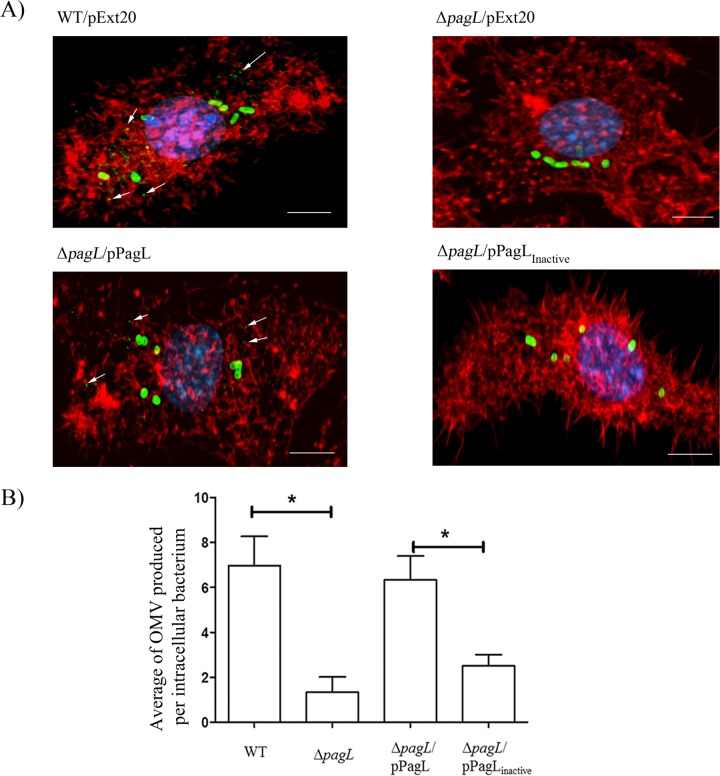
Outer membrane vesicles (OMV) are proposed to mediate multiple functions during pathogenesis and symbiosis. However, the mechanisms responsible for OMV formation remain poorly understood. It has been shown in eukaryotic membranes that lipids with an inverted-cone shape favor the formation of positive membrane curvatures. Based on these studies, we formulated the hypothesis that lipid A deacylation might impose shape modifications that result in the curvature of the outer membrane (OM) and subsequent OMV formation. We tested the effect of lipid A remodeling on OMV biogenesis employing Salmonella enterica serovar Typhimurium as a model organism. Expression of the lipid A deacylase PagL resulted in increased vesiculation, without inducing an envelope stress response. Mass spectrometry analysis revealed profound differences in the patterns of lipid A in OM and OMV, with accumulation of deacylated lipid A forms exclusively in OMV. OMV biogenesis by intracellular bacteria upon macrophage infection was drastically reduced in a pagL mutant strain. We propose a novel mechanism for OMV biogenesis requiring lipid A deacylation in the context of a multifactorial process that involves the orchestrated remodeling of the outer membrane.
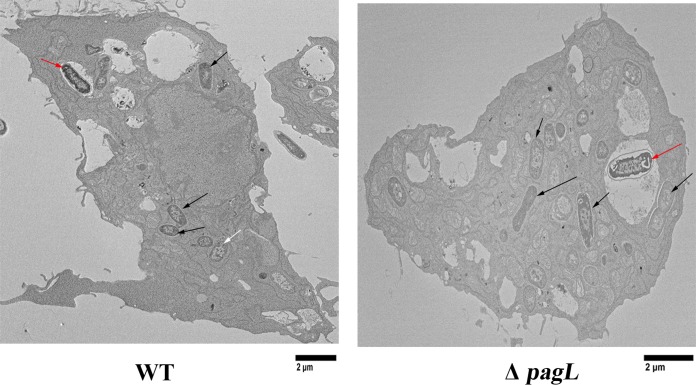
The role of lipid remodeling in vesiculation is well documented in eukaryotes. Similarly, bacteria produce membrane-derived vesicles; however, the molecular mechanisms underlying their production are yet to be determined. In this work, we investigated the role of outer membrane remodeling in OMV biogenesis in S Typhimurium. We showed that the expression of the lipid A deacylase PagL results in overvesiculation with deacylated lipid A accumulation exclusively in OMV. An S Typhimurium ΔpagL strain showed a significant reduction in intracellular OMV secretion relative to the wild-type strain. Our results suggest a novel mechanism for OMV biogenesis that involves outer membrane remodeling through lipid A modification. Understanding how OMV are produced by bacteria is important to advance our understanding of the host-pathogen interactions.
外膜囊泡(OMV)被认为在发病机制和共生过程中介导多种功能。然而,负责OMV形成的机制仍知之甚少。在真核细胞膜中已表明,具有倒锥形形状的脂质有利于正膜曲率的形成。基于这些研究,我们提出了一个假设,即脂质A脱酰基可能会引起形状改变,从而导致外膜(OM)弯曲并随后形成OMV。我们以鼠伤寒沙门氏菌为模型生物,测试了脂质A重塑对OMV生物发生的影响。脂质A脱酰酶PagL的表达导致囊泡形成增加,而不会诱导包膜应激反应。质谱分析揭示了OM和OMV中脂质A模式的深刻差异,脱酰化脂质A形式仅在OMV中积累。pagL突变株中巨噬细胞感染后细胞内细菌的OMV生物发生显著减少。我们提出了一种新的OMV生物发生机制,该机制需要在涉及外膜精心编排重塑的多因素过程中进行脂质A脱酰基作用。
脂质重塑在囊泡形成中的作用在真核生物中已有充分记录。同样,细菌会产生膜衍生囊泡;然而,其产生的分子机制尚未确定。在这项工作中,我们研究了外膜重塑在鼠伤寒沙门氏菌OMV生物发生中的作用。我们表明,脂质A脱酰酶PagL的表达导致过度囊泡化,脱酰化脂质A仅在OMV中积累。相对于野生型菌株,鼠伤寒沙门氏菌ΔpagL菌株的细胞内OMV分泌显著减少。我们的结果表明了一种新的OMV生物发生机制,该机制涉及通过脂质A修饰对外膜进行重塑。了解细菌如何产生OMV对于推进我们对宿主-病原体相互作用的理解很重要。