Kinny-Köster Benedict, Bartels Michael, Becker Susen, Scholz Markus, Thiery Joachim, Ceglarek Uta, Kaiser Thorsten
Institute of Laboratory Medicine, Clinical Chemistry and Molecular Diagnostics, University Hospital Leipzig, Leipzig, Germany.
Department of Visceral, Vascular, Thoracic and Transplant Surgery, University Hospital Leipzig, Leipzig, Germany.
PLoS One. 2016 Jul 13;11(7):e0159205. doi: 10.1371/journal.pone.0159205. eCollection 2016.
The liver plays a key role in amino acid metabolism. In former studies, a ratio between branched-chain and aromatic amino acids (Fischer's ratio) revealed associations with hepatic encephalopathy. Furthermore, low concentrations of branched-chain amino acids were linked to sarcopenia in literature. Encephalopathy and sarcopenia are known to dramatically worsen the prognosis. Aim of this study was to investigate a complex panel of plasma amino acids in the context of mortality in patients with end-stage liver disease.
166 patients evaluated for orthotopic liver transplantation were included. 19 amino acids were measured from citrated plasma samples using mass spectrometry. We performed survival analysis for plasma amino acid constellations and examined the relationship to established mortality predictors.
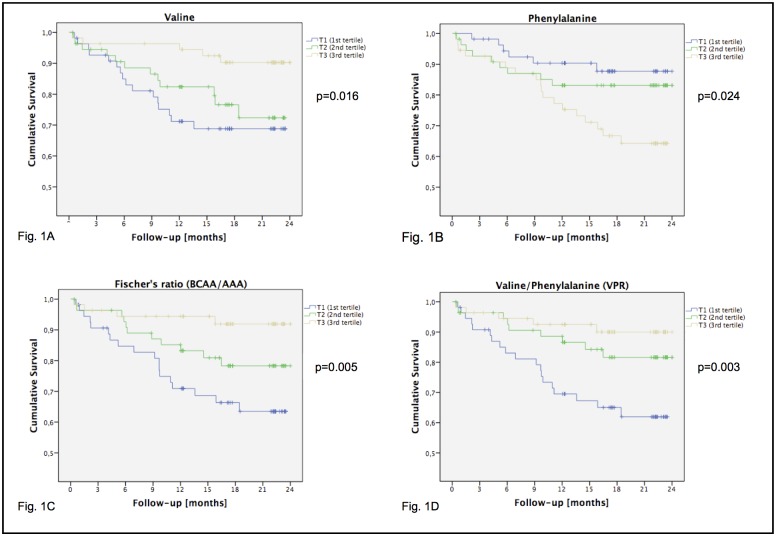
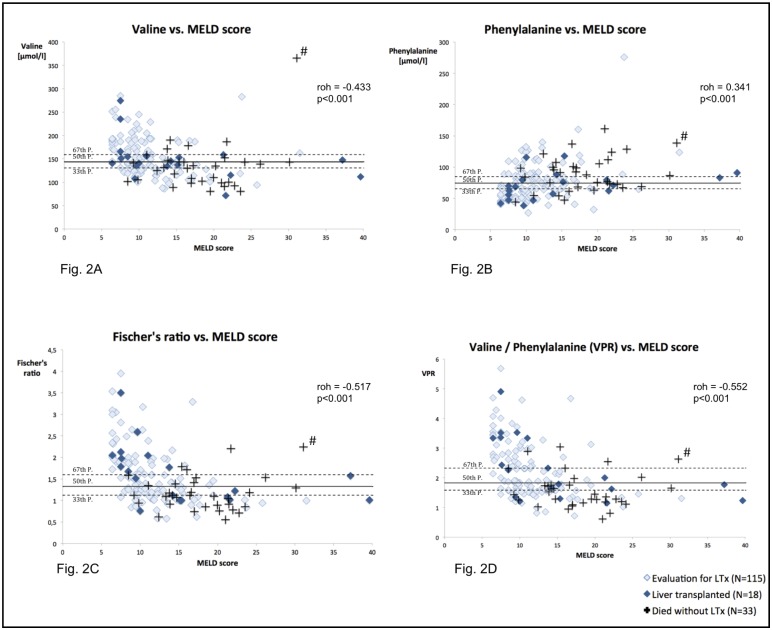
33/166 (19.9%) patients died during follow-up. Lower values of valine (p<0.001), Fischer's ratio (p<0.001) and valine to phenylalanine ratio (p<0.001) and higher values of phenylalanine (p<0.05) and tyrosine (p<0.05) were significantly associated with mortality. When divided in three groups, the tertiles discriminated cumulative survival for valine (p = 0.016), phenylalanine (p = 0.024) and in particular for valine to phenylalanine ratio (p = 0.003) and Fischer's ratio (p = 0.005). Parameters were also significantly correlated with MELD and MELD-Na score.
Amino acids in plasma are valuable biomarkers to determine increased risk of mortality in patients with end-stage liver disease. In particular, valine concentrations and constellations composed of branched-chain and aromatic amino acids were strongly associated with prognosis. Due to their pathophysiological importance, the identified amino acids could be used to examine individual dietary recommendations to serve as potential therapeutic targets.
肝脏在氨基酸代谢中起关键作用。在先前的研究中,支链氨基酸与芳香族氨基酸的比例(费舍尔比值)显示出与肝性脑病的关联。此外,文献中低浓度的支链氨基酸与肌肉减少症有关。已知肝性脑病和肌肉减少症会显著恶化预后。本研究的目的是在终末期肝病患者的死亡率背景下,研究一组复杂的血浆氨基酸。
纳入166例接受原位肝移植评估的患者。使用质谱法从枸橼酸盐血浆样本中测量19种氨基酸。我们对血浆氨基酸组成进行了生存分析,并检查了与既定死亡率预测指标的关系。
166例患者中有33例(19.9%)在随访期间死亡。缬氨酸值较低(p<0.001)、费舍尔比值(p<0.001)和缬氨酸与苯丙氨酸比值(p<0.001)以及苯丙氨酸值较高(p<0.05)和酪氨酸值较高(p<0.05)与死亡率显著相关。分为三组时,三分位数区分了缬氨酸(p = 0.016)、苯丙氨酸(p = 0.024),特别是缬氨酸与苯丙氨酸比值(p = 0.003)和费舍尔比值(p = 0.005)的累积生存率。这些参数也与MELD和MELD-Na评分显著相关。
血浆中的氨基酸是确定终末期肝病患者死亡风险增加的有价值生物标志物。特别是,缬氨酸浓度以及由支链和芳香族氨基酸组成的组合与预后密切相关。由于其病理生理重要性,所确定的氨基酸可用于检查个体饮食建议,作为潜在的治疗靶点。