Stylianou Michalis, Kulinna Pamela Hodges, van der Mars Hans, Mahar Matthew T, Adams Marc A, Amazeen Eric
School of Human Movement and Nutrition Sciences, The University of Queensland, St Lucia, Queensland 4072, Australia.
Mary Lou Fulton Teachers College, Arizona State University, Mesa, AZ 85212, USA.
Prev Med Rep. 2016 Feb 1;3:196-202. doi: 10.1016/j.pmedr.2016.01.010. eCollection 2016 Jun.
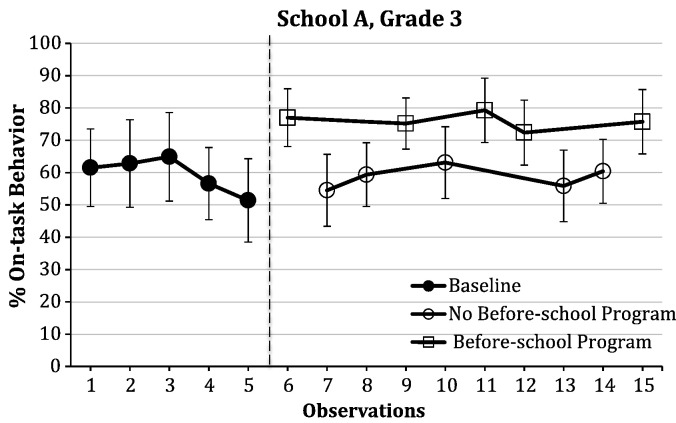
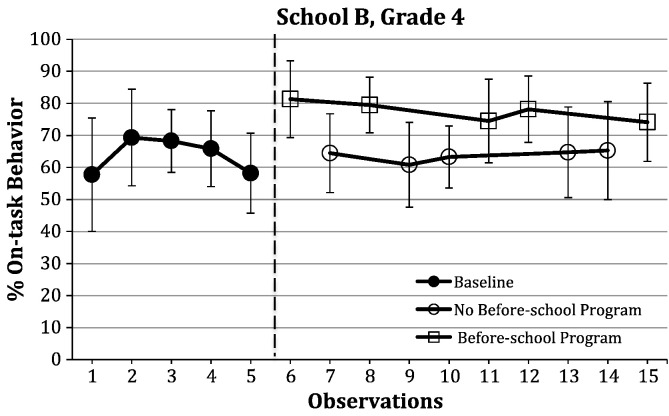
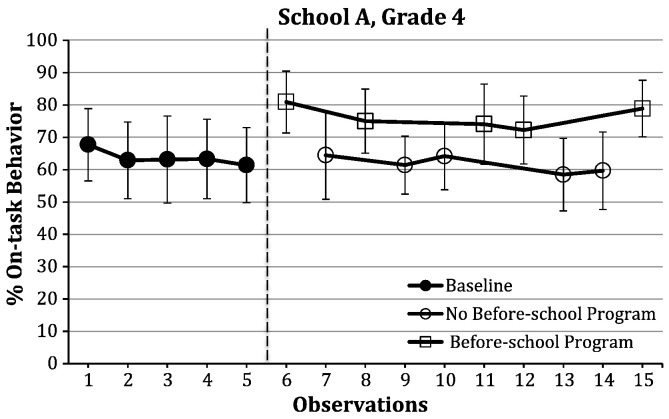
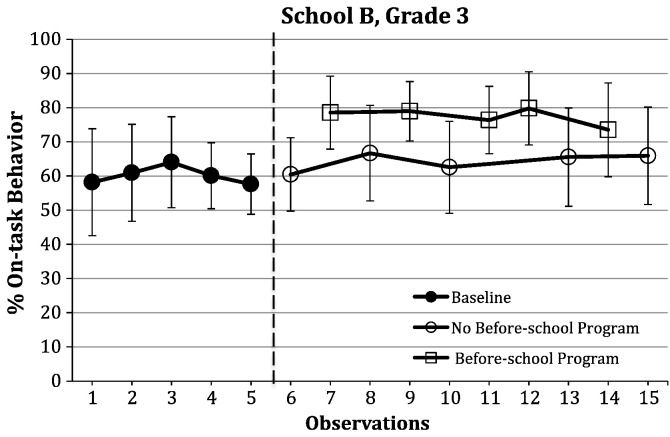
Before-school programs provide a good opportunity for children to engage in physical activity (PA) as well as improve their readiness to learn. The purpose of this study was to examine the effect of a before-school running/walking club on elementary school children's on-task behavior. The study employed a two-phase experimental design with an initial baseline phase followed by an alternating treatments phase, and was first conducted at a private school (School A) and subsequently replicated at a public school (School B). Participants were third and fourth grade children from two schools in the Southwestern U.S. who participated in a before-school running/walking club that met two times each week (School A: 20 min; School B: 15 min) during the 2013/2014 academic year. Participation in the program was monitored using pedometers and on-task behavior was assessed through direct observation. Data analyses included visual analysis, Tau-U index, and multilevel modeling. Results from all analyses indicated that on-task behavior was significantly higher on days the children attended the before-school program than on days they did not. According to multilevel modeling results, mean differences and effect sizes were: School A = 15.78%, pseudo-R (2) = .34 [strong effect]; School B = 14.26%, pseudo-R (2) = .22 [moderate effect]. Results provide evidence for the positive impact of before-school PA programs on children's classroom behavior and readiness to learn. Such programs do not take time away from academics and may be an attractive option for schools. Results also have implications for the structure of children's school day and the scheduling of PA opportunities.
学前项目为儿童提供了参与体育活动(PA)的良好机会,同时也提高了他们的学习准备程度。本研究的目的是考察一个学前跑步/步行俱乐部对小学生任务专注行为的影响。该研究采用两阶段实验设计,首先是初始基线阶段,随后是交替治疗阶段,研究首先在一所私立学校(A校)进行,随后在一所公立学校(B校)重复进行。参与者是来自美国西南部两所学校的三、四年级学生,他们在2013/2014学年参加了一个每周两次的学前跑步/步行俱乐部(A校:20分钟;B校:15分钟)。使用计步器监测项目参与情况,并通过直接观察评估任务专注行为。数据分析包括视觉分析、Tau-U指数和多层次建模。所有分析结果表明,儿童参加学前项目的日子里,其任务专注行为显著高于未参加的日子。根据多层次建模结果,平均差异和效应量为:A校=15.78%,伪R(2)=.34[强效应];B校=14.26%,伪R(2)=.22[中等效应]。结果为学前体育活动项目对儿童课堂行为和学习准备程度的积极影响提供了证据。此类项目不会占用学习时间,可能是学校的一个有吸引力的选择。结果也对儿童上学日的结构和体育活动机会的安排有启示。