
利用SCoT、ISSR和RAPD标记揭示微繁殖毛果海桐(Pittosporum eriocarpum Royle)——一种地方特有且濒危的药用植物的遗传同质性
Genetic Homogeneity Revealed Using SCoT, ISSR and RAPD Markers in Micropropagated Pittosporum eriocarpum Royle- An Endemic and Endangered Medicinal Plant.
作者信息
Thakur Julie, Dwivedi Mayank D, Sourabh Pragya, Uniyal Prem L, Pandey Arun K
机构信息
Department of Botany, University of Delhi, Delhi, India.
出版信息
PLoS One. 2016 Jul 19;11(7):e0159050. doi: 10.1371/journal.pone.0159050. eCollection 2016.
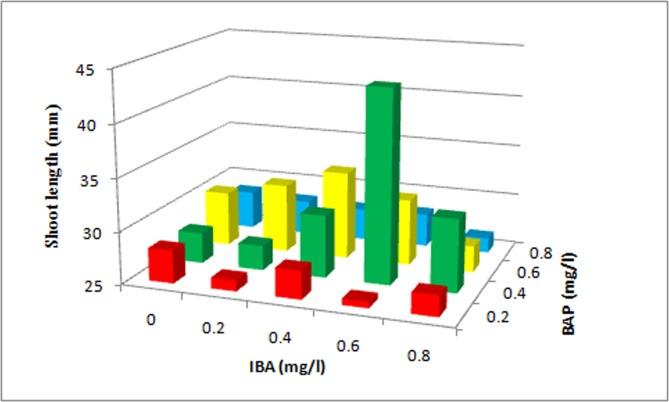
Pittosporum eriocarpum Royle, a medicinally important taxon, is endemic to Uttarakhand region of Himalaya. It has become endangered due to over-collection and the loss of habitats. As raising plants through seeds in this plant is problematic, a reliable protocol for micropropagation using nodal explants has been developed. High shoot regeneration (95%) occurred in MS medium augmented with BA 0.4mg/l in combination IBA 0.6mg/l. In vitro regenerated shoots were rooted in MS medium supplemented with three auxins, of which 0.6 mg/l indole butyric acid proved to be the best for rooting (90%) with maximum number of roots per shoot. Thereafter, rooted plants were hardened and nearly 73% of rooted shoots were successfully acclimatized and established in the field. Start codon targeted (SCoT), inter simple sequence repeats (ISSR) and random amplified polymorphic DNA (RAPD) markers were used to validate the genetic homogeneity amongst nine in vitro raised plantlets with mother plant. DNA fingerprints of in vitro regenerated plantlets displayed monomorphic bands similar to mother plant, indicating homogeneity among the micropropagated plants with donor mother plant. The similarity values were calculated based on SCoT, ISSR and RAPD profiles which ranged from 0.89 to 1.00, 0.91 to 1.00 and 0.95 to 1.00 respectively. The dendrograms generated through Unweighted Pair Group Method with arithmetic mean (UPGMA) analysis revealed 97% similarity amongst micropropagated plants with donor mother plant, thus confirming genetic homogeneity of micropropagated clones. This is the first report on micropropagation and genetic homogeneity assessment of P. eriocarpum. The protocol would be useful for the conservation and large scale production of P. eriocarpum to meet the demand for medicinal formulations and also for the re-introduction of in vitro grown plants in the suitable natural habitats to restore the populations.
毛果海桐(Pittosporum eriocarpum Royle)是一种具有重要药用价值的分类群,原产于喜马拉雅山脉的北阿坎德邦地区。由于过度采集和栖息地丧失,它已成为濒危物种。由于通过种子繁殖这种植物存在问题,因此已经开发出一种使用茎尖外植体进行微繁殖的可靠方案。在添加了0.4mg/l BA和0.6mg/l IBA的MS培养基中,芽再生率很高(95%)。离体再生芽在添加了三种生长素的MS培养基中生根,其中0.6mg/l吲哚丁酸被证明是生根效果最好的(90%),每个芽的根数量最多。此后,生根的植株进行炼苗,近73%的生根芽成功驯化并在田间定植。起始密码子靶向(SCoT)、简单序列重复区间(ISSR)和随机扩增多态性DNA(RAPD)标记被用于验证9株离体培养的幼苗与母株之间的遗传同质性。离体再生幼苗的DNA指纹图谱显示出与母株相似的单态带,表明微繁殖植株与供体母株之间具有同质性。基于SCoT、ISSR和RAPD图谱计算的相似性值分别为0.89至1.00、0.91至1.00和0.95至1.00。通过非加权组平均法(UPGMA)分析生成的聚类图显示,微繁殖植株与供体母株之间的相似性为97%,从而证实了微繁殖克隆的遗传同质性。这是关于毛果海桐微繁殖和遗传同质性评估的首次报道。该方案将有助于毛果海桐的保护和大规模生产,以满足药用配方的需求,也有助于将离体培养的植物重新引入合适的自然栖息地以恢复种群数量。




 Zotero 插件