Wu Kunlin, Zeng Songjun, Lin Danni, Teixeira da Silva Jaime A, Bu Zhaoyang, Zhang Jianxia, Duan Jun
Key Laboratory of Plant Resources Conservation and Sustainable Utilization, South China Botanical Garden, Chinese Academy of Sciences, Guangzhou, China.
Kagawa-ken, Japan.
PLoS One. 2014 Oct 28;9(10):e110033. doi: 10.1371/journal.pone.0110033. eCollection 2014.
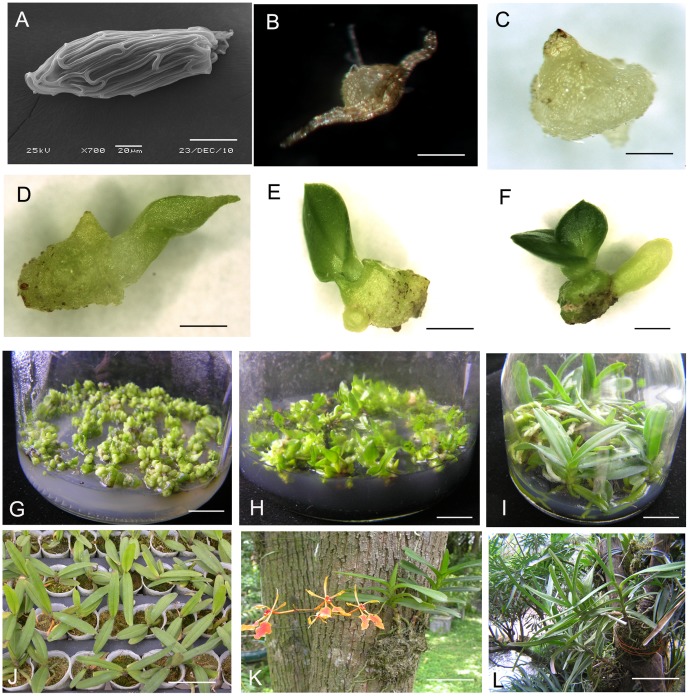
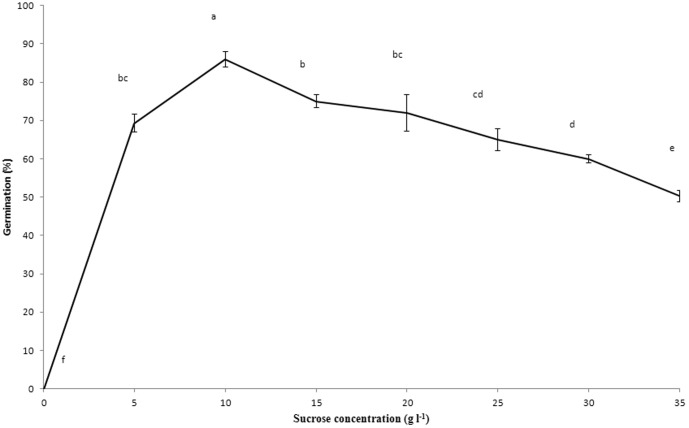
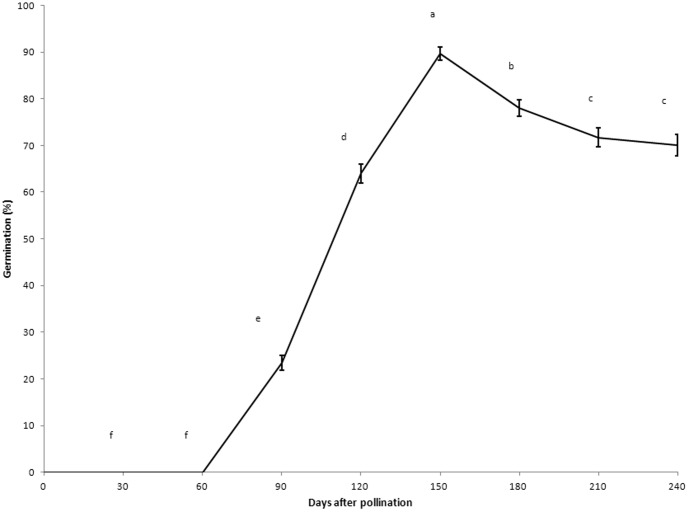
Renanthera imschootiana Rolfe is an endangered tropical epiphytic orchid that is threatened with extinction due to over-collection and the loss of suitable habitats. In vitro propagation is a useful way to mass produce plants for re-establishment in the wild and for commercial propagation. Seeds collected 150 days after pollination (DAP) were the optimum stage for in vitro culture. Seed germination reached 93.1% on quarter-strength MS (i.e., MS containing a quarter of macro- and micronutrients) medium containing 0.5 mg l(-1) α-naphthaleneacetic acid (NAA), 20% coconut water (CW), 1.0 g l(-1) peptone, 10 g l(-1) sucrose and 1.0 g l(-1) activated charcoal (AC). Quarter-strength MS medium supplemented with 1.0 mg l(-1) BA, 0.5 mg l(-1) NAA, 1.0 g l(-1) peptone, 10 g l(-1) sucrose and 20% CW was suitable for the sub-culture of protocorm-like bodies (PLBs) in which the PLB proliferation ratio was 2.88. Quarter-strength MS medium containing 1.0 mg l(-1) NAA, 1.0 g l(-1) peptone, 100 g l(-1) banana homogenate (BH), and 1.0 g l(-1) AC was suitable for plantlet formation and 95.67% of plantlets developed from PLBs within 60 days of culture. Hyponex N016 medium supplemented with 0.5 mg l(-1) NAA, 1.0 g l(-1) peptone, 20 g l(-1) sucrose, 150 g l(-1) BH, and 1.0 g l(-1) AC was suitable for the in vitro growth of plantlets about 2-cm in height. Plantlets 3-cm in height or taller were transplanted to Chilean sphagnum moss, and 95% of plantlets survived after 60 days in a greenhouse. Three hundred transplanted of seedlings 360-days old were reintroduced into three natural habitats. Highest percentage survival (79.67%) was observed in Yuanjiang Nature Reserve two years after reintroduction, followed by Huolu Mountain forest park (71.33%). This protocol is an efficient means for the large-scale propagation and in vitro and in vivo germplasm conservation of R. imschootiana.
滇西火焰兰是一种濒危的热带附生兰花,因过度采集和适宜栖息地丧失而面临灭绝威胁。离体繁殖是大量生产植株以用于野外重建和商业繁殖的有效方法。授粉后150天(DAP)采集的种子是离体培养的最佳阶段。在含有0.5 mg l(-1) α-萘乙酸(NAA)、20%椰子水(CW)、1.0 g l(-1)蛋白胨、10 g l(-1)蔗糖和1.0 g l(-1)活性炭(AC)的1/4强度MS(即含有1/4大量和微量元素的MS)培养基上,种子发芽率达到93.1%。添加1.0 mg l(-1) BA、0.5 mg l(-1) NAA、1.0 g l(-1)蛋白胨、10 g l(-1)蔗糖和20% CW的1/4强度MS培养基适合原球茎状球体(PLBs)的继代培养,其中PLB增殖率为2.88。含有1.0 mg l(-1) NAA, 1.0 g l(-1)蛋白胨, 100 g l(-1)香蕉匀浆(BH)和1.0 g l(-1) AC的1/4强度MS培养基适合幼苗形成,95.67%的幼苗在培养60天内从PLBs发育而来。添加0.5 mg l(-1) NAA、1.0 g l(-1)蛋白胨、20 g l(-1)蔗糖、150 g l(-1) BH和1.0 g l(-1) AC的花宝N016培养基适合约2厘米高的幼苗离体生长。3厘米及更高的幼苗被移植到智利水苔中,95%的幼苗在温室中60天后存活。300株360日龄的移栽幼苗被重新引入三个自然栖息地。重新引入两年后,在元江自然保护区观察到最高的成活率(79.67%),其次是火落山森林公园(71.33%)。该方案是滇西火焰兰大规模繁殖及离体和活体种质保存的有效手段。