Alanis-Lobato Gregorio, Mier Pablo, Andrade-Navarro Miguel A
Faculty of Biology, Johannes Gutenberg Universität, Institute of Molecular Biology, Ackermannweg 4, 55128 Mainz, Germany.
Sci Rep. 2016 Jul 22;6:30108. doi: 10.1038/srep30108.
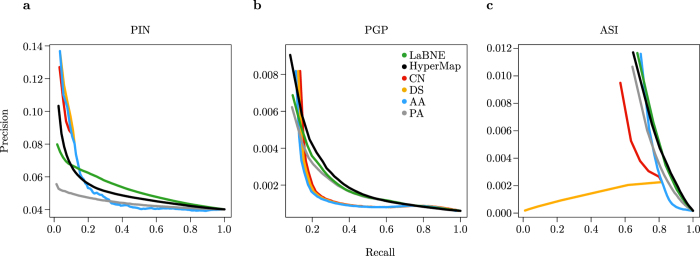
The different factors involved in the growth process of complex networks imprint valuable information in their observable topologies. How to exploit this information to accurately predict structural network changes is the subject of active research. A recent model of network growth sustains that the emergence of properties common to most complex systems is the result of certain trade-offs between node birth-time and similarity. This model has a geometric interpretation in hyperbolic space, where distances between nodes abstract this optimisation process. Current methods for network hyperbolic embedding search for node coordinates that maximise the likelihood that the network was produced by the afore-mentioned model. Here, a different strategy is followed in the form of the Laplacian-based Network Embedding, a simple yet accurate, efficient and data driven manifold learning approach, which allows for the quick geometric analysis of big networks. Comparisons against existing embedding and prediction techniques highlight its applicability to network evolution and link prediction.
复杂网络生长过程中涉及的不同因素会在其可观测的拓扑结构中留下有价值的信息。如何利用这些信息准确预测网络结构的变化是当前活跃的研究课题。最近的一个网络生长模型认为,大多数复杂系统共有的属性的出现是节点出生时间和相似性之间某些权衡的结果。该模型在双曲空间中有几何解释,其中节点之间的距离抽象了这个优化过程。当前用于网络双曲嵌入的方法是寻找节点坐标,以使网络由上述模型产生的可能性最大化。在此,我们采用了一种不同的策略,即基于拉普拉斯的网络嵌入,这是一种简单而准确、高效且数据驱动的流形学习方法,它能够对大型网络进行快速的几何分析。与现有嵌入和预测技术的比较突出了其在网络演化和链接预测方面的适用性。