Shah Preeya T, Martin Rebecca, Yan Yanling, Shapiro Joseph I, Liu Jiang
Department of Pharmacology, Physiology and Toxicology, Joan C. Edwards School of Medicine, Marshall University Huntington, WV, USA.
Front Physiol. 2016 Jun 28;7:256. doi: 10.3389/fphys.2016.00256. eCollection 2016.
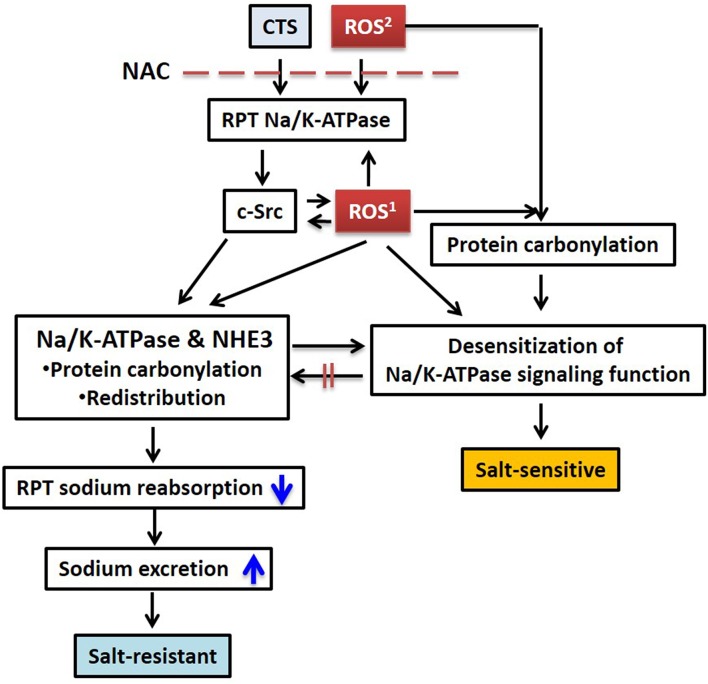
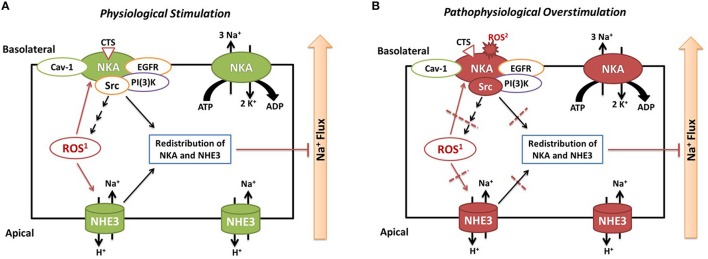
Na/K-ATPase signaling has been implicated in different physiological and pathophysiological conditions. Accumulating evidence indicates that oxidative stress not only regulates the Na/K-ATPase enzymatic activity, but also regulates its signaling and other functions. While cardiotonic steroids (CTS)-induced increase in reactive oxygen species (ROS) generation is an intermediate step in CTS-mediated Na/K-ATPase signaling, increase in ROS alone also stimulates Na/K-ATPase signaling. Based on literature and our observations, we hypothesize that ROS have biphasic effects on Na/K-ATPase signaling, transcellular sodium transport, and urinary sodium excretion. Oxidative modulation, in particular site specific carbonylation of the Na/K-ATPase α1 subunit, is a critical step in proximal tubular Na/K-ATPase signaling and decreased transcellular sodium transport leading to increases in urinary sodium excretion. However, once this system is overstimulated, the signaling, and associated changes in sodium excretion are blunted. This review aims to evaluate ROS-mediated carbonylation of the Na/K-ATPase, and its potential role in the regulation of pump signaling and sodium reabsorption in the renal proximal tubule (RPT).
钠钾ATP酶信号传导与多种生理和病理生理状况有关。越来越多的证据表明,氧化应激不仅调节钠钾ATP酶的酶活性,还调节其信号传导及其他功能。强心甾类(CTS)诱导的活性氧(ROS)生成增加是CTS介导的钠钾ATP酶信号传导的中间步骤,单独的ROS增加也会刺激钠钾ATP酶信号传导。基于文献及我们的观察,我们推测ROS对钠钾ATP酶信号传导、跨细胞钠转运及尿钠排泄具有双相效应。氧化调节,特别是钠钾ATP酶α1亚基的位点特异性羰基化,是近端小管钠钾ATP酶信号传导及跨细胞钠转运减少导致尿钠排泄增加的关键步骤。然而,一旦该系统受到过度刺激,信号传导及相关的钠排泄变化就会减弱。本综述旨在评估ROS介导的钠钾ATP酶羰基化及其在调节肾近端小管(RPT)中泵信号传导和钠重吸收方面的潜在作用。