Park Seung-Hwan, Zheng Jin Hai, Nguyen Vu Hong, Jiang Sheng-Nan, Kim Dong-Yeon, Szardenings Michael, Min Jung Hyun, Hong Yeongjin, Choy Hyon E, Min Jung-Joon
1. Department of Nuclear Medicine, Chonnam National University Medical School, Gwangju, Republic of Korea;; 6. Biological Resource Center, Korea Research Institute of Bioscience and Biotechnology (KRIBB), Jeongeup, Republic of Korea.
1. Department of Nuclear Medicine, Chonnam National University Medical School, Gwangju, Republic of Korea;
Theranostics. 2016 Jun 20;6(10):1672-82. doi: 10.7150/thno.16135. eCollection 2016.
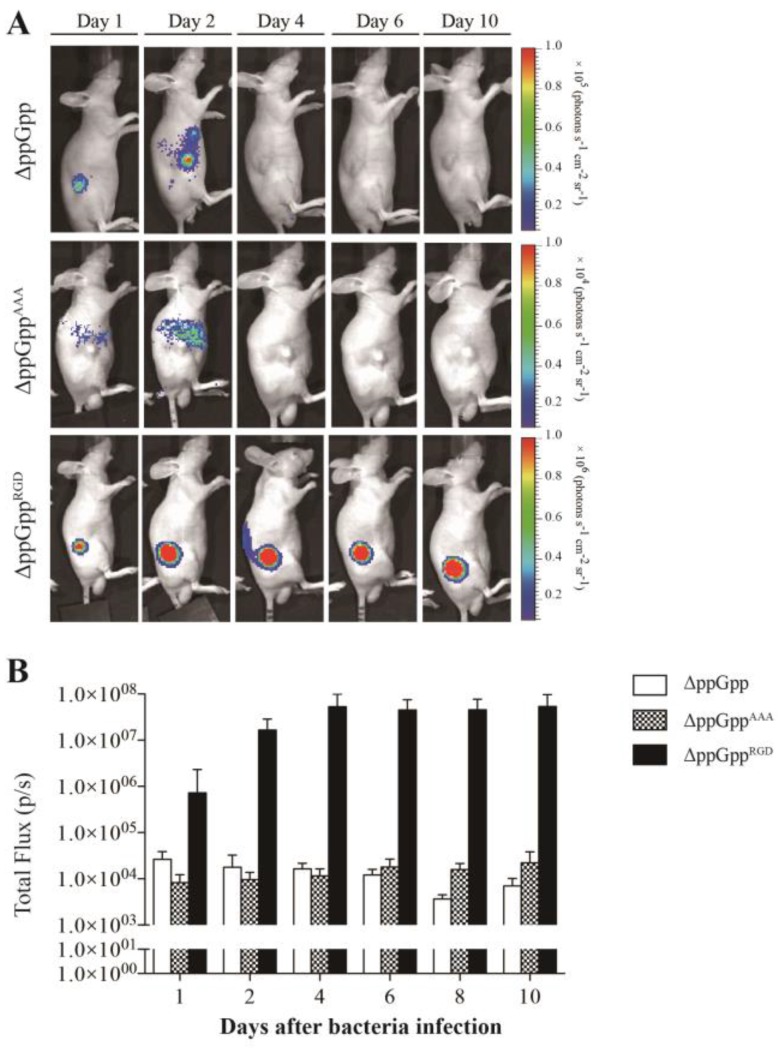
Bacteria-based anticancer therapies aim to overcome the limitations of current cancer therapy by actively targeting and efficiently removing cancer. To achieve this goal, new approaches that target and maintain bacterial drugs at sufficient concentrations during the therapeutic window are essential. Here, we examined the tumor tropism of attenuated Salmonella typhimurium displaying the RGD peptide sequence (ACDCRGDCFCG) on the external loop of outer membrane protein A (OmpA). RGD-displaying Salmonella strongly bound to cancer cells overexpressing αvβ3, but weakly bound to αvβ3-negative cancer cells, suggesting the feasibility of displaying a preferential homing peptide on the bacterial surface. In vivo studies revealed that RGD-displaying Salmonellae showed strong targeting efficiency, resulting in the regression in αvβ3-overexpressing cancer xenografts, and prolonged survival of mouse models of human breast cancer (MDA-MB-231) and human melanoma (MDA-MB-435). Thus, surface engineering of Salmonellae to display RGD peptides increases both their targeting efficiency and therapeutic effect.
基于细菌的抗癌疗法旨在通过主动靶向并有效清除癌症来克服当前癌症治疗的局限性。为实现这一目标,在治疗窗口期间靶向并维持细菌药物处于足够浓度的新方法至关重要。在此,我们研究了在外膜蛋白A(OmpA)外环展示RGD肽序列(ACDCRGDCFCG)的减毒鼠伤寒沙门氏菌的肿瘤嗜性。展示RGD的沙门氏菌与过表达αvβ3的癌细胞强烈结合,但与αvβ3阴性癌细胞结合较弱,这表明在细菌表面展示优先归巢肽的可行性。体内研究表明,展示RGD的沙门氏菌显示出强大的靶向效率,导致过表达αvβ3的癌症异种移植瘤消退,并延长了人乳腺癌(MDA-MB-231)和人黑色素瘤(MDA-MB-435)小鼠模型的生存期。因此,对沙门氏菌进行表面工程改造以展示RGD肽可提高其靶向效率和治疗效果。