Huntingford Chris, Mercado Lina M
Centre for Ecology and Hydrology, Wallingford, Oxfordshire, OX10 8BB, UK.
College of Life and Environmental Sciences, University of Exeter, Amory Building, Rennes Drive, Exeter, EX4 4RJ, UK.
Sci Rep. 2016 Jul 27;6:30294. doi: 10.1038/srep30294.
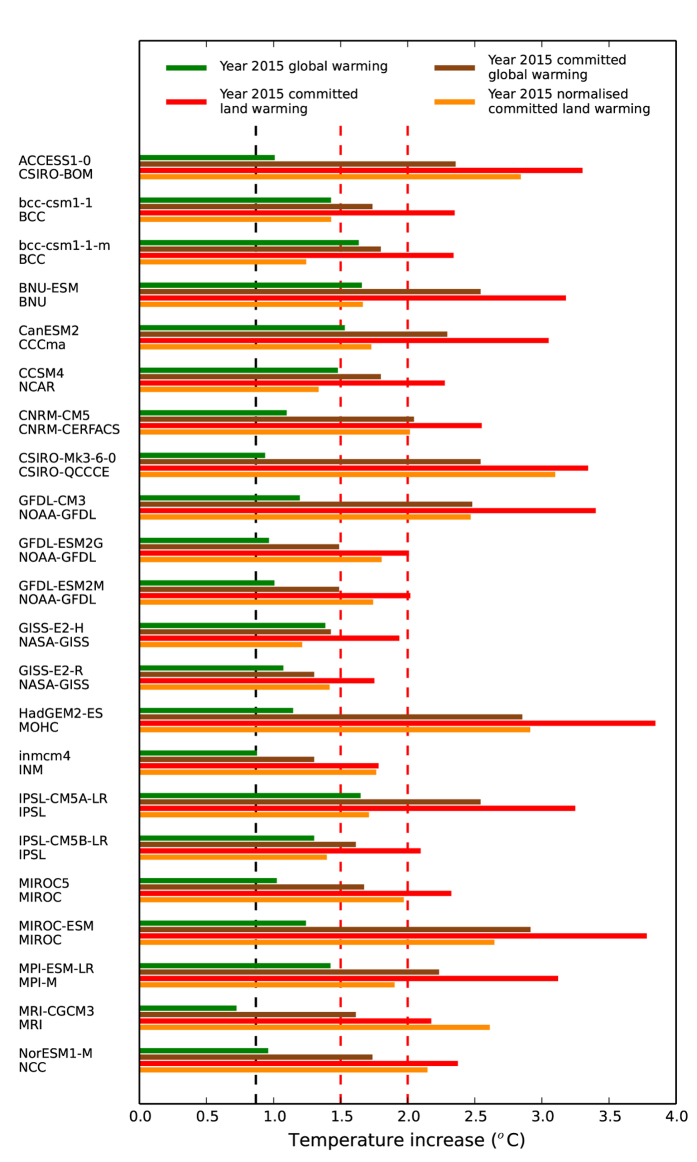
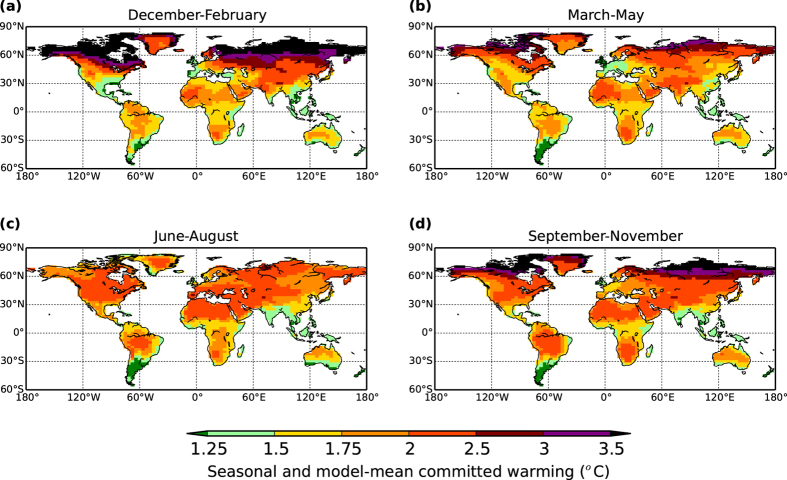
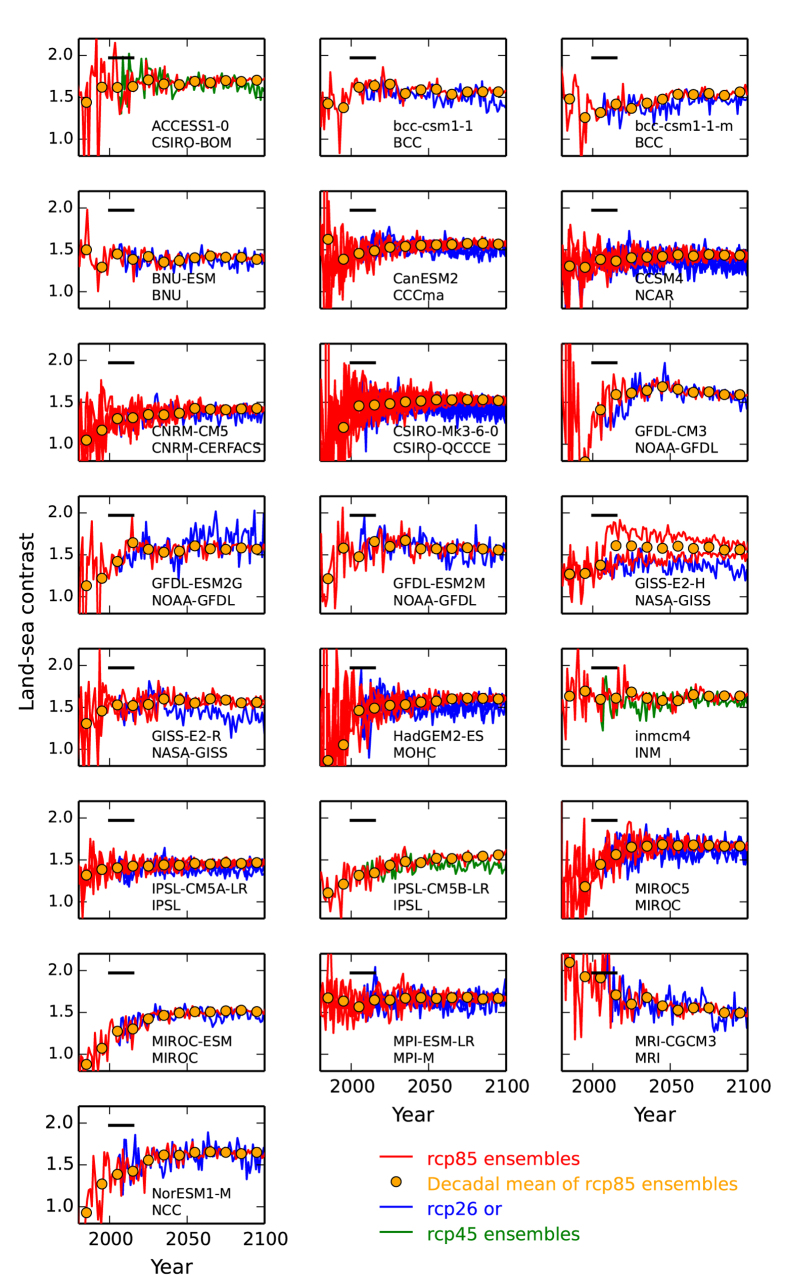
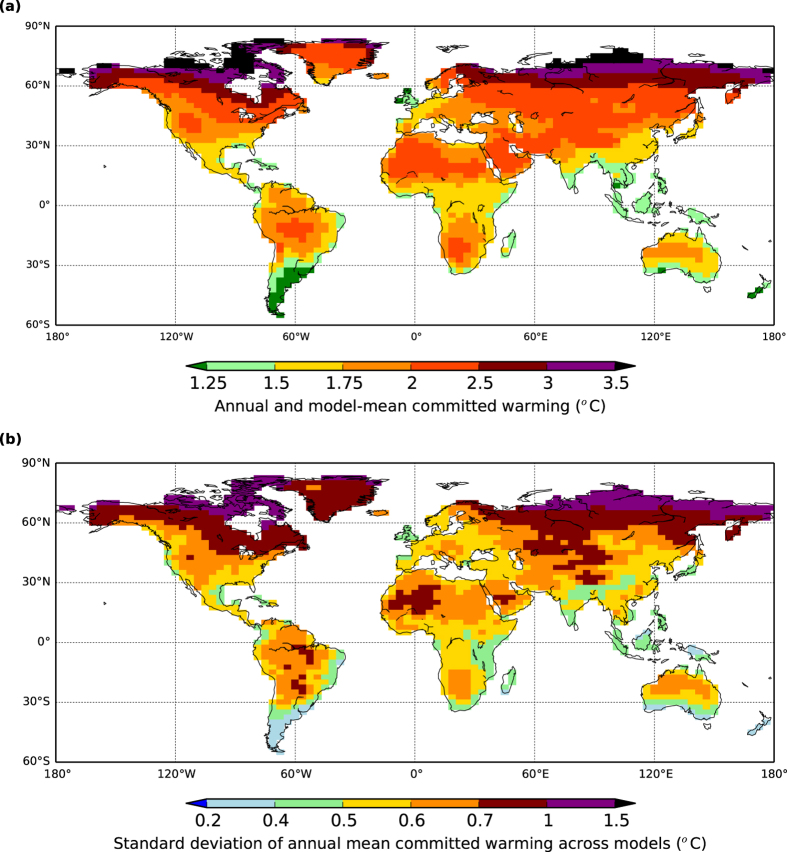
The recent Paris UNFCCC climate meeting discussed the possibility of limiting global warming to 2 °C since pre-industrial times, or possibly even 1.5 °C, which would require major future emissions reductions. However, even if climate is stabilised at current atmospheric greenhouse gas (GHG) concentrations, those warming targets would almost certainly be surpassed in the context of mean temperature increases over land only. The reason for this is two-fold. First, current transient warming lags significantly below equilibrium or "committed" warming. Second, almost all climate models indicate warming rates over land are much higher than those for the oceans. We demonstrate this potential for high eventual temperatures over land, even for contemporary GHG levels, using a large set of climate models and for which climate sensitivities are known. Such additional land warming has implications for impacts on terrestrial ecosystems and human well-being. This suggests that even if massive and near-immediate emissions reductions occur such that atmospheric GHGs increase further by only small amounts, careful planning is needed by society to prepare for higher land temperatures in an eventual equilibrium climatic state.
最近在巴黎举行的联合国气候变化框架公约气候会议讨论了将全球变暖限制在自工业化前时代起升温2摄氏度以内、甚至可能升温1.5摄氏度的可能性,这将需要在未来大幅减排。然而,即使气候在当前大气温室气体(GHG)浓度水平上实现稳定,仅就陆地平均温度上升而言,这些升温目标几乎肯定会被突破。原因有两方面。其一,当前的瞬时变暖显著滞后于平衡或“既定”变暖。其二,几乎所有气候模型都表明陆地升温速率远高于海洋。我们使用大量已知气候敏感度的气候模型,证明了即使是在当代温室气体水平下,陆地最终也有可能出现高温。这种额外的陆地升温对陆地生态系统和人类福祉的影响重大。这表明,即使立即大幅减排,使得大气温室气体仅小幅增加,社会仍需精心规划,为最终平衡气候状态下更高的陆地温度做好准备。