Rommel Anna-Sophie, Kitsune Glenn L, Michelini Giorgia, Hosang Georgina M, Asherson Philip, McLoughlin Gráinne, Brandeis Daniel, Kuntsi Jonna
King's College London, MRC Social, Genetic and Developmental Psychiatry Centre, Institute of Psychiatry, Psychology and Neuroscience, London, UK.
King's College London, Department of Psychological Medicine, Institute of Psychiatry, Psychology and Neuroscience, London, UK.
Brain Topogr. 2016 Nov;29(6):856-866. doi: 10.1007/s10548-016-0508-0. Epub 2016 Jul 27.
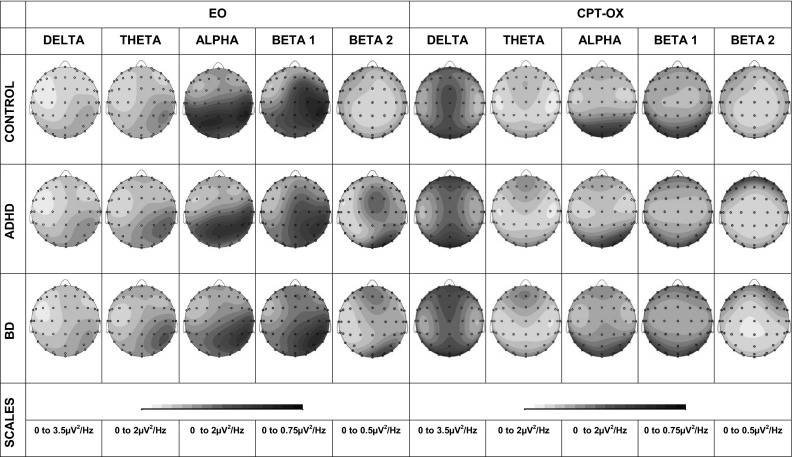
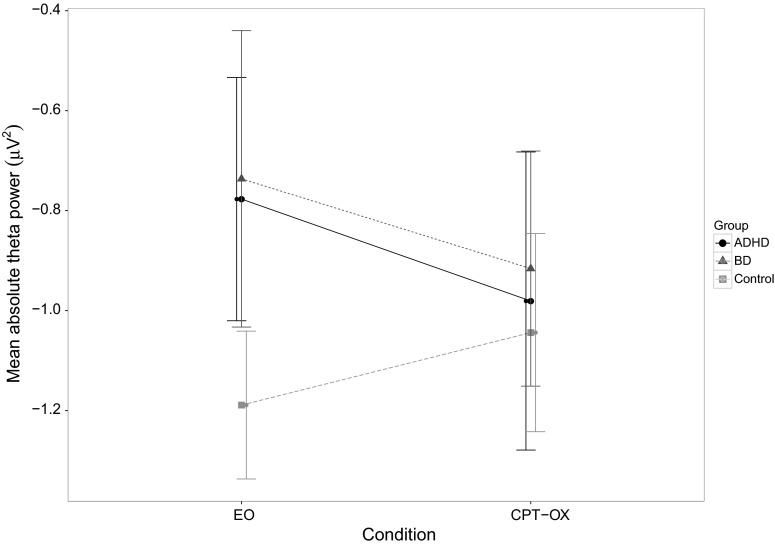
While attention-deficit/hyperactivity disorder (ADHD) and bipolar disorder (BD) denote distinct psychiatric conditions, diagnostic delineation is impeded by considerable symptomatic overlap. Direct comparisons across ADHD and BD on neurophysiological measures are limited. They could inform us on impairments that are specific to or shared between the disorders and, therefore, potential biomarkers that may aid in the identification of the diagnostic boundaries. Our aim was to test whether quantitative EEG (QEEG) identifies differences or similarities between women with ADHD and women with BD during resting-state and task conditions. QEEG activity was directly compared between 20 ADHD, 20 BD and 20 control women during an eyes-open resting-state condition (EO) and a cued continuous performance task (CPT-OX). Both ADHD (t = 2.50, p = 0.017) and BD (t = 2.54, p = 0.018) participants showed higher absolute theta power during EO than controls. No significant differences emerged between the two clinical groups. While control participants showed a task-related increase in absolute theta power from EO to CPT-OX (t = -3.77, p = 0.001), no such change in absolute theta power was observed in the ADHD (t = -0.605, p = 0.553) or BD (t = 1.82, p = 0.084) groups. Our results provide evidence for commonalities in brain dysfunction between ADHD and BD. Absolute theta power may play a role as a marker of neurobiological processes in both disorders.
注意缺陷多动障碍(ADHD)和双相情感障碍(BD)是两种不同的精神疾病,但由于症状有相当大的重叠,使得诊断区分受到阻碍。关于ADHD和BD在神经生理学指标上的直接比较有限。这些比较可以让我们了解这两种疾病特有的或共有的损伤,从而了解可能有助于确定诊断界限的潜在生物标志物。我们的目的是测试定量脑电图(QEEG)是否能识别患有ADHD的女性和患有BD的女性在静息状态和任务状态下的差异或相似之处。在睁眼静息状态(EO)和提示连续操作任务(CPT-OX)期间,对20名患有ADHD的女性、20名患有BD的女性和20名对照女性的QEEG活动进行了直接比较。ADHD组(t = 2.50,p = 0.017)和BD组(t = 2.54,p = 0.018)的参与者在EO期间的绝对θ波功率均高于对照组。两个临床组之间未出现显著差异。虽然对照组参与者从EO到CPT-OX的绝对θ波功率出现了与任务相关的增加(t = -3.77,p = 0.001),但在ADHD组(t = -0.605,p = 0.553)或BD组(t = 1.82,p = 0.084)中未观察到绝对θ波功率有此类变化。我们的结果为ADHD和BD之间脑功能障碍的共性提供了证据。绝对θ波功率可能在这两种疾病中作为神经生物学过程的标志物发挥作用。