Dinnes Jacqueline, Mallett Susan, Hopewell Sally, Roderick Paul J, Deeks Jonathan J
Biostatistics, Evidence Synthesis and Test Evaluation Research Group, Institute for Applied Health Research, University of Birmingham, Edgbaston, Birmingham B15 2TT, UK.
Centre for Statistics in Medicine, Nuffield Department of Orthopaedics, Rheumatology and Musculoskeletal Sciences, University of Oxford/Botnar Research Centre, Windmill Road, Oxford OX3 7LD, UK.
J Clin Epidemiol. 2016 Dec;80:77-87. doi: 10.1016/j.jclinepi.2016.07.011. Epub 2016 Jul 30.
To compare meta-analyses of diagnostic test accuracy using the Moses-Littenberg summary receiver operating characteristic (SROC) approach with those of the hierarchical SROC (HSROC) model.
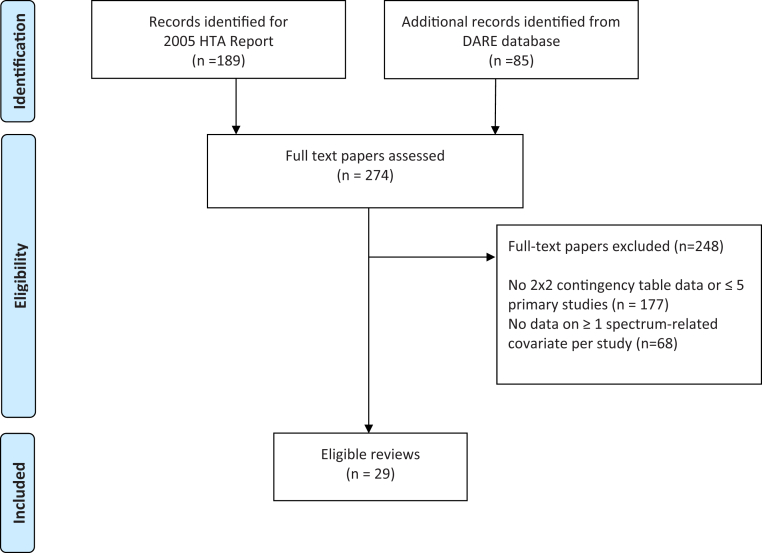
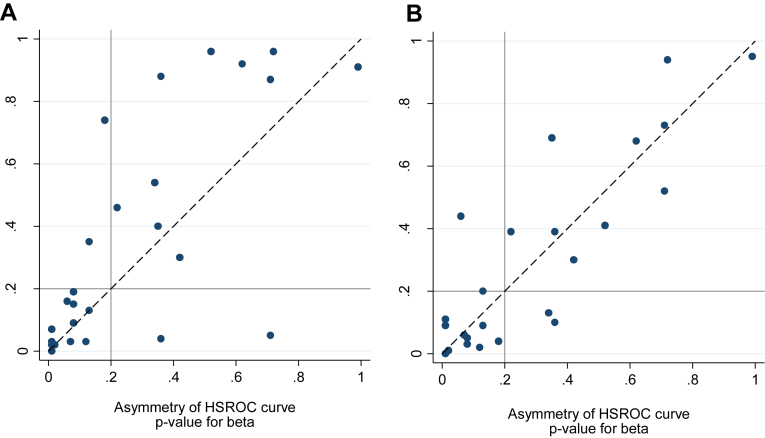
Twenty-six data sets from existing test accuracy systematic reviews were reanalyzed with the Moses-Littenberg model, using equal weighting ("E-ML") and weighting by the inverse variance of the log DOR ("W-ML"), and with the HSROC model. The diagnostic odds ratios (DORs) were estimated and covariates added to both models to estimate relative DORs (RDORs) between subgroups. Models were compared by calculating the ratio of DORs, the ratio of RDORs, and P-values for detecting asymmetry and effects of covariates on DOR.
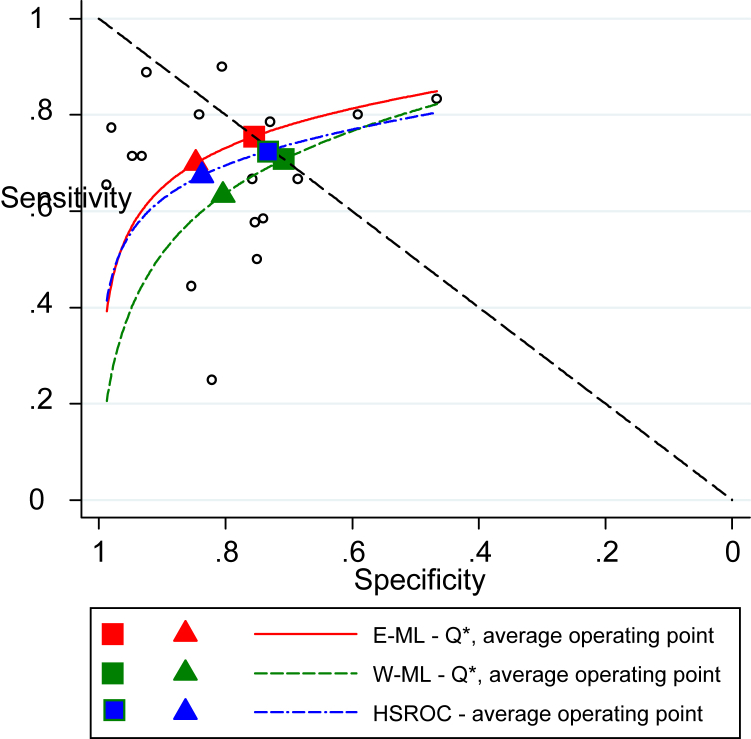
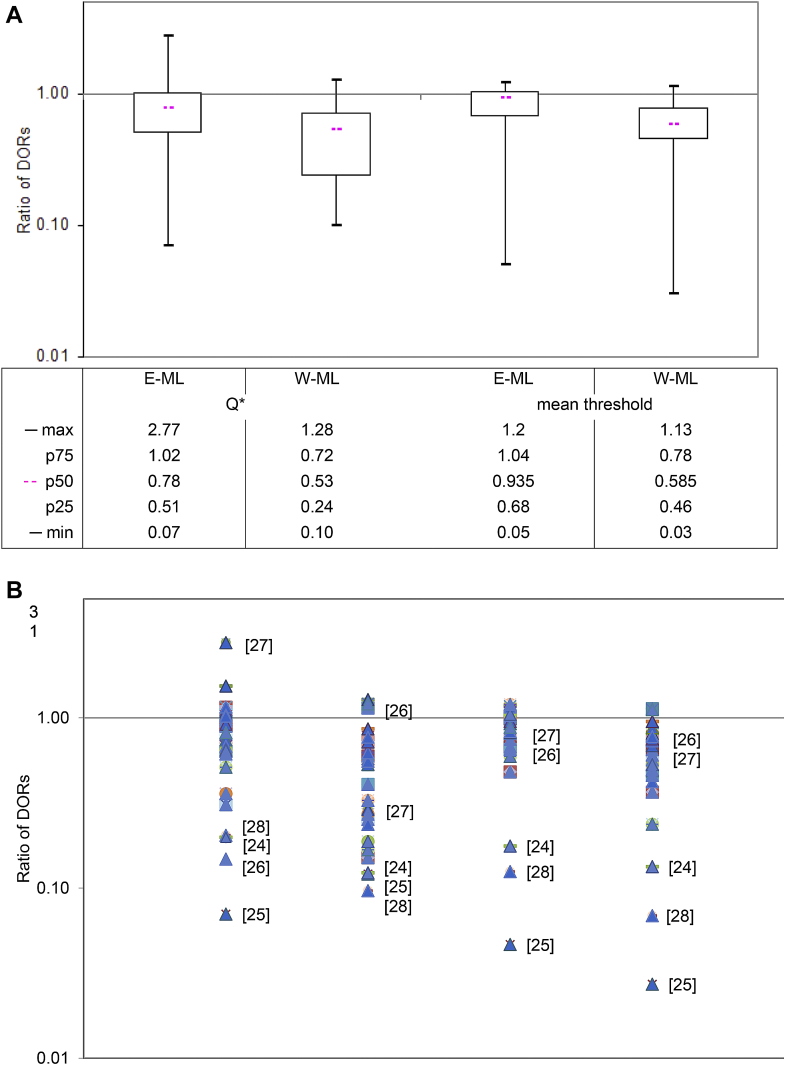
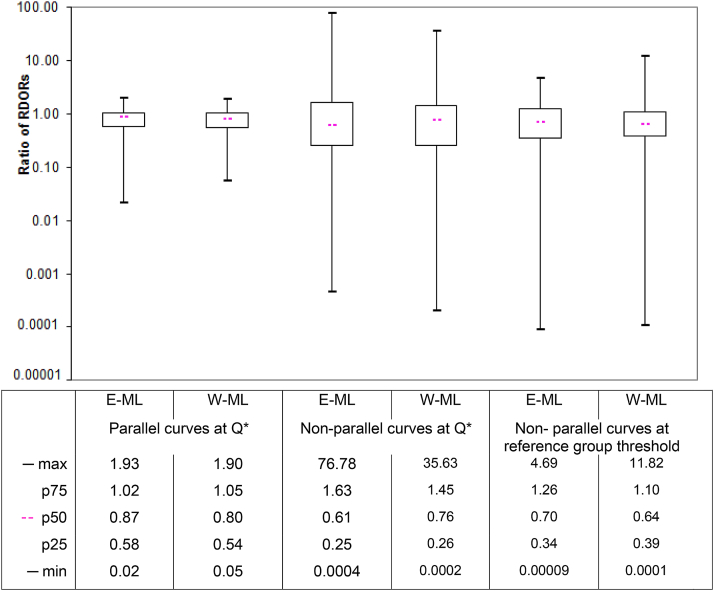
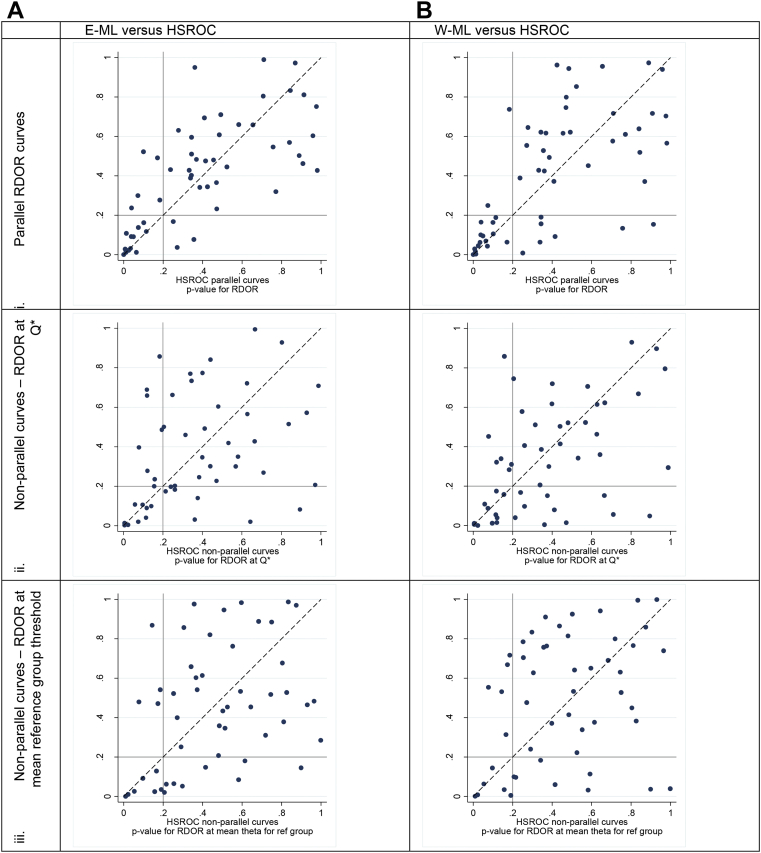
Compared to the HSROC model, the Moses-Littenberg model DOR estimates were a median of 22% ("E-ML") and 47% ("W-ML") lower at Q*, and 7% and 42% lower at the central point in the data. Instances of the ML models giving estimates higher than the HSROC model also occurred. Investigations of heterogeneity also differed; the Moses-Littenberg models on average estimating smaller differences in RDOR.
Moses-Littenberg meta-analyses can generate lower estimates of test accuracy, and smaller differences in accuracy, compared to mathematically superior hierarchical models. This has implications for the usefulness of meta-analyses using this approach. We recommend meta-analysis of diagnostic test accuracy studies to be conducted using available hierarchical model-based approaches.
比较使用摩西-利滕伯格汇总受试者工作特征(SROC)方法与分层SROC(HSROC)模型进行的诊断试验准确性的荟萃分析。
对来自现有试验准确性系统评价的26个数据集,使用摩西-利滕伯格模型进行重新分析,采用等权重法(“E-ML”)和对数诊断比值比(DOR)的逆方差加权法(“W-ML”),并使用HSROC模型。估计诊断比值比(DOR),并在两个模型中添加协变量以估计亚组之间的相对DOR(RDOR)。通过计算DOR的比值、RDOR的比值以及检测不对称性和协变量对DOR影响的P值来比较模型。
与HSROC模型相比,摩西-利滕伯格模型的DOR估计值在Q*处中位数低22%(“E-ML”)和47%(“W-ML”),在数据中心点低7%和42%。也出现了ML模型估计值高于HSROC模型的情况。对异质性的研究也有所不同;摩西-利滕伯格模型平均估计的RDOR差异较小。
与数学上更优的分层模型相比,摩西-利滕伯格荟萃分析可能得出较低的试验准确性估计值和较小的准确性差异。这对使用该方法的荟萃分析的有用性有影响。我们建议使用基于现有分层模型的方法对诊断试验准确性研究进行荟萃分析。