Bhagwat Nikhil, Pipitone Jon, Winterburn Julie L, Guo Ting, Duerden Emma G, Voineskos Aristotle N, Lepage Martin, Miller Steven P, Pruessner Jens C, Chakravarty M Mallar
Institute of Biomaterials and Biomedical Engineering, University of TorontoToronto, ON, Canada; Cerebral Imaging Centre, Douglas Mental Health University InstituteVerdun, QC, Canada; Kimel Family Translational Imaging-Genetics Research Lab, Research Imaging Centre, Campbell Family Mental Health Research Institute, Centre for Addiction and Mental HealthToronto, ON, Canada.
Kimel Family Translational Imaging-Genetics Research Lab, Research Imaging Centre, Campbell Family Mental Health Research Institute, Centre for Addiction and Mental Health Toronto, ON, Canada.
Front Neurosci. 2016 Jul 19;10:325. doi: 10.3389/fnins.2016.00325. eCollection 2016.
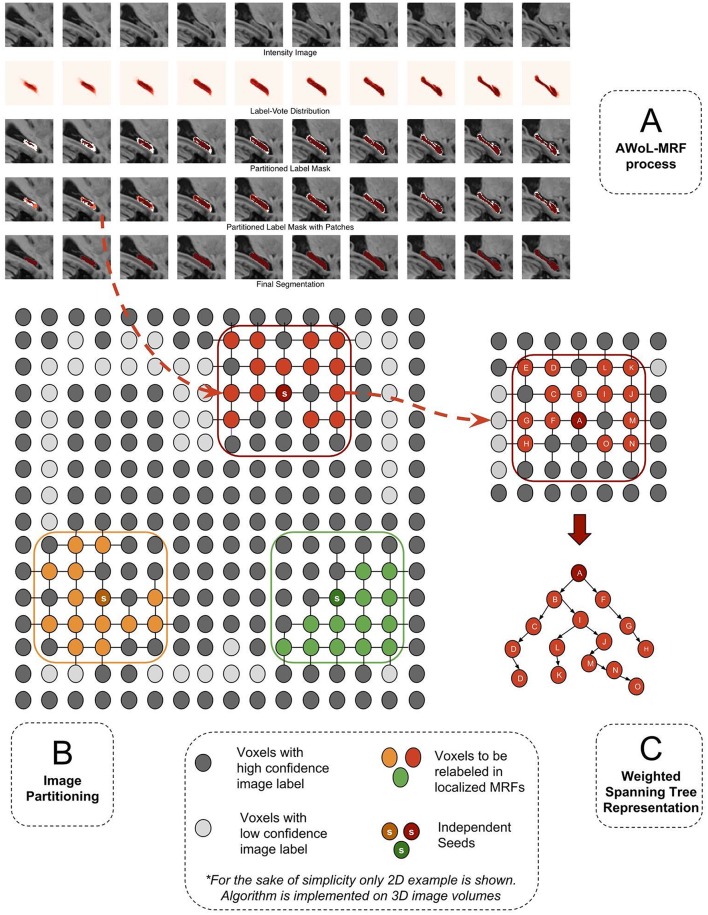
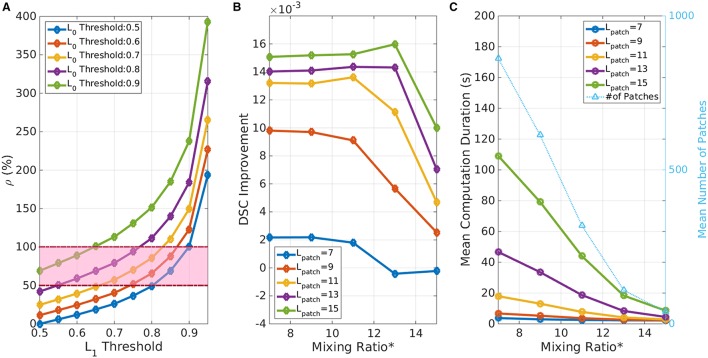
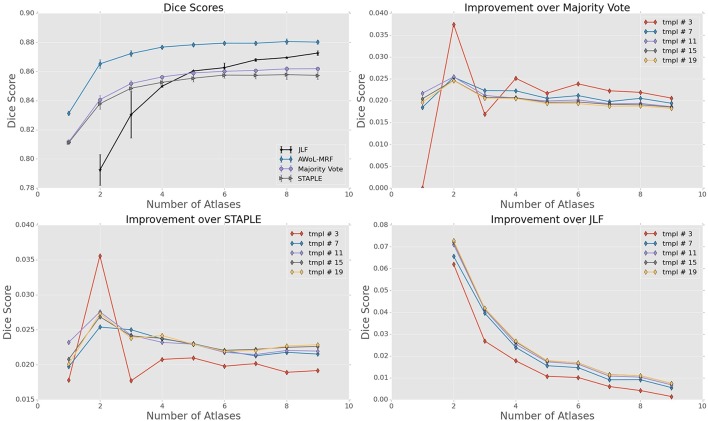
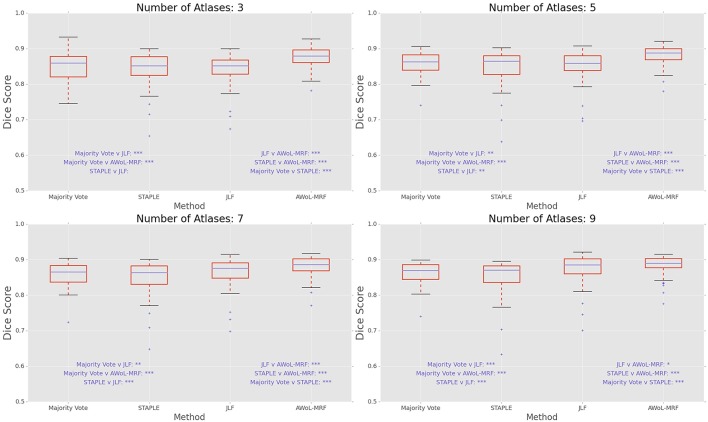
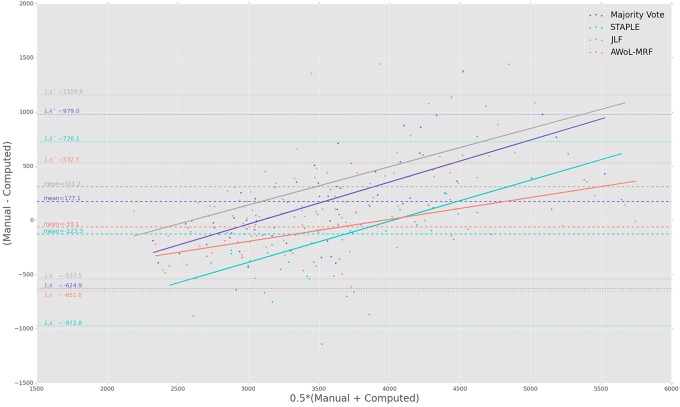
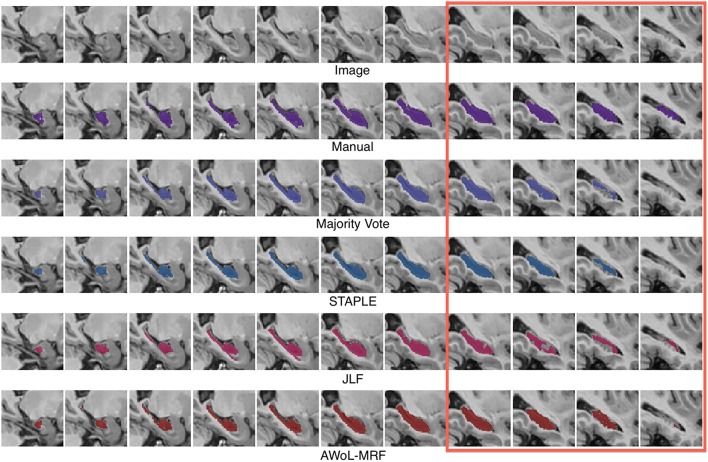
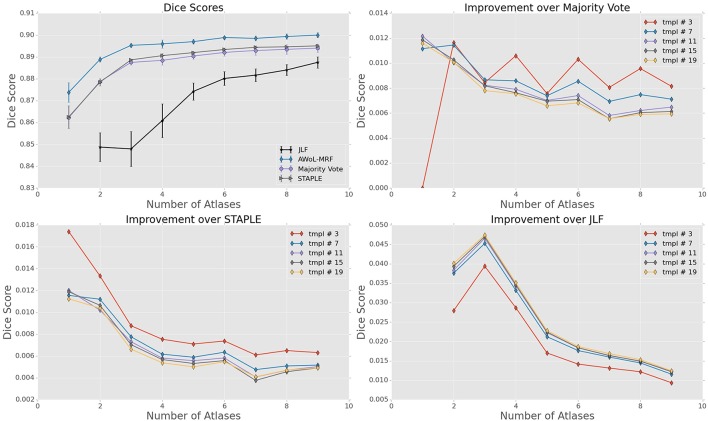
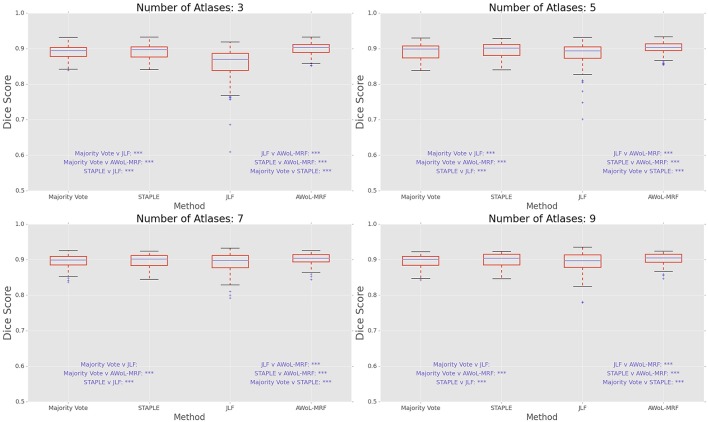
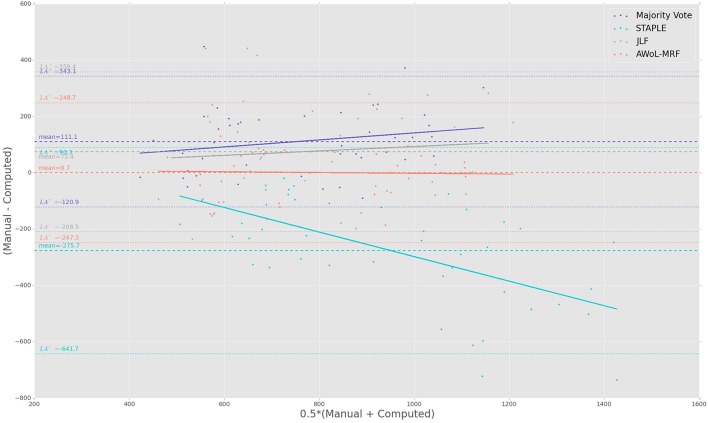
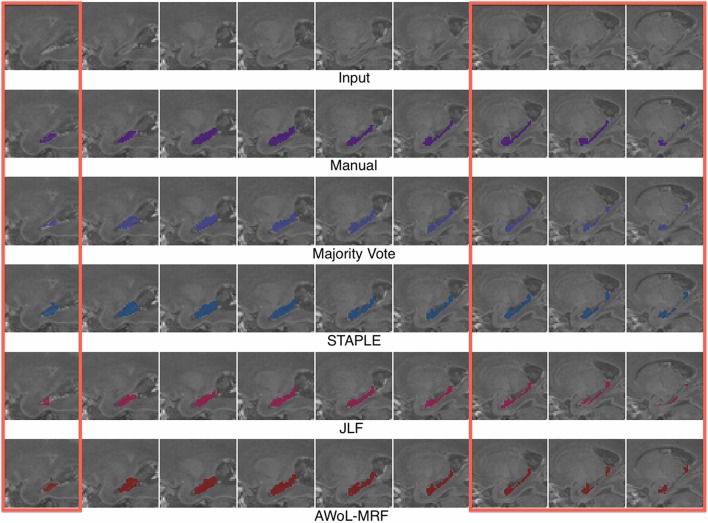
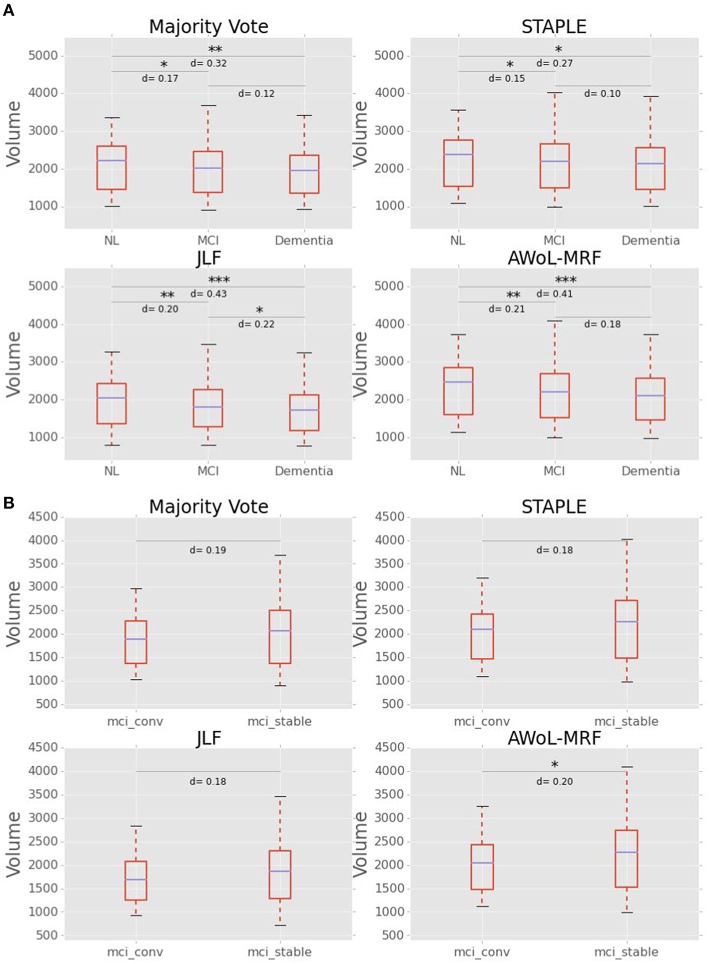
Recent advances in multi-atlas based algorithms address many of the previous limitations in model-based and probabilistic segmentation methods. However, at the label fusion stage, a majority of algorithms focus primarily on optimizing weight-maps associated with the atlas library based on a theoretical objective function that approximates the segmentation error. In contrast, we propose a novel method-Autocorrecting Walks over Localized Markov Random Fields (AWoL-MRF)-that aims at mimicking the sequential process of manual segmentation, which is the gold-standard for virtually all the segmentation methods. AWoL-MRF begins with a set of candidate labels generated by a multi-atlas segmentation pipeline as an initial label distribution and refines low confidence regions based on a localized Markov random field (L-MRF) model using a novel sequential inference process (walks). We show that AWoL-MRF produces state-of-the-art results with superior accuracy and robustness with a small atlas library compared to existing methods. We validate the proposed approach by performing hippocampal segmentations on three independent datasets: (1) Alzheimer's Disease Neuroimaging Database (ADNI); (2) First Episode Psychosis patient cohort; and (3) A cohort of preterm neonates scanned early in life and at term-equivalent age. We assess the improvement in the performance qualitatively as well as quantitatively by comparing AWoL-MRF with majority vote, STAPLE, and Joint Label Fusion methods. AWoL-MRF reaches a maximum accuracy of 0.881 (dataset 1), 0.897 (dataset 2), and 0.807 (dataset 3) based on Dice similarity coefficient metric, offering significant performance improvements with a smaller atlas library (< 10) over compared methods. We also evaluate the diagnostic utility of AWoL-MRF by analyzing the volume differences per disease category in the ADNI1: Complete Screening dataset. We have made the source code for AWoL-MRF public at: https://github.com/CobraLab/AWoL-MRF.
基于多图谱的算法的最新进展解决了先前基于模型和概率分割方法中的许多局限性。然而,在标签融合阶段,大多数算法主要专注于基于近似分割误差的理论目标函数来优化与图谱库相关的权重图。相比之下,我们提出了一种新颖的方法——局部马尔可夫随机场的自动校正游走(AWoL-MRF),其旨在模仿手动分割的顺序过程,而手动分割实际上是所有分割方法的金标准。AWoL-MRF 以多图谱分割管道生成的一组候选标签作为初始标签分布开始,并使用新颖的顺序推理过程(游走)基于局部马尔可夫随机场(L-MRF)模型细化低置信度区域。我们表明,与现有方法相比,AWoL-MRF 使用小型图谱库就能产生具有卓越准确性和鲁棒性的最先进结果。我们通过在三个独立数据集上进行海马体分割来验证所提出的方法:(1)阿尔茨海默病神经影像数据库(ADNI);(2)首发精神病患者队列;以及(3)一组在生命早期和足月等效年龄时进行扫描的早产儿队列。我们通过将 AWoL-MRF 与多数投票、STAPLE 和联合标签融合方法进行比较,从定性和定量两方面评估性能的提升。基于骰子相似系数度量,AWoL-MRF 在数据集 1 中达到最大准确率 0.881,在数据集 2 中为 0.897,在数据集 3 中为 0.807,与比较方法相比,使用较小的图谱库(<10)就能显著提高性能。我们还通过分析 ADNI1:完整筛查数据集中每个疾病类别的体积差异来评估 AWoL-MRF 的诊断效用。我们已将 AWoL-MRF 的源代码公开在:https://github.com/CobraLab/AWoL-MRF。