Ladage Mary L, King Skylar D, Burks David J, Quan Daniel L, Garcia Anastacia M, Azad Rajeev K, Padilla Pamela A
Department of Biological Sciences, University of North Texas, Denton, Texas 76203.
Department of Biological Sciences, University of North Texas, Denton, Texas 76203 Department of Mathematics, University of North Texas, Denton, Texas 76203.
G3 (Bethesda). 2016 Oct 13;6(10):3149-3160. doi: 10.1534/g3.116.031583.
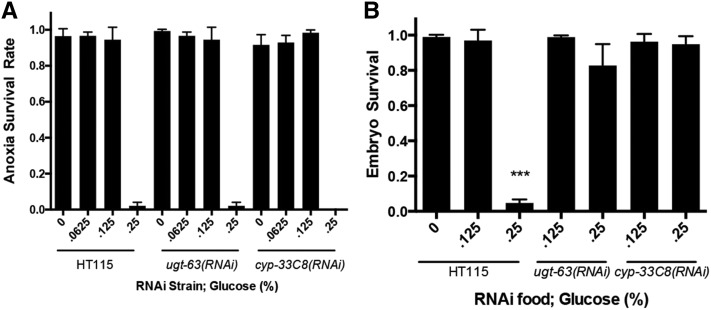
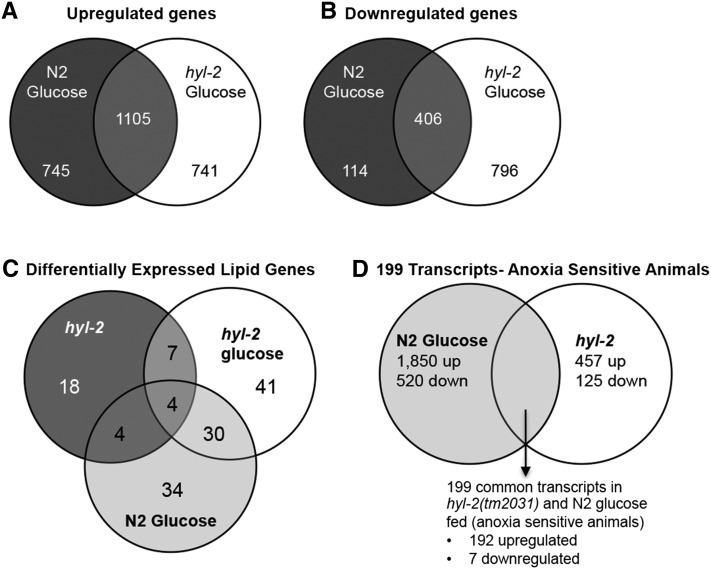
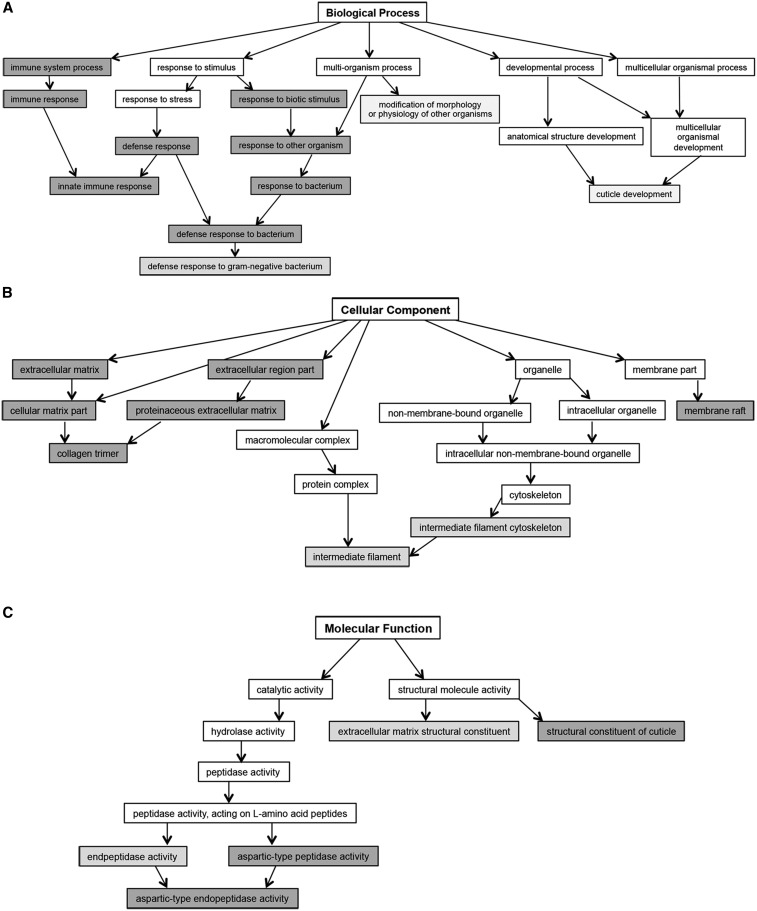
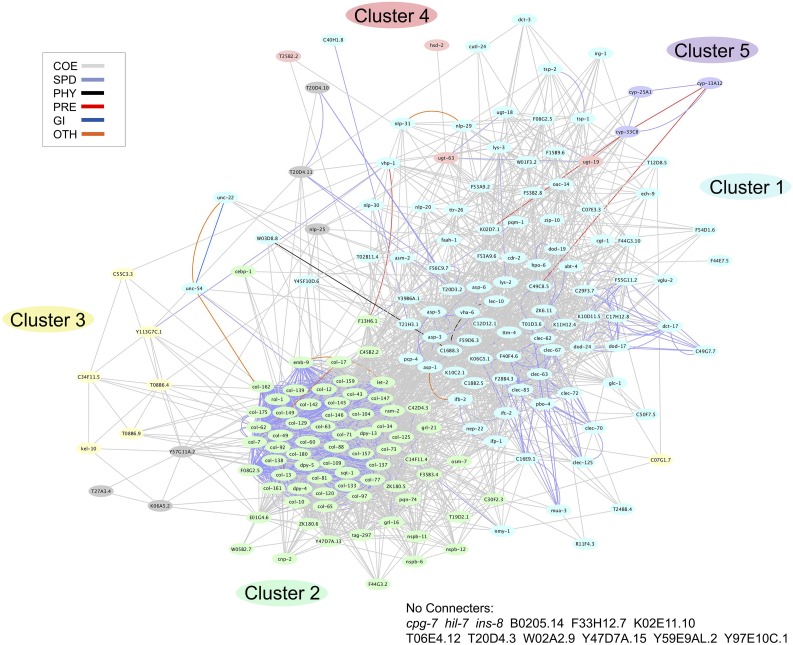
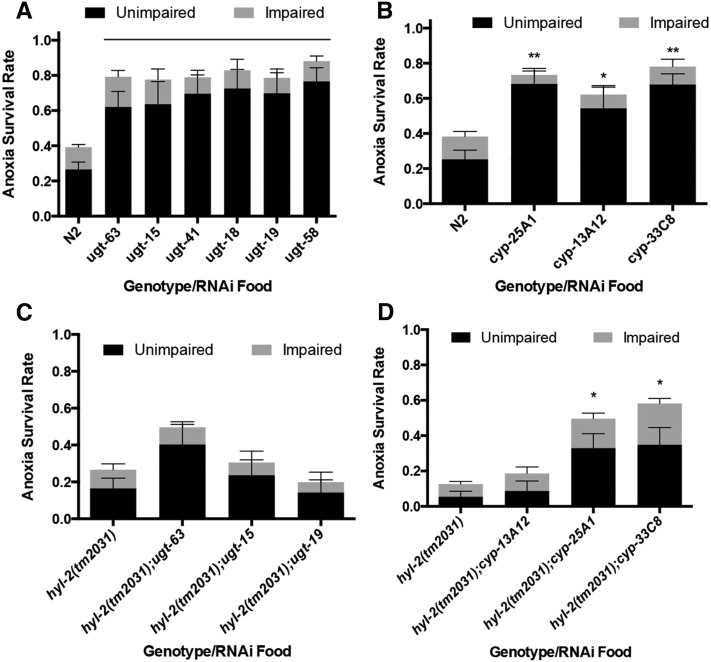
Individuals with type 2 diabetes display metabolic abnormalities, such as hyperglycemia, increased free fatty acids, insulin resistance, and altered ceramide levels, that contribute to vascular dysfunctions and compromised oxygen delivery. Caenorhabditis elegans fed a glucose-supplemented diet or with altered ceramide metabolism, due to a hyl-2 mutation, are sensitive to oxygen deprivation (anoxia). Our experiments showed that the combination of these factors further decreased the anoxia survival. RNA-sequencing analysis was performed to assess how a glucose-supplemented diet and/or a hyl-2 mutation altered the transcriptome. Comparison analysis of transcripts associated with anoxia-sensitive animals [hyl-2(tm2031) mutation or a glucose diet] revealed 199 common transcripts encoded by genes with known or predicted functions involving innate immunity, cuticle function (collagens), or xenobiotic and endobiotic phase I and II detoxification system. Use of RNA interference (RNAi) to target gene products of the xenobiotic and endobiotic phase I and II detoxification system (UDP-glycosyltransferase and Cytochrome p450 genes; ugt-15, ugt-18, ugt-19, ugt-41, ugt-63, cyp-13A12, cyp-25A1, and cyp-33C8) increased anoxia survival in wild-type animals fed a standard diet. Anoxia sensitivity of the hyl-2(tm2031) animals was suppressed by RNAi of cyp-25A1 or cyp-33C8 genes. A glucose diet fed to the P0 hermaphrodite decreased the anoxia survival of its F1 embryos; however, the RNAi of ugt-63 and cyp-33C8 suppressed anoxia sensitivity. These studies provide evidence that the detoxification system impacts oxygen deprivation responses and that C. elegans can be used to model the conserved detoxification system.
2型糖尿病患者表现出代谢异常,如高血糖、游离脂肪酸增加、胰岛素抵抗和神经酰胺水平改变,这些都会导致血管功能障碍和氧输送受损。喂食补充葡萄糖饮食或由于hyl-2突变导致神经酰胺代谢改变的秀丽隐杆线虫对缺氧(无氧)敏感。我们的实验表明,这些因素的组合进一步降低了缺氧存活率。进行RNA测序分析以评估补充葡萄糖饮食和/或hyl-2突变如何改变转录组。对与缺氧敏感动物相关的转录本进行比较分析[hyl-2(tm2031)突变或葡萄糖饮食],发现了199个由具有已知或预测功能的基因编码的共同转录本,这些功能涉及先天免疫、表皮功能(胶原蛋白)或外源性和内源性物质的I相和II相解毒系统。使用RNA干扰(RNAi)靶向外源性和内源性物质的I相和II相解毒系统的基因产物(UDP-糖基转移酶和细胞色素P450基因;ugt-15、ugt-18、ugt-19、ugt-41、ugt-63、cyp-13A12、cyp-25A1和cyp-33C8)可提高喂食标准饮食的野生型动物的缺氧存活率。cyp-25A1或cyp-33C8基因的RNAi可抑制hyl-2(tm2031)动物的缺氧敏感性。喂食P0雌雄同体的葡萄糖饮食会降低其F1胚胎的缺氧存活率;然而,ugt-63和cyp-33C8的RNAi可抑制缺氧敏感性。这些研究提供了证据,表明解毒系统会影响缺氧反应,并且秀丽隐杆线虫可用于模拟保守的解毒系统。