Stewart Neil, Hermens Frouke, Matthews William J
University of Warwick UK.
University of Aberdeen UK.
J Behav Decis Mak. 2016 Apr-Jul;29(2-3):116-136. doi: 10.1002/bdm.1854. Epub 2015 Jan 26.
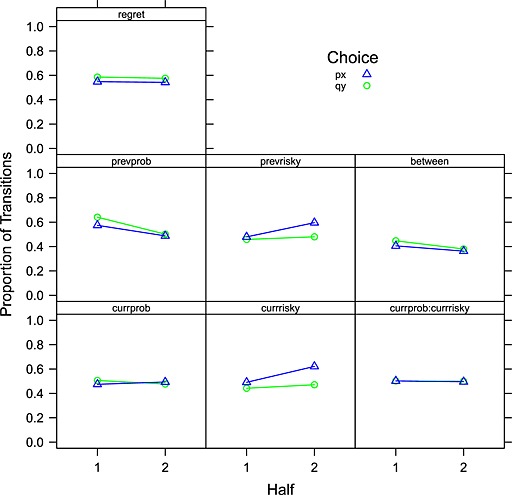
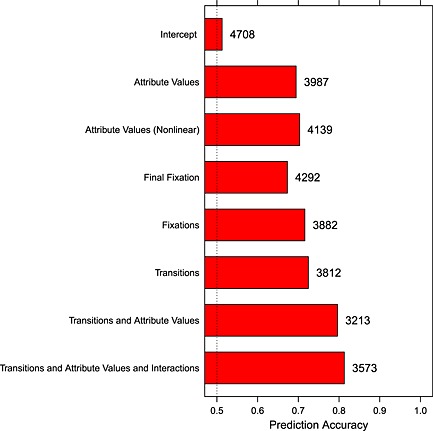
We asked participants to make simple risky choices while we recorded their eye movements. We built a complete statistical model of the eye movements and found very little systematic variation in eye movements over the time course of a choice or across the different choices. The only exceptions were finding more (of the same) eye movements when choice options were similar, and an emerging gaze bias in which people looked more at the gamble they ultimately chose. These findings are inconsistent with prospect theory, the priority heuristic, or decision field theory. However, the eye movements made during a choice have a large relationship with the final choice, and this is mostly independent from the contribution of the actual attribute values in the choice options. That is, eye movements tell us not just about the processing of attribute values but also are independently associated with choice. The pattern is simple-people choose the gamble they look at more often, independently of the actual numbers they see-and this pattern is simpler than predicted by decision field theory, decision by sampling, and the parallel constraint satisfaction model. © 2015 The Authors. published by John Wiley & Sons Ltd.
我们要求参与者在我们记录他们的眼动时做出简单的风险选择。我们构建了一个完整的眼动统计模型,发现在做出选择的时间过程中或在不同选择之间,眼动几乎没有系统变化。唯一的例外是,当选择选项相似时,会出现更多(相同的)眼动,以及一种新出现的注视偏差,即人们会更多地看向他们最终选择的赌博选项。这些发现与前景理论、优先启发式或决策场理论不一致。然而,在做出选择过程中的眼动与最终选择有很大关系,并且这在很大程度上独立于选择选项中实际属性值的贡献。也就是说,眼动不仅告诉我们关于属性值的处理,而且还与选择独立相关。模式很简单——人们更频繁地看向哪个赌博选项就选择哪个,而与他们看到的实际数字无关——并且这种模式比决策场理论、抽样决策和平行约束满足模型所预测的更为简单。© 2015作者。由约翰·威利父子有限公司出版。