Center for Adaptive Rationality, Max Planck Institute for Human Development Berlin, Germany.
Front Psychol. 2013 Sep 27;4:646. doi: 10.3389/fpsyg.2013.00646. eCollection 2013.
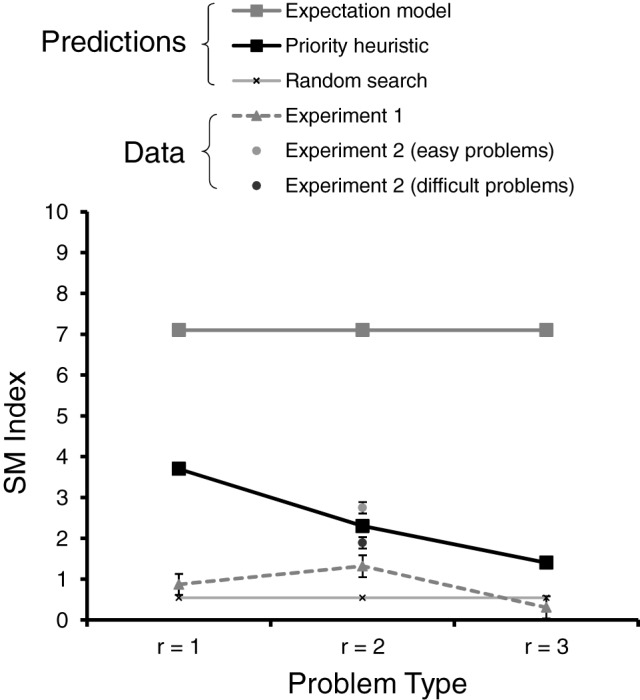
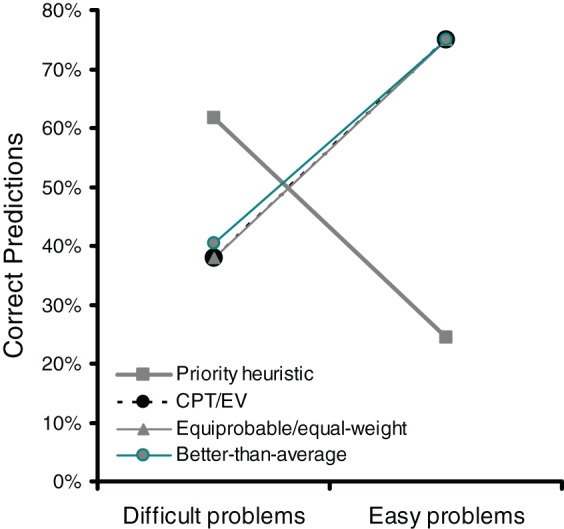
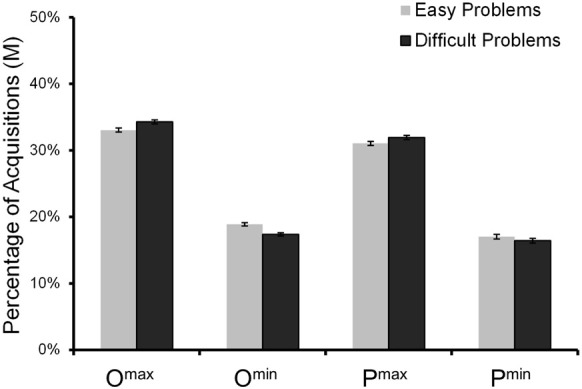
This article presents a quantitative model comparison contrasting the process predictions of two prominent views on risky choice. One view assumes a trade-off between probabilities and outcomes (or non-linear functions thereof) and the separate evaluation of risky options (expectation models). Another view assumes that risky choice is based on comparative evaluation, limited search, aspiration levels, and the forgoing of trade-offs (heuristic models). We derived quantitative process predictions for a generic expectation model and for a specific heuristic model, namely the priority heuristic (Brandstätter et al., 2006), and tested them in two experiments. The focus was on two key features of the cognitive process: acquisition frequencies (i.e., how frequently individual reasons are looked up) and direction of search (i.e., gamble-wise vs. reason-wise). In Experiment 1, the priority heuristic predicted direction of search better than the expectation model (although neither model predicted the acquisition process perfectly); acquisition frequencies, however, were inconsistent with both models. Additional analyses revealed that these frequencies were primarily a function of what Rubinstein (1988) called "similarity." In Experiment 2, the quantitative model comparison approach showed that people seemed to rely more on the priority heuristic in difficult problems, but to make more trade-offs in easy problems. This finding suggests that risky choice may be based on a mental toolbox of strategies.
本文提出了一个定量模型比较,对比了两种有影响力的风险选择观点的过程预测。一种观点假设概率和结果(或其非线性函数)之间存在权衡,以及对风险选项的单独评估(期望模型)。另一种观点假设风险选择基于比较评估、有限搜索、愿望水平和放弃权衡(启发式模型)。我们为一个通用的期望模型和一个特定的启发式模型(即优先启发式,Brandstätter 等人,2006)推导出了定量的过程预测,并在两个实验中进行了测试。重点是认知过程的两个关键特征:获取频率(即个体原因被查找的频率)和搜索方向(即明智地赌博与明智地寻找原因)。在实验 1 中,优先启发式比期望模型更好地预测了搜索方向(尽管两个模型都不能完美地预测获取过程);然而,获取频率与两个模型都不一致。进一步的分析表明,这些频率主要是鲁宾斯坦(Rubinstein,1988)所谓的“相似性”的函数。在实验 2 中,定量模型比较方法表明,人们在困难问题中似乎更多地依赖优先启发式,但在简单问题中进行更多的权衡。这一发现表明,风险选择可能基于一种策略的心智工具箱。