Zhang Shanshan, Burda Joshua E, Anderson Mark A, Zhao Ziru, Ao Yan, Cheng Yin, Sun Yi, Deming Timothy J, Sofroniew Michael V
Department of Chemistry and Biochemistry, University of California Los Angeles, Los Angeles CA 90095-1569, USA.
Department of Neurobiology, David Geffen School of Medicine, University of California Los Angeles, Los Angeles CA 90095-1763, USA.
ACS Biomater Sci Eng. 2015 Aug 10;1(8):705-717. doi: 10.1021/acsbiomaterials.5b00153. Epub 2015 Jun 22.
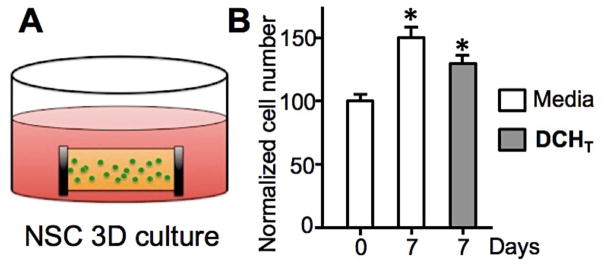
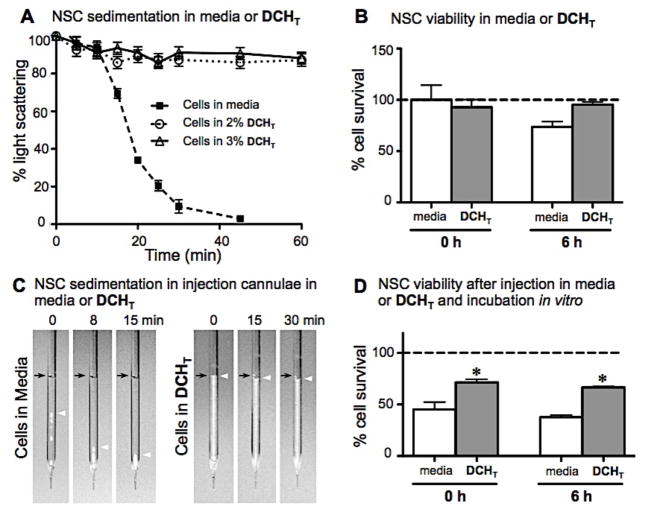
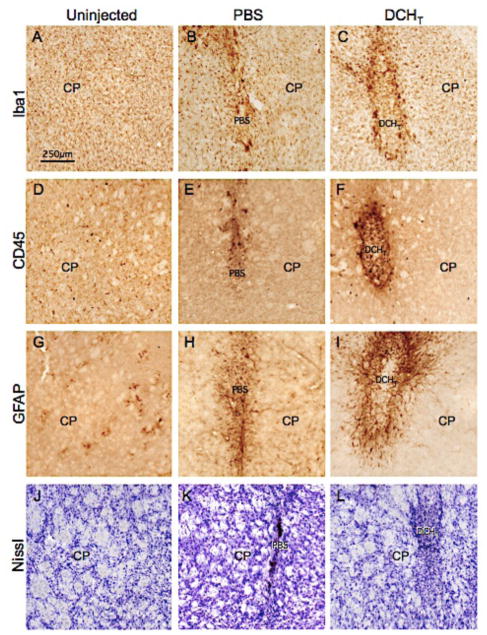
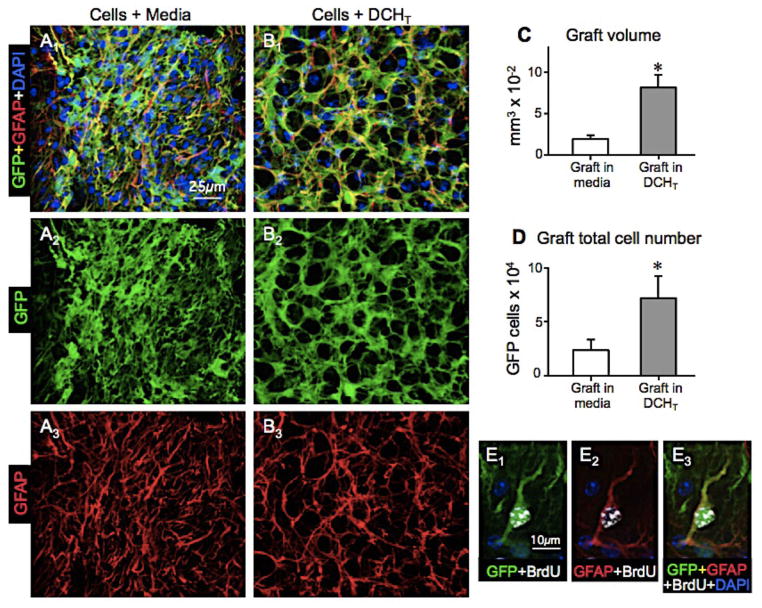
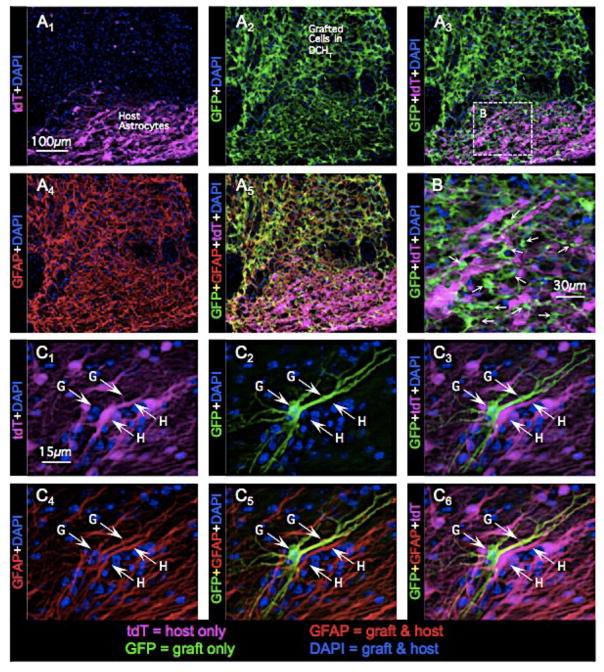
Biomaterial vehicles have the potential to facilitate cell transplantation in the central nervous system (CNS). We have previously shown that highly tunable ionic diblock copolypeptide hydrogels (DCH) can provide sustained release of hydrophilic and hydrophobic molecules in the CNS. Here, we show that recently developed non-ionic and thermoresponsive DCH called DCH exhibit excellent cytocompatibility. Neural stem cell (NSC) suspensions in DCH were easily injected as liquids at room temperature. DCH with a viscosity tuned to prevent cell sedimentation and clumping significantly increased the survival of NSC passed through injection cannulae. At body temperature, DCH self-assembled into hydrogels with a stiffness tuned to that of CNS tissue. After injection , DCH significantly increased by three-fold the survival of NSC grafted into healthy CNS. In injured CNS, NSC injected as suspensions in DCH distributed well in non-neural lesion cores, integrated with healthy neural cells at lesion perimeters and supported regrowing host nerve fibers. Our findings show that non-ionic DCH have numerous advantageous properties that make them useful tools for delivery of cells and molecules in the CNS for experimental investigations and potential therapeutic strategies.
生物材料载体有促进细胞移植至中枢神经系统(CNS)的潜力。我们之前已表明,高度可调谐的离子型双嵌段共多肽水凝胶(DCH)能够在中枢神经系统中实现亲水性和疏水性分子的持续释放。在此,我们表明,最近开发的名为DCH的非离子型热敏性DCH具有出色的细胞相容性。DCH中的神经干细胞(NSC)悬浮液在室温下很容易作为液体注射。通过调整粘度以防止细胞沉降和聚集的DCH显著提高了通过注射套管的NSC的存活率。在体温下,DCH自组装成具有与中枢神经系统组织相匹配硬度的水凝胶。注射后,DCH使移植到健康中枢神经系统中的NSC存活率显著提高了三倍。在受损的中枢神经系统中,以DCH悬浮液形式注射的NSC在非神经病变核心中分布良好,在病变周边与健康神经细胞整合,并支持宿主神经纤维再生。我们的研究结果表明,非离子型DCH具有众多有利特性,使其成为在中枢神经系统中用于细胞和分子递送以进行实验研究和潜在治疗策略的有用工具。