Lee Wei-Ju, Chen Liang-Kung, Peng Li-Ning, Chiou Shu-Ti, Chou Pesus
Aging and Health Research Center Institute of Public Health, National Yang Ming University Department of Family Medicine, Taipei Veterans General Hospital Yuanshan Branch Center for Geriatrics and Gerontology, Taipei Veterans General Hospital Health Promotion Administration, Ministry of Health and Welfare, Taipei, Taiwan.
Medicine (Baltimore). 2016 Aug;95(34):e4661. doi: 10.1097/MD.0000000000004661.
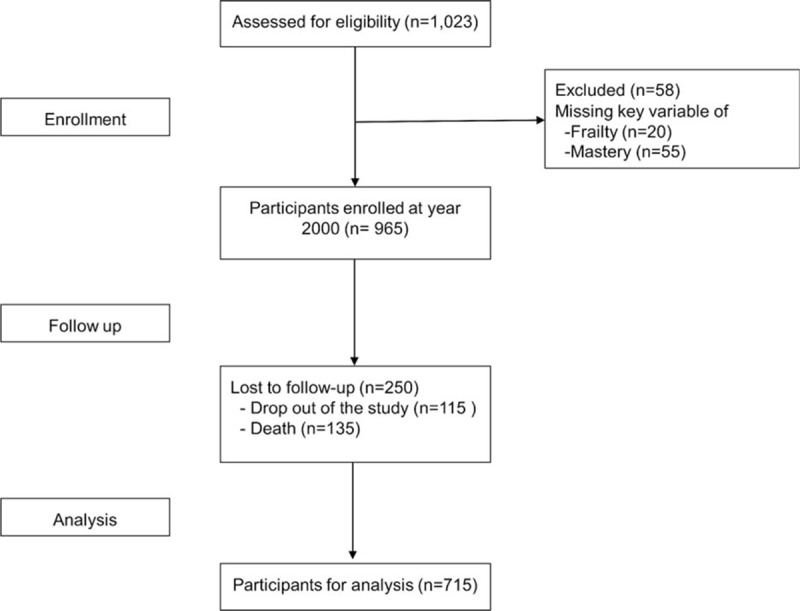
Personal mastery is an important determinant in shaping physical health across middle and late life. The modified effect of mastery on relation between frailty and adverse health outcome remains unclear. The main purpose of this study was to evaluate the prognostic role of mastery on frailty among older people by using a nationwide representative population-based cohort. In total, 715 community-dwelling participants aged 54 years and over recruited in 2000 and received second visit 6 years later. Personal mastery was represented by the Pearlin mastery score, and frailty was defined by modified Fried criteria. Multivariate generalized linear mixed analysis was used to examine the association interaction between frailty and Pearlin mastery scores for activities of daily living decline. Overall, prevalence of frailty and prefrail were 9.7% and 48.8%. In a 6-year period, 94 participants (13.1%) experienced functional decline. Compared with function nondecliners, function decliners had greater proportion of frailty (26.6% vs 7.1%; P < 0.001) and lesser mastery score (17.2 vs 18.7; P < 0.001). After adjusting with basic demography, healthy behavior, cognitive function, and multimorbidity, frailty status and mastery were significantly interacted (coefficient estimate: -0.80, standard error: 0.23, P = 0.001). The negative coefficient estimate indicated that self-control, that is, self-mastery, may attenuate the adverse effects of frailty on functional outcomes. Similar results were shown when subjects with baseline functional deficits were excluded for analysis. In conclusion, high self-mastery attenuates adverse effects of frailty on functional decline.
自我掌控能力是影响中老年身体健康的重要因素。然而,自我掌控能力对虚弱与不良健康结局之间关系的调节作用尚不清楚。本研究的主要目的是通过一项全国代表性的基于人群的队列研究,评估自我掌控能力在老年人虚弱状况中的预后作用。2000年,共招募了715名年龄在54岁及以上的社区居民参与者,并在6年后进行了第二次随访。自我掌控能力由皮尔林掌控能力得分表示,虚弱状况根据改良的弗里德标准定义。采用多变量广义线性混合分析,以检验虚弱状况与皮尔林掌控能力得分之间对日常生活能力下降的关联交互作用。总体而言,虚弱和衰弱前期的患病率分别为9.7%和48.8%。在6年的时间里,94名参与者(13.1%)出现了功能下降。与功能未下降者相比,功能下降者的虚弱比例更高(26.6%对7.1%;P<0.001),掌控能力得分更低(17.2对18.7;P<0.001)。在调整了基本人口统计学、健康行为、认知功能和多种疾病因素后,虚弱状况和自我掌控能力之间存在显著的交互作用(系数估计值:-0.80,标准误:0.23,P=0.001)。负系数估计值表明,自我控制,即自我掌控能力,可能会减弱虚弱对功能结局的不利影响。当排除基线功能缺陷的受试者进行分析时,也得到了类似的结果。总之,高自我掌控能力可减轻虚弱对功能下降的不利影响。