Zemoura Khaled, Trümpler Claudia, Benke Dietmar
From the Institute of Pharmacology and Toxicology, University of Zurich.
From the Institute of Pharmacology and Toxicology, University of Zurich,
J Biol Chem. 2016 Oct 7;291(41):21682-21693. doi: 10.1074/jbc.M116.750968. Epub 2016 Aug 29.
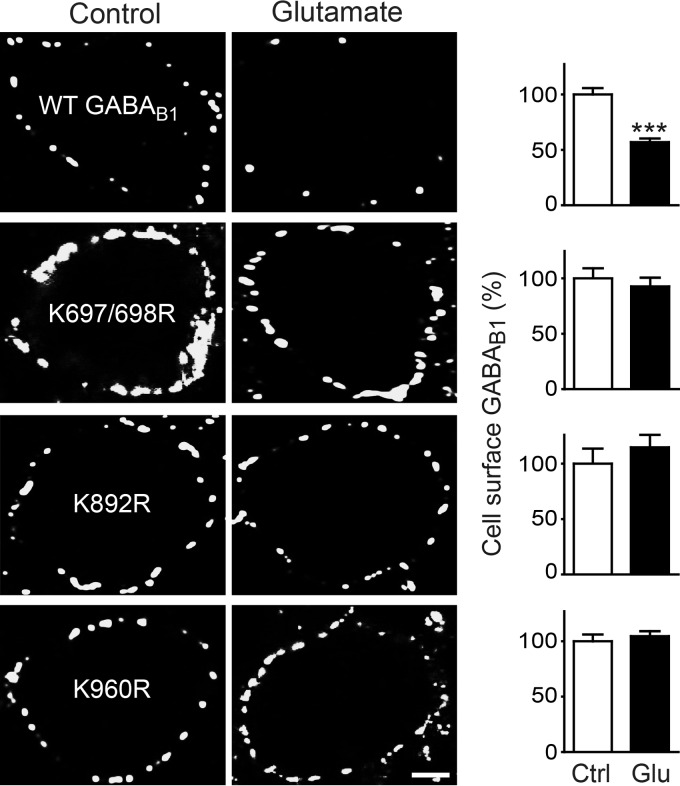
GABA receptors are heterodimeric G protein-coupled receptors, which control neuronal excitability by mediating prolonged inhibition. The magnitude of GABA receptor-mediated inhibition essentially depends on the amount of receptors in the plasma membrane. However, the factors regulating cell surface expression of GABA receptors are poorly characterized. Cell surface GABA receptors are constitutively internalized and either recycled to the plasma membrane or degraded in lysosomes. The signal that sorts GABA receptors to lysosomes is currently unknown. Here we show that Mind bomb-2 (MIB2)-mediated Lys-63-linked ubiquitination of the GABA subunit at multiple sites is the lysosomal sorting signal for GABA receptors. We found that inhibition of lysosomal activity in cultured rat cortical neurons increased the fraction of Lys-63-linked ubiquitinated GABA receptors and enhanced the expression of total as well as cell surface GABA receptors. Mutational inactivation of four putative ubiquitination sites in the GABA subunit significantly diminished Lys-63-linked ubiquitination of GABA receptors and prevented their lysosomal degradation. We identified MIB2 as the E3 ligase triggering Lys-63-linked ubiquitination and lysosomal degradation of GABA receptors. Finally, we show that sustained activation of glutamate receptors, a condition occurring in brain ischemia that down-regulates GABA receptors, considerably increased the expression of MIB2 and Lys-63-linked ubiquitination of GABA receptors. Interfering with Lys-63-linked ubiquitination by overexpressing ubiquitin mutants or GABA mutants deficient in Lys-63-linked ubiquitination prevented glutamate-induced down-regulation of the receptors. These findings indicate that Lys-63-linked ubiquitination of GABA at multiple sites by MIB2 controls sorting of GABA receptors to lysosomes for degradation under physiological and pathological conditions.
γ-氨基丁酸(GABA)受体是异源二聚体G蛋白偶联受体,通过介导长时间抑制来控制神经元兴奋性。GABA受体介导的抑制强度主要取决于质膜中受体的数量。然而,调节GABA受体细胞表面表达的因素目前尚不清楚。细胞表面的GABA受体持续内化,要么循环回到质膜,要么在溶酶体中降解。目前尚不清楚将GABA受体分选到溶酶体的信号是什么。在此,我们表明Mind bomb-2(MIB2)介导的GABA亚基在多个位点的赖氨酸63连接的泛素化是GABA受体的溶酶体分选信号。我们发现,抑制培养的大鼠皮质神经元中的溶酶体活性会增加赖氨酸63连接的泛素化GABA受体的比例,并增强总GABA受体以及细胞表面GABA受体的表达。GABA亚基中四个假定的泛素化位点的突变失活显著减少了GABA受体的赖氨酸63连接的泛素化,并阻止了它们的溶酶体降解。我们确定MIB2为触发GABA受体赖氨酸63连接的泛素化和溶酶体降解的E3连接酶。最后,我们表明,谷氨酸受体的持续激活(一种发生在脑缺血中会下调GABA受体的情况)会显著增加MIB2的表达以及GABA受体的赖氨酸63连接的泛素化。通过过表达泛素突变体或缺乏赖氨酸63连接的泛素化的GABA突变体来干扰赖氨酸63连接的泛素化,可防止谷氨酸诱导的受体下调。这些发现表明,MIB2介导的GABA在多个位点的赖氨酸63连接的泛素化在生理和病理条件下控制GABA受体分选到溶酶体进行降解。