Xu Jinshan, He Qiang, Ma Zhenggang, Li Tian, Zhang Xiaoyan, Debrunner-Vossbrinck Bettina A, Zhou Zeyang, Vossbrinck Charles R
College of Life Sciences, Chongqing Normal University, Chongqing, China.
State Key Laboratory of Silkworm Genome Biology, Southwest University, Chongqing, China.
PLoS One. 2016 Sep 6;11(9):e0162336. doi: 10.1371/journal.pone.0162336. eCollection 2016.
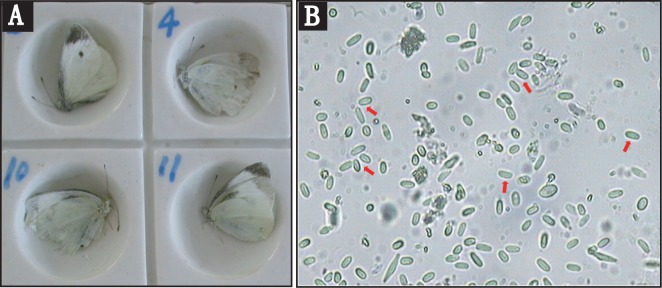
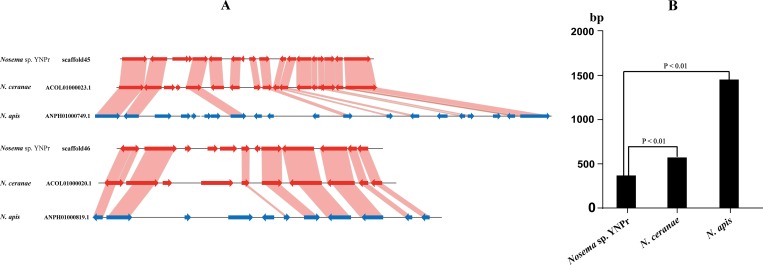
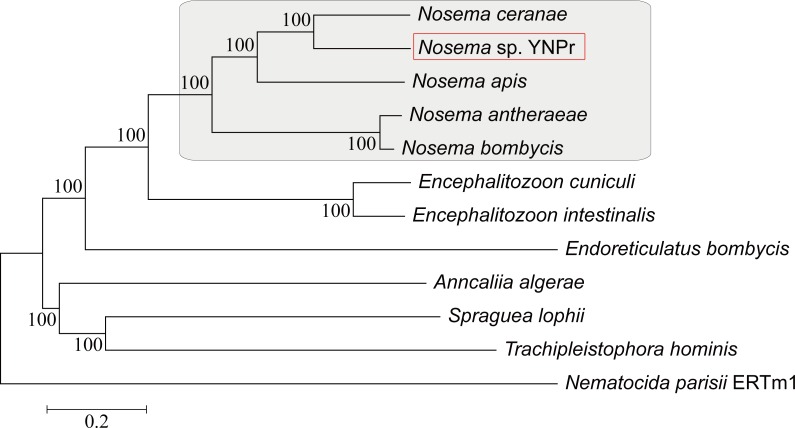
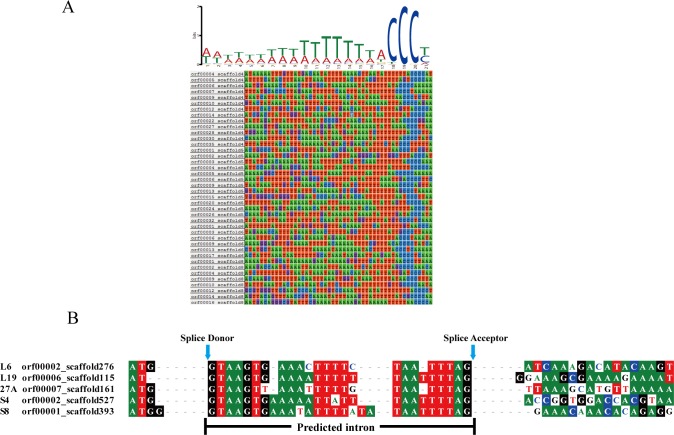
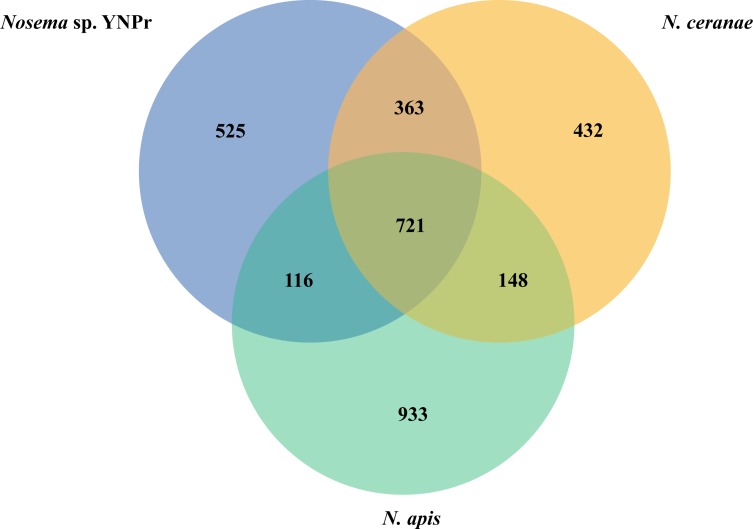
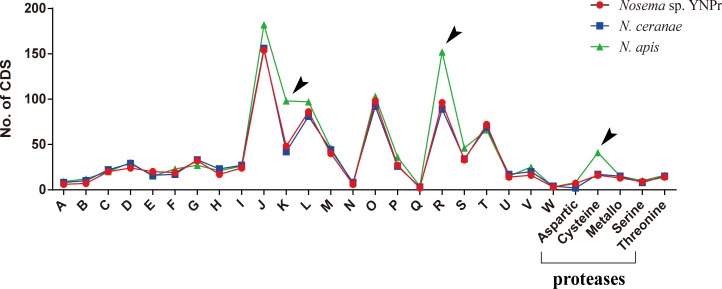
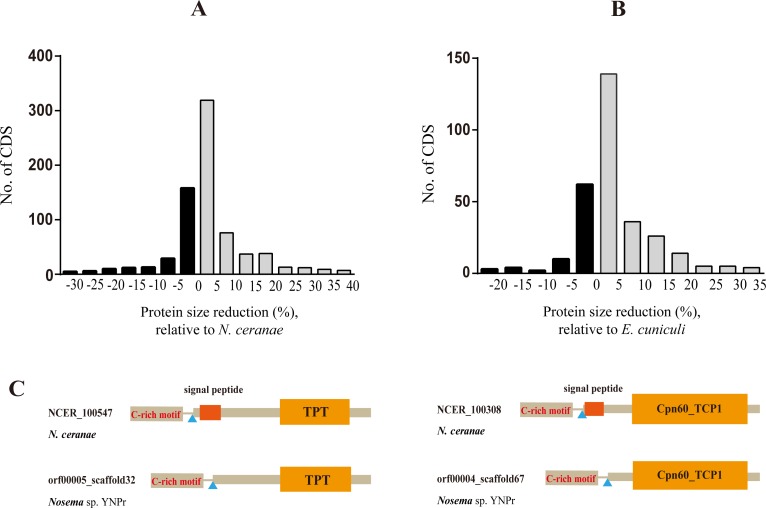
The microsporidian parasite designated here as Nosema sp. Isolate YNPr was isolated from the cabbage butterfly Pieris rapae collected in Honghe Prefecture, Yunnan Province, China. The genome was sequenced by Illumina sequencing and compared to those of two related members of the Nosema/Vairimorpha clade, Nosema ceranae and Nosema apis. Based upon assembly statistics, the Nosema sp. YNPr genome is 3.36 x 10⁶bp with a G+C content of 23.18% and 2,075 protein coding sequences. An "ACCCTT" motif is present approximately 50-bp upstream of the start codon, as reported from other members of the clade and from Encephalitozoon cuniculi, a sister taxon. Comparative small subunit ribosomal DNA (SSU rDNA) analysis as well as genome-wide phylogenetic analysis confirms a closer relationship between N. ceranae and Nosema sp. YNPr than between the two honeybee parasites N. ceranae and N. apis. The more closely related N. ceranae and Nosema sp. YNPr show similarities in a number of structural characteristics such as gene synteny, gene length, gene number, transposon composition and gene reduction. Based on transposable element content of the assemblies, the transposon content of Nosema sp. YNPr is 4.8%, that of N. ceranae is 3.7%, and that of N. apis is 2.5%, with large differences in the types of transposons present among these 3 species. Gene function annotation indicates that the number of genes participating in most metabolic activities is similar in all three species. However, the number of genes in the transcription, general function, and cysteine protease categories is greater in N. apis than in the other two species. Our studies further characterize the evolution of the Nosema/Vairimorpha clade of microsporidia. These organisms maintain variable but very reduced genomes. We are interested in understanding the effects of genetic drift versus natural selection on genome size in the microsporidia and in developing a testable hypothesis for further studies on the genomic ecology of this group.
在此指定为微孢子虫属(Nosema sp.)分离株YNPr的微孢子虫寄生虫,是从中国云南省红河州采集的菜粉蝶(Pieris rapae)中分离得到的。通过Illumina测序对其基因组进行了测序,并与微孢子虫属/变形孢虫属(Nosema/Vairimorpha)分支的两个相关成员,即东方蜜蜂微孢子虫(Nosema ceranae)和蜜蜂微孢子虫(Nosema apis)的基因组进行了比较。根据组装统计数据,微孢子虫属YNPr基因组大小为3.36×10⁶bp,G+C含量为23.18%,有2075个蛋白质编码序列。如该分支的其他成员以及姐妹分类单元兔脑炎微孢子虫(Encephalitozoon cuniculi)所报道的那样,起始密码子上游约50bp处存在一个“ACCCTT”基序。比较小亚基核糖体DNA(SSU rDNA)分析以及全基因组系统发育分析证实,东方蜜蜂微孢子虫与微孢子虫属YNPr之间的关系比两种蜜蜂寄生虫东方蜜蜂微孢子虫和蜜蜂微孢子虫之间的关系更为密切。关系更为密切的东方蜜蜂微孢子虫和微孢子虫属YNPr在许多结构特征上表现出相似性,如基因共线性、基因长度、基因数量、转座子组成和基因缩减。根据组装体的转座元件含量,微孢子虫属YNPr的转座子含量为4.8%,东方蜜蜂微孢子虫为3.7%,蜜蜂微孢子虫为2.5%,这三个物种中转座子的类型存在很大差异。基因功能注释表明,参与大多数代谢活动的基因数量在这三个物种中相似。然而,蜜蜂微孢子虫中转录、一般功能和半胱氨酸蛋白酶类别的基因数量比其他两个物种更多。我们的研究进一步描述了微孢子虫属/变形孢虫属微孢子虫分支的进化。这些生物体维持着可变但非常精简的基因组。我们有兴趣了解遗传漂变与自然选择对微孢子虫基因组大小的影响,并为该类群基因组生态学的进一步研究提出一个可检验的假设。