
在激波管中调整爆炸暴露条件以产生纯净的一次激波:端板有助于消除样本的二次加载。
Tailoring the Blast Exposure Conditions in the Shock Tube for Generating Pure, Primary Shock Waves: The End Plate Facilitates Elimination of Secondary Loading of the Specimen.
作者信息
Kuriakose Matthew, Skotak Maciej, Misistia Anthony, Kahali Sudeepto, Sundaramurthy Aravind, Chandra Namas
机构信息
Center for Injury Biomechanics, Materials and Medicine (CIBM3), Department of Biomedical Engineering, New Jersey Institute of Technology, Newark, NJ, 07102-1982, United States of America.
出版信息
PLoS One. 2016 Sep 7;11(9):e0161597. doi: 10.1371/journal.pone.0161597. eCollection 2016.
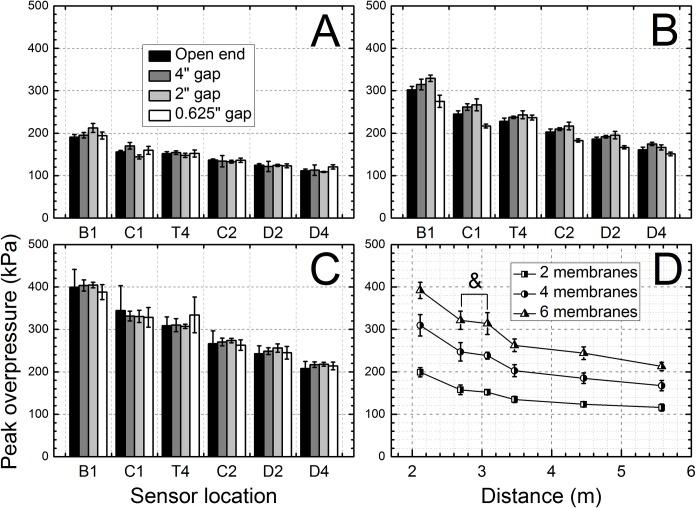
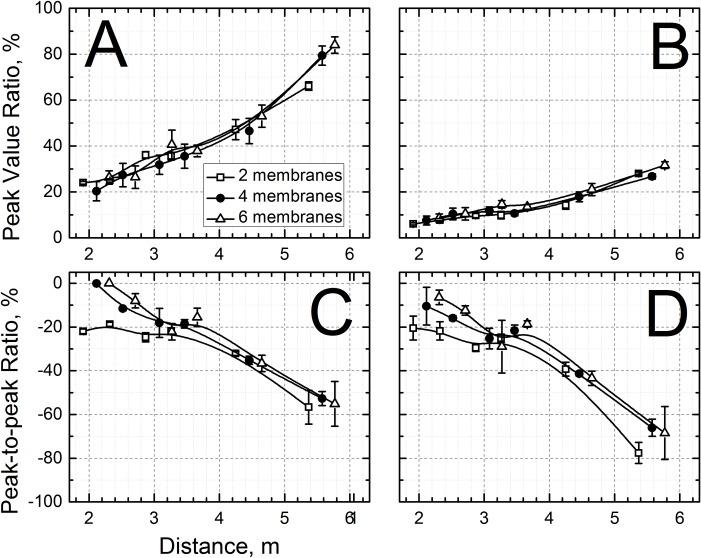
The end plate mounted at the mouth of the shock tube is a versatile and effective implement to control and mitigate the end effects. We have performed a series of measurements of incident shock wave velocities and overpressures followed by quantification of impulse values (integral of pressure in time domain) for four different end plate configurations (0.625, 2, 4 inches, and an open end). Shock wave characteristics were monitored by high response rate pressure sensors allocated in six positions along the length of 6 meters long 229 mm square cross section shock tube. Tests were performed at three shock wave intensities, which was controlled by varying the Mylar membrane thickness (0.02, 0.04 and 0.06 inch). The end reflector plate installed at the exit of the shock tube allows precise control over the intensity of reflected waves penetrating into the shock tube. At the optimized distance of the tube to end plate gap the secondary waves were entirely eliminated from the test section, which was confirmed by pressure sensor at T4 location. This is pronounced finding for implementation of pure primary blast wave animal model. These data also suggest only deep in the shock tube experimental conditions allow exposure to a single shock wave free of artifacts. Our results provide detailed insight into spatiotemporal dynamics of shock waves with Friedlander waveform generated using helium as a driver gas and propagating in the air inside medium sized tube. Diffusion of driver gas (helium) inside the shock tube was responsible for velocity increase of reflected shock waves. Numerical simulations combined with experimental data suggest the shock wave attenuation mechanism is simply the expansion of the internal pressure. In the absence of any other postulated shock wave decay mechanisms, which were not implemented in the model the agreement between theory and experimental data is excellent.
安装在激波管管口的端板是一种通用且有效的控制和减轻端部效应的工具。我们对四种不同端板配置(0.625英寸、2英寸、4英寸以及开口端)进行了一系列入射激波速度和超压的测量,随后对冲量值(时域压力积分)进行了量化。通过沿6米长、横截面为229毫米见方的激波管长度方向布置的六个位置的高响应率压力传感器来监测激波特性。测试在三种激波强度下进行,通过改变聚酯薄膜厚度(0.02英寸、0.04英寸和0.06英寸)来控制激波强度。安装在激波管出口处的端部反射板能够精确控制穿透进入激波管的反射波强度。在激波管与端板间隙的优化距离处,二次波从测试段完全消除,这在T4位置的压力传感器得到了证实。这对于实施纯原发性冲击波动物模型是一个显著的发现。这些数据还表明,只有在激波管较深处的实验条件下才能暴露于无伪影的单一激波。我们的结果详细洞察了以氦气作为驱动气体产生的具有弗里德兰德波形并在中型管内空气中传播的激波的时空动力学。驱动气体(氦气)在激波管内的扩散导致了反射激波速度的增加。数值模拟与实验数据相结合表明,激波衰减机制仅仅是内部压力的膨胀。在没有模型中未实施的任何其他假定激波衰减机制的情况下,理论与实验数据之间的一致性非常好。






 Zotero 插件