Miller Jennifer R B, Jhala Yadvendradev V, Schmitz Oswald J
Yale School of Forestry & Environmental Studies, New Haven, Connecticut, United States of America.
Wildlife Institute of India, Dehradun, Uttarakhand, India.
PLoS One. 2016 Sep 12;11(9):e0162685. doi: 10.1371/journal.pone.0162685. eCollection 2016.
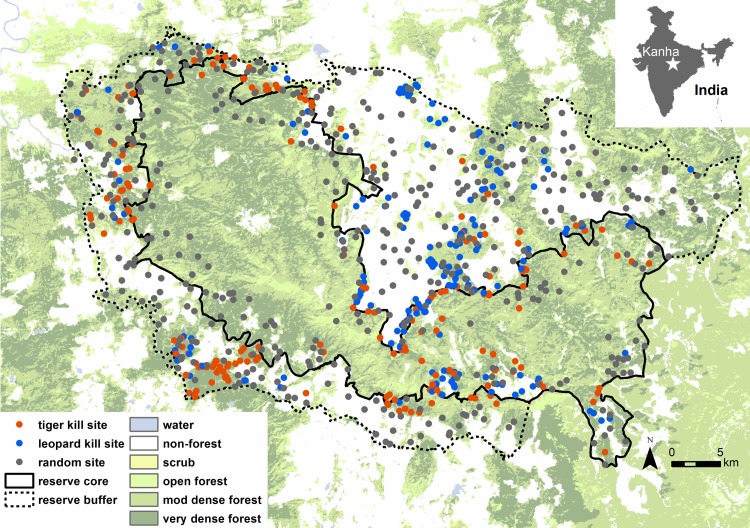
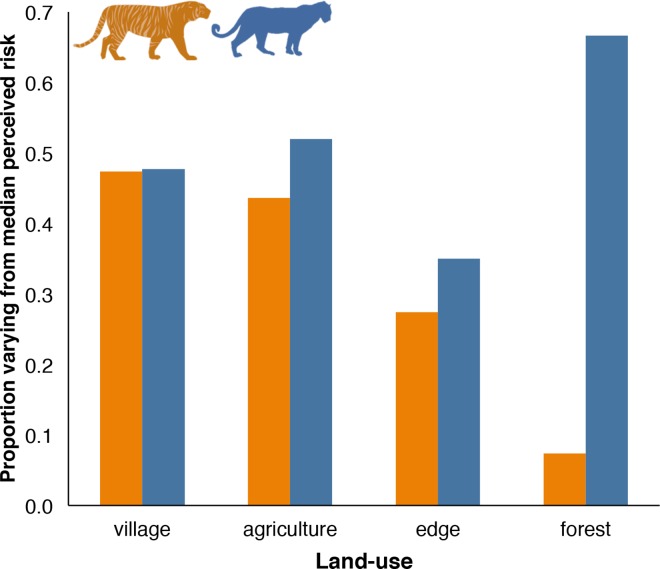
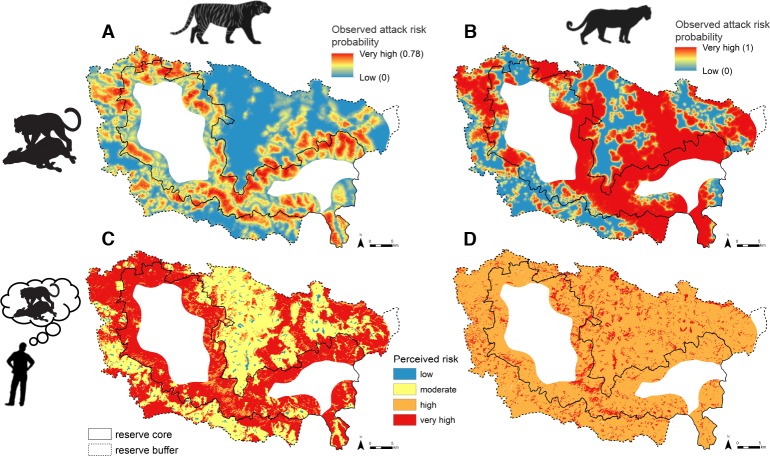
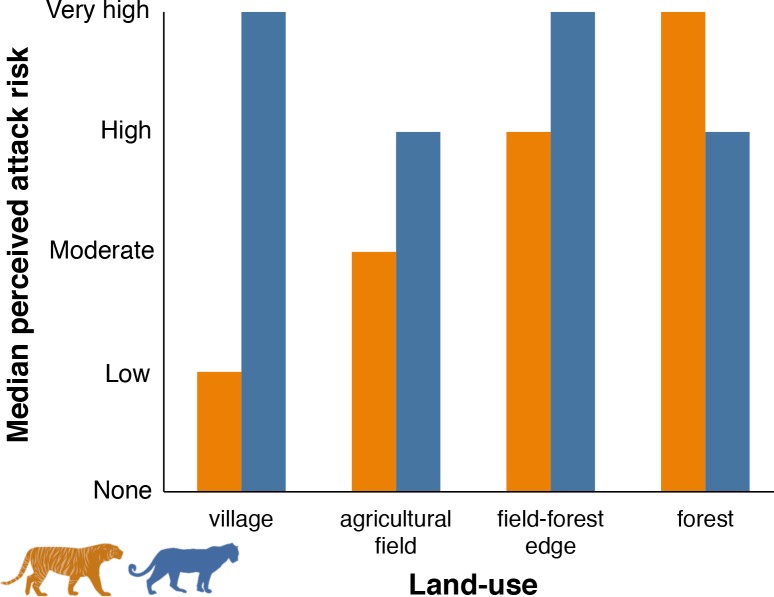
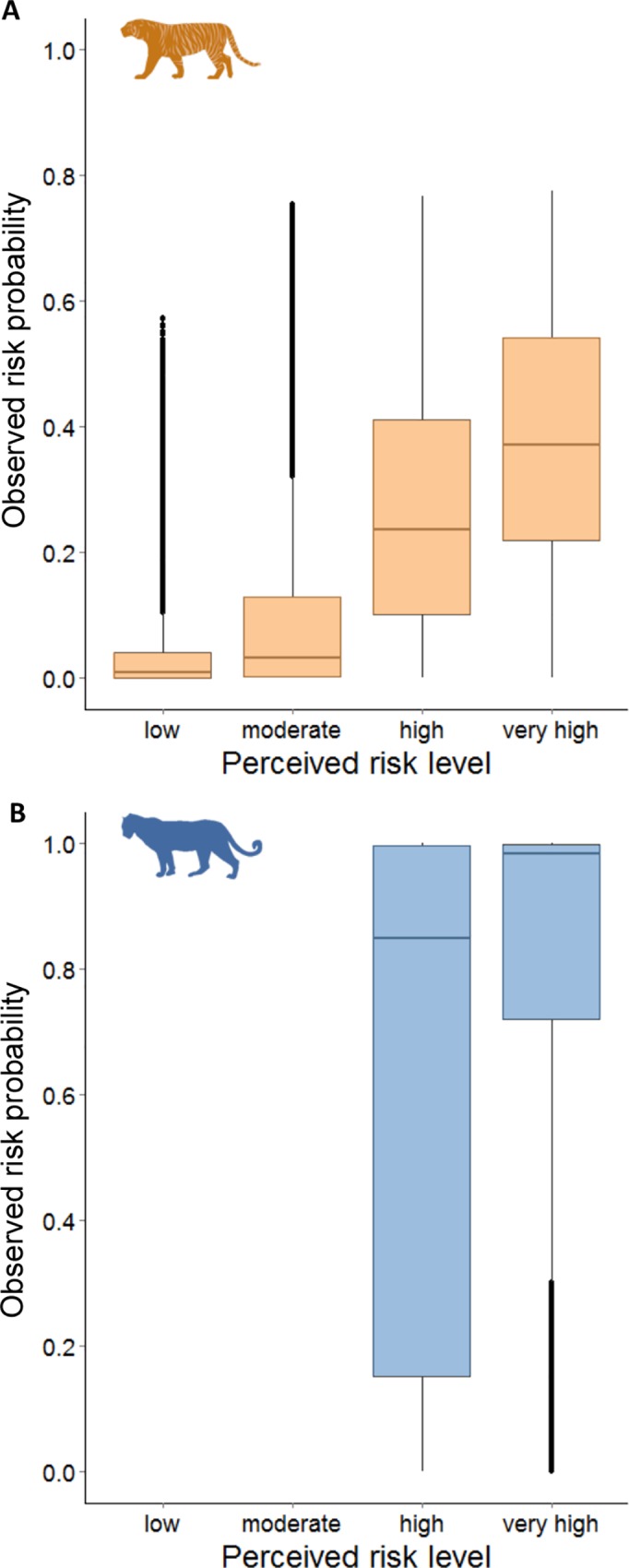
Human-carnivore conflict is challenging to quantify because it is shaped by both the realities and people's perceptions of carnivore threats. Whether perceptions align with realities can have implications for conflict mitigation: misalignments can lead to heightened and indiscriminant persecution of carnivores whereas alignments can offer deeper insights into human-carnivore interactions. We applied a landscape-scale spatial analysis of livestock killed by tigers and leopards in India to model and map observed attack risk, and surveyed owners of livestock killed by tigers and leopards for their rankings of threats across habitats to map perceived attack risk. Observed tiger risk to livestock was greatest near dense forests and at moderate distances from human activity while leopard risk was greatest near open vegetation. People accurately perceived spatial differences between tiger and leopard hunting patterns, expected greater threat in areas with high values of observed risk for both carnivores. Owners' perception of threats largely did not depend on environmental conditions surrounding their village (spatial location, dominant land-use or observed carnivore risk). Surveys revealed that owners who previously lost livestock to carnivores used more livestock protection methods than those who had no prior losses, and that owners who had recently lost livestock for the first time expressed greater interest in changing their protection methods than those who experienced prior losses. Our findings suggest that in systems where realities and perceptions of carnivore risk align, conservation programs and policies can optimize conservation outcomes by (1) improving the effectiveness of livestock protection methods and (2) working with owners who have recently lost livestock and are most willing to invest effort in adapting protection strategies to mitigate human-carnivore conflict.
人类与食肉动物的冲突难以量化,因为它既受食肉动物威胁的现实情况影响,也受人们对这些威胁的认知影响。认知与现实是否相符会对冲突缓解产生影响:两者不符可能导致对食肉动物的迫害加剧且不加区分,而相符则能更深入地了解人类与食肉动物的相互作用。我们对印度老虎和豹子捕杀牲畜的情况进行了景观尺度的空间分析,以模拟和绘制观察到的攻击风险,并调查了被老虎和豹子捕杀牲畜的所有者,了解他们对不同栖息地威胁的排名,从而绘制出感知到的攻击风险。观察到老虎对牲畜的风险在茂密森林附近以及距离人类活动适中的地方最大,而豹子的风险在开阔植被附近最大。人们准确地感知到了老虎和豹子捕猎模式的空间差异,预计在两种食肉动物观察到的风险值都很高的地区威胁更大。牲畜所有者对威胁的认知在很大程度上并不取决于他们村庄周围的环境条件(空间位置、主要土地用途或观察到的食肉动物风险)。调查显示,之前牲畜被食肉动物捕杀的所有者比没有此类损失的所有者使用更多的牲畜保护方法,而且最近首次遭受牲畜损失的所有者比之前有过损失的所有者对改变保护方法表现出更大的兴趣。我们的研究结果表明,在食肉动物风险的现实情况与认知相符的系统中,保护计划和政策可以通过以下方式优化保护成果:(1)提高牲畜保护方法的有效性;(2)与最近遭受牲畜损失且最愿意投入精力调整保护策略以缓解人类与食肉动物冲突的所有者合作。