Wiangkham Taweewat, Duda Joan, Haque M Sayeed, Rushton Alison
School of Sport, Exercise and Rehabilitation Sciences, College of Life and Environmental Sciences, University of Birmingham, Birmingham, UK.
Institute of Clinical Sciences, College of Medical and Dental Sciences, University of Birmingham, Birmingham, UK.
BMJ Open. 2016 Sep 14;6(9):e011764. doi: 10.1136/bmjopen-2016-011764.
To develop an active behavioural physiotherapy intervention (ABPI) for managing acute whiplash-associated disorder (WAD) II using a modified Delphi method to develop consensus for the basic features of the ABPI.
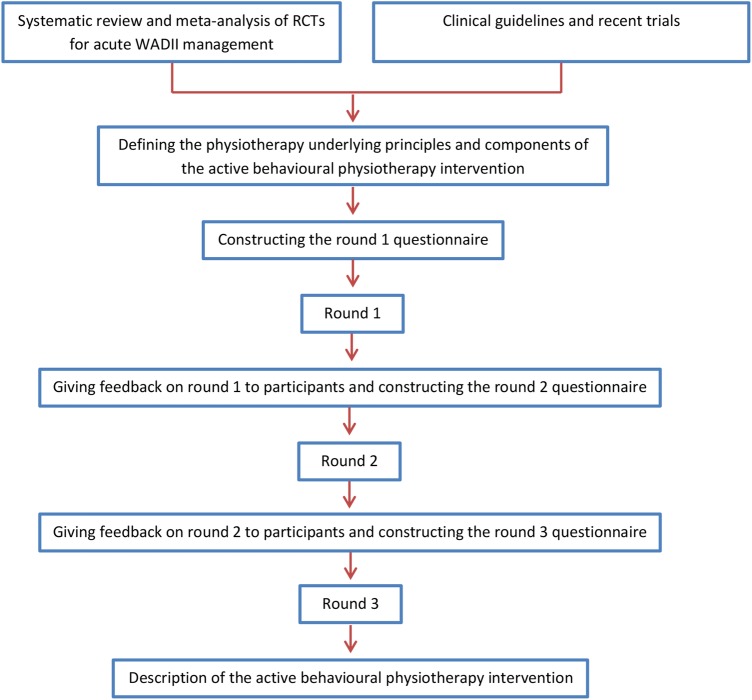
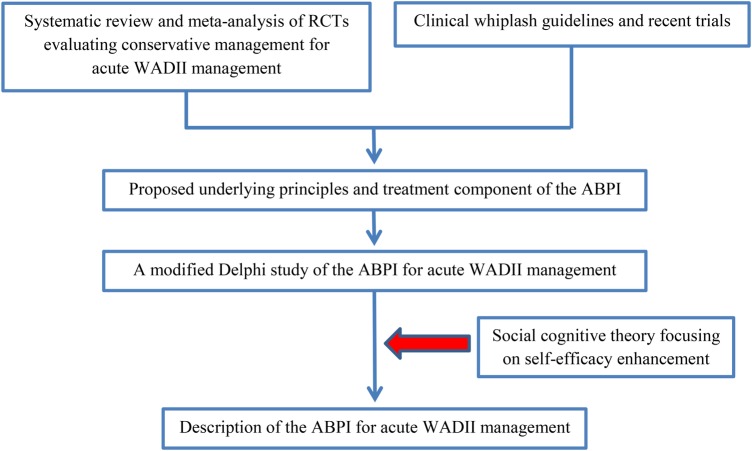
Modified Delphi study. Our systematic review and meta-analysis evaluating conservative management for acute WADII found that a combined ABPI may be a useful intervention to prevent patients progressing to chronicity. No previous research has considered a combined behavioural approach and active physiotherapy in the management of acute WADII patients. The ABPI was therefore developed using a rigorous consensus method using international research and local clinical whiplash experts. Descriptive statistics were used to assess consensus in each round.
Online international survey.
A purposive sample of 97 potential participants (aiming to recruit n=30) consisting of international research whiplash experts, UK private physiotherapists and UK postgraduate musculoskeletal physiotherapy students were invited to participate via electronic mail with an attached participant information sheet and consent form.
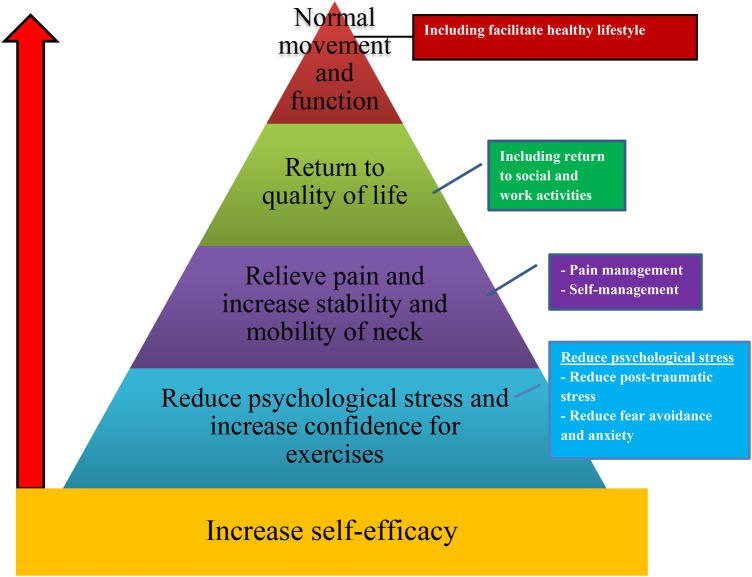
36 individuals signed and returned the consent form. In round 1, 32/36 participants (response rate=89%, mean age±SD=36.03±13.22 years) across 8 countries (Australia, Finland, Greece, India, Netherlands, Norway, Sweden and UK) contributed to round 1 questionnaire. Response rates were 78% and 75% for rounds 2 and 3, respectively. Following round 3, 12 underlying principles (eg, return to normal function as soon as possible, pain management, encouragement of self-management, reduce fear avoidance and anxiety) achieved consensus. The treatment components reaching consensus included behavioural (eg, education, reassurance, self-management) and physiotherapy components (eg, exercises for stability and mobility). No passive intervention achieved consensus.
Experts suggested and agreed the underlying principles and treatment components of the ABPI for the management of acute WADII. The ABPI was underpinned by social cognitive theory focusing on self-efficacy enhancement prior to conducting a phase II trial.
采用改良德尔菲法,就积极行为物理治疗干预(ABPI)的基本特征达成共识,以制定一种用于管理急性挥鞭样损伤相关疾病(WAD)II型的积极行为物理治疗干预方案。
改良德尔菲研究。我们对急性WAD II型保守治疗的系统评价和荟萃分析发现,联合ABPI可能是一种预防患者发展为慢性疾病的有效干预措施。此前尚无研究考虑在急性WAD II型患者的管理中采用联合行为方法和积极物理治疗。因此,ABPI是通过使用国际研究和当地临床挥鞭样损伤专家的严格共识方法制定的。描述性统计用于评估每一轮的共识情况。
在线国际调查。
通过电子邮件邀请了97名潜在参与者(目标招募人数n = 30)组成的目的抽样样本,包括国际研究挥鞭样损伤专家、英国私人物理治疗师和英国研究生肌肉骨骼物理治疗专业学生,并附上参与者信息表和同意书。
36人签署并返回了同意书。在第1轮中,来自8个国家(澳大利亚、芬兰、希腊、印度、荷兰、挪威、瑞典和英国)的32/36名参与者(回复率 = 89%,平均年龄±标准差 = 36.03±13.22岁)参与了第1轮问卷。第2轮和第3轮的回复率分别为78%和75%。在第3轮之后,12条基本原则(如尽快恢复正常功能、疼痛管理、鼓励自我管理、减少恐惧回避和焦虑)达成了共识。达成共识的治疗组成部分包括行为方面(如教育、安慰、自我管理)和物理治疗方面(如稳定性和活动度锻炼)。没有被动干预措施达成共识。
专家们提出并认可了用于管理急性WAD II型的ABPI的基本原则和治疗组成部分。ABPI以社会认知理论为基础,在进行II期试验之前侧重于提高自我效能感。