Dowling Daniel P, Miles Zachary D, Köhrer Caroline, Maiocco Stephanie J, Elliott Sean J, Bandarian Vahe, Drennan Catherine L
Howard Hughes Medical Institute, Massachusetts Institute of Technology, Cambridge, MA 02139, USA.
Department of Chemistry, Massachusetts Institute of Technology, Cambridge, MA 02139, USA.
Nucleic Acids Res. 2016 Nov 16;44(20):9965-9976. doi: 10.1093/nar/gkw806. Epub 2016 Sep 15.
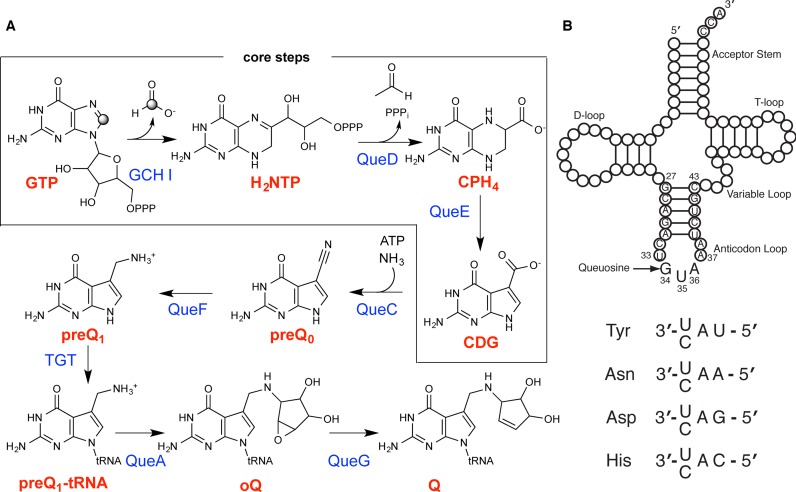
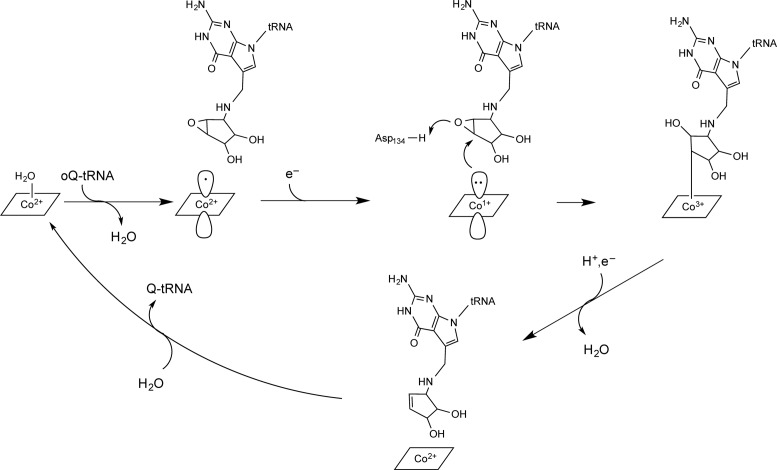
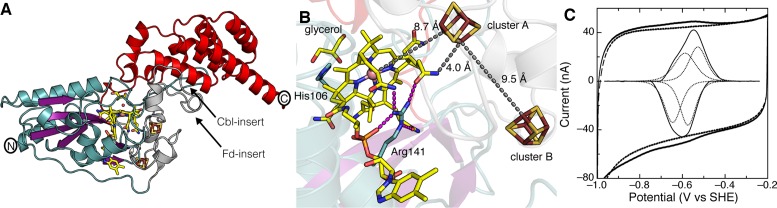
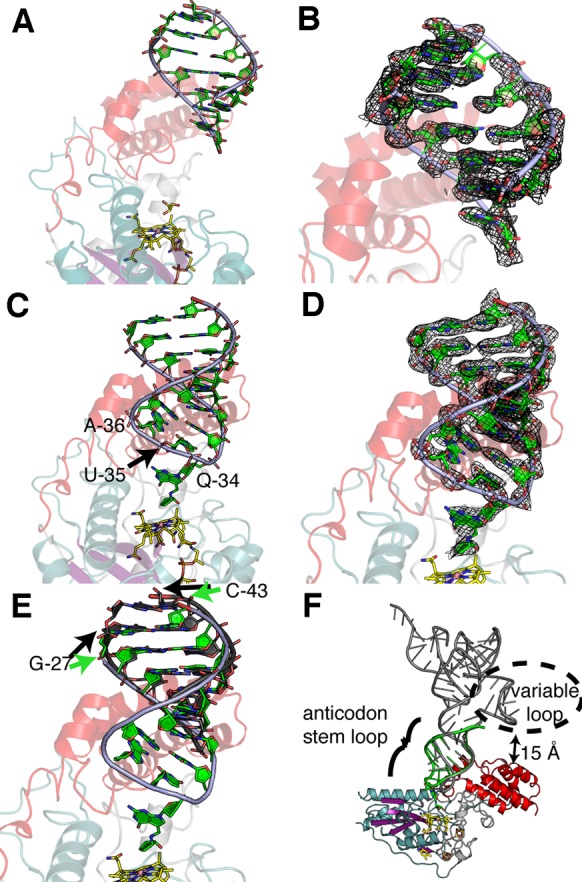
Queuosine (Q) was discovered in the wobble position of a transfer RNA (tRNA) 47 years ago, yet the final biosynthetic enzyme responsible for Q-maturation, epoxyqueuosine (oQ) reductase (QueG), was only recently identified. QueG is a cobalamin (Cbl)-dependent, [4Fe-4S] cluster-containing protein that produces the hypermodified nucleoside Q in situ on four tRNAs. To understand how QueG is able to perform epoxide reduction, an unprecedented reaction for a Cbl-dependent enzyme, we have determined a series of high resolution structures of QueG from Bacillus subtilis Our structure of QueG bound to a tRNA anticodon stem loop shows how this enzyme uses a HEAT-like domain to recognize the appropriate anticodons and position the hypermodified nucleoside into the enzyme active site. We find Q bound directly above the Cbl, consistent with a reaction mechanism that involves the formation of a covalent Cbl-tRNA intermediate. Using protein film electrochemistry, we show that two [4Fe-4S] clusters adjacent to the Cbl have redox potentials in the range expected for Cbl reduction, suggesting how Cbl can be activated for nucleophilic attack on oQ. Together, these structural and electrochemical data inform our understanding of Cbl dependent nucleic acid modification.
47年前,在转运RNA(tRNA)的摆动位置发现了queuosine(Q),然而,负责Q成熟的最终生物合成酶——环氧queuosine(oQ)还原酶(QueG),直到最近才被鉴定出来。QueG是一种依赖钴胺素(Cbl)、含有[4Fe-4S]簇的蛋白质,它能在四种tRNA上原位产生超修饰核苷Q。为了理解QueG如何能够进行环氧化物还原(这是一种依赖Cbl的酶前所未有的反应),我们测定了一系列来自枯草芽孢杆菌的QueG的高分辨率结构。我们的QueG与tRNA反密码子茎环结合的结构显示了这种酶如何利用一个类似HEAT的结构域来识别合适的反密码子,并将超修饰核苷定位到酶的活性位点。我们发现Q直接结合在Cbl上方,这与涉及形成共价Cbl-tRNA中间体的反应机制一致。利用蛋白质膜电化学,我们表明与Cbl相邻的两个[4Fe-4S]簇具有Cbl还原预期范围内的氧化还原电位,这表明Cbl如何被激活以对oQ进行亲核攻击。这些结构和电化学数据共同为我们对依赖Cbl的核酸修饰的理解提供了信息。