Kempe Allison, Hurley Laura P, Cardemil Cristina V, Allison Mandy A, Crane Lori A, Brtnikova Michaela, Beaty Brenda L, Pabst Laura J, Lindley Megan C
Adult and Child Consortium for Health Outcomes Research and Delivery Science, University of Colorado School of Medicine and Children's Hospital Colorado, Aurora, Colorado; Department of Pediatrics, University of Colorado School of Medicine, Aurora, Colorado.
Adult and Child Consortium for Health Outcomes Research and Delivery Science, University of Colorado School of Medicine and Children's Hospital Colorado, Aurora, Colorado; Division of General Internal Medicine, Denver Health, Denver, Colorado.
Am J Prev Med. 2017 Feb;52(2):173-182. doi: 10.1016/j.amepre.2016.07.029. Epub 2016 Sep 14.
Immunization information systems (IISs) are highly effective for increasing vaccination rates but information about how primary care physicians use them is limited.
Pediatricians, family physicians (FPs), and general internists (GIMs) were surveyed by e-mail and mail from January 2015 to April 2015 from all states with an existing IIS. Providers were recruited to be representative of national provider organization memberships. Multivariable log binomial regression examined factors associated with IIS use (October 2015-April 2016).
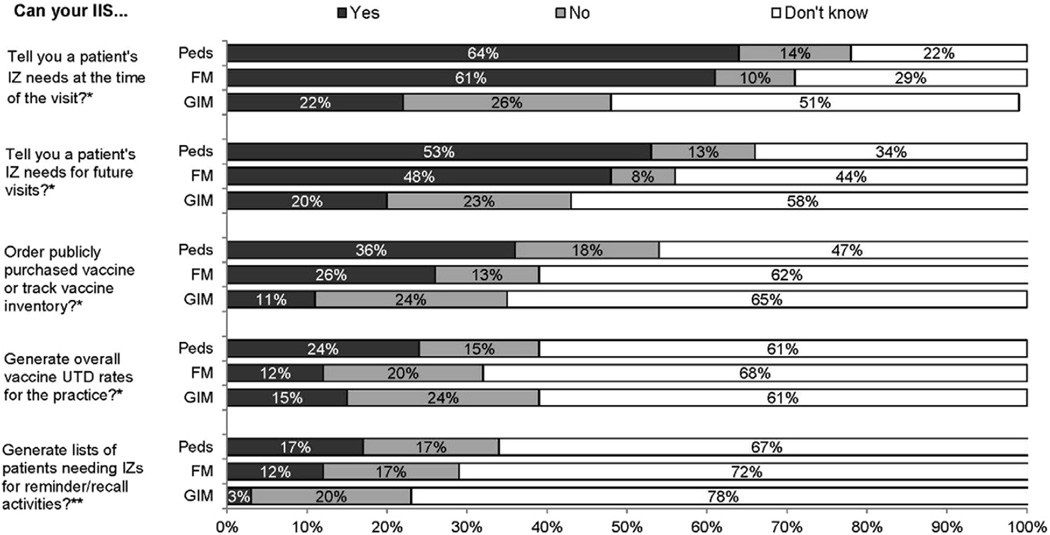
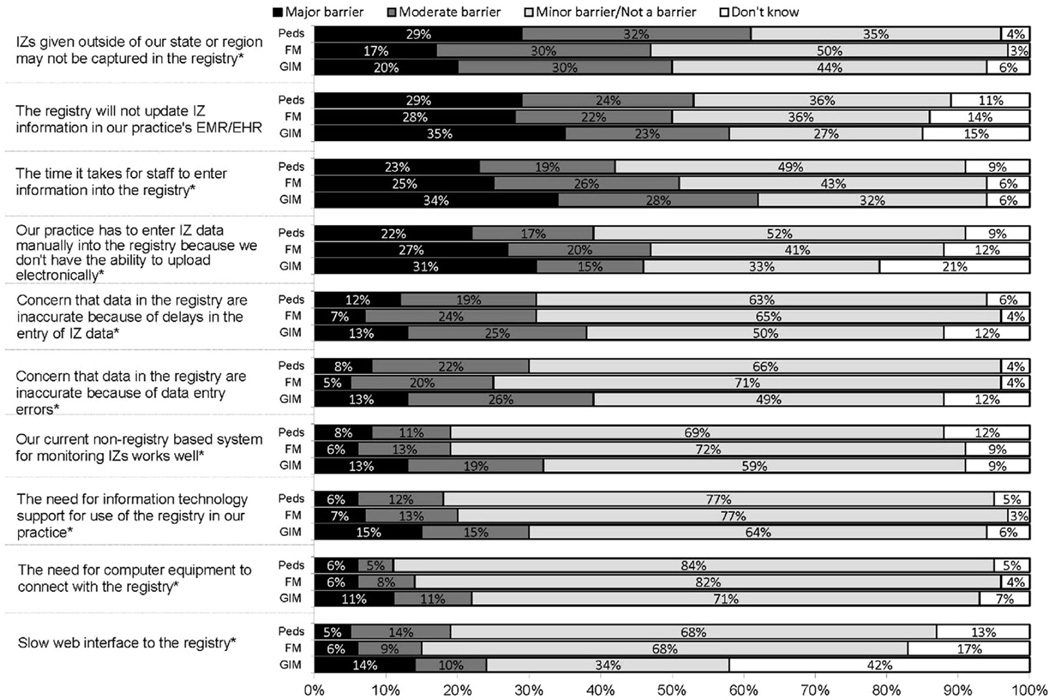
Response rates among pediatricians, FPs, and GIMs, respectively, were 75% (325/435), 68% (310/459), and 63% (272/431). A proportion of pediatricians (5%), FPs (14%), and GIMs (48%) did not know there was a state/local IIS; 81%, 72%, and 27% reported using an IIS (p<0.0001). Among those who used IISs, 64% of pediatricians, 61% of FPs, and 22% of GIMs thought the IIS could tell them a patient's immunization needs; 22%, 29%, and 51% did not know. The most frequently reported major barriers to use included the IIS not updating the electronic medical record (29%, 28%, 35%) and lack of ability to submit data electronically (22%, 27%, 31%). Factors associated with lower IIS use included FP (adjusted risk ratio=0.85; 95% CI=0.75, 0.97) or GIM (adjusted risk ratio=0.33; 95% CI=0.25, 0.42) versus pediatric specialty and older versus younger provider age (adjusted risk ratio=0.96; 95 CI%=0.94, 0.98).
There are substantial gaps in knowledge of IIS capabilities, especially among GIMs; barriers to interoperability between IISs and electronic medical records affect all specialties. Closing these gaps may increase use of proven IIS functions including decision support and reminder/recall.
免疫接种信息系统(IISs)对提高疫苗接种率非常有效,但关于基层医疗医生如何使用这些系统的信息有限。
2015年1月至2015年4月,通过电子邮件和信件对所有设有现有IIS的州的儿科医生、家庭医生(FPs)和普通内科医生(GIMs)进行了调查。招募的提供者代表了全国提供者组织的成员。多变量对数二项回归分析了与IIS使用相关的因素(2015年10月至2016年4月)。
儿科医生、家庭医生和普通内科医生的回复率分别为75%(325/435)、68%(310/459)和63%(272/431)。一定比例的儿科医生(5%)、家庭医生(14%)和普通内科医生(48%)不知道有州/地方IIS;81%、72%和27%的人报告使用了IIS(p<0.0001)。在使用IIS的人中,64%的儿科医生、61%的家庭医生和22%的普通内科医生认为IIS可以告诉他们患者的免疫接种需求;22%、29%和51%的人不知道。最常报告的使用主要障碍包括IIS未更新电子病历(29%、28%、35%)和缺乏电子提交数据的能力(22%、27%、31%)。与较低IIS使用相关的因素包括与儿科专科相比的家庭医生(调整风险比=0.85;95%CI=0.75,0.97)或普通内科医生(调整风险比=0.33;95%CI=0.25,0.42)以及与年轻提供者年龄相比的年长提供者年龄(调整风险比=0.96;95%CI=0.94,0.98)。
在IIS功能的知识方面存在很大差距,尤其是在普通内科医生中;IIS与电子病历之间的互操作性障碍影响所有专科。缩小这些差距可能会增加对包括决策支持和提醒/召回在内的已证实的IIS功能的使用。