Brunner Clair, Davies Neil M, Martin Richard M, Eeles Rosalind, Easton Doug, Kote-Jarai Zsofia, Al Olama Ali Amin, Benlloch Sara, Muir Kenneth, Giles Graham, Wiklund Fredrik, Gronberg Henrik, Haiman Christopher A, Schleutker Johanna, Nordestgaard Børge G, Travis Ruth C, Neal David, Donovan Jenny, Hamdy Freddie C, Pashayan Nora, Khaw Kay-Tee, Stanford Janet L, Blot William J, Thibodeau Stephen, Maier Christiane, Kibel Adam S, Cybulski Cezary, Cannon-Albright Lisa, Brenner Hermann, Park Jong, Kaneva Radka, Batra Jyotsna, Teixeira Manuel R, Pandha Hardev, Zuccolo Luisa
School of Social and Community Medicine, University of Bristol, Bristol, United Kingdom.
MRC/University of Bristol Integrative Epidemiology Unit, University of Bristol, Bristol, United Kingdom.
Int J Cancer. 2017 Jan 1;140(1):75-85. doi: 10.1002/ijc.30436. Epub 2016 Oct 8.
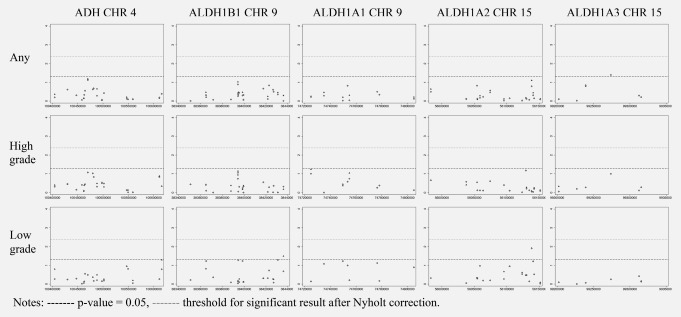
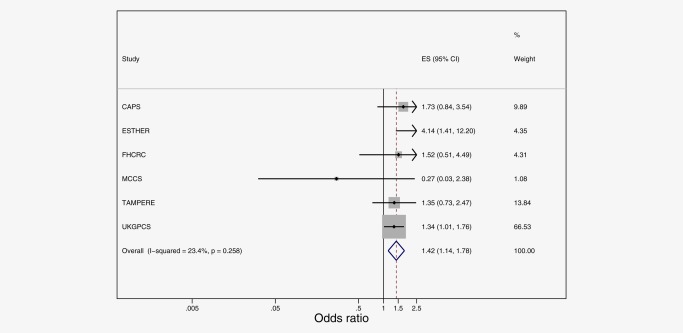
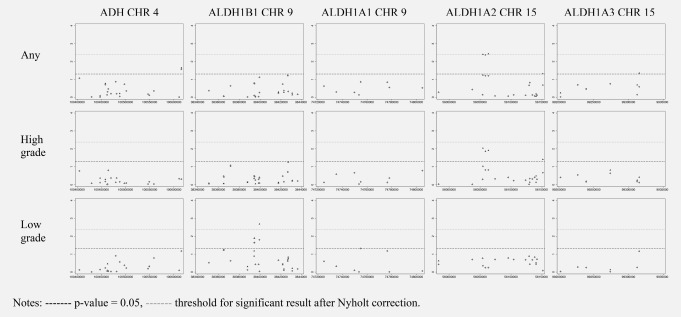
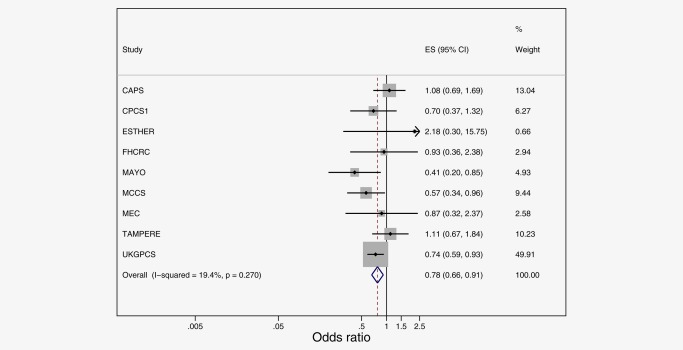
Prostate cancer is the most common cancer in men in developed countries, and is a target for risk reduction strategies. The effects of alcohol consumption on prostate cancer incidence and survival remain unclear, potentially due to methodological limitations of observational studies. In this study, we investigated the associations of genetic variants in alcohol-metabolising genes with prostate cancer incidence and survival. We analysed data from 23,868 men with prostate cancer and 23,051 controls from 25 studies within the international PRACTICAL Consortium. Study-specific associations of 68 single nucleotide polymorphisms (SNPs) in 8 alcohol-metabolising genes (Alcohol Dehydrogenases (ADHs) and Aldehyde Dehydrogenases (ALDHs)) with prostate cancer diagnosis and prostate cancer-specific mortality, by grade, were assessed using logistic and Cox regression models, respectively. The data across the 25 studies were meta-analysed using fixed-effect and random-effects models. We found little evidence that variants in alcohol metabolising genes were associated with prostate cancer diagnosis. Four variants in two genes exceeded the multiple testing threshold for associations with prostate cancer mortality in fixed-effect meta-analyses. SNPs within ALDH1A2 associated with prostate cancer mortality were rs1441817 (fixed effects hazard ratio, HR = 0.78; 95% confidence interval (95%CI):0.66,0.91; p values = 0.002); rs12910509, HR = 0.76; 95%CI:0.64,0.91; p values = 0.003); and rs8041922 (HR = 0.76; 95%CI:0.64,0.91; p values = 0.002). These SNPs were in linkage disequilibrium with each other. In ALDH1B1, rs10973794 (HR = 1.43; 95%CI:1.14,1.79; p values = 0.002) was associated with prostate cancer mortality in men with low-grade prostate cancer. These results suggest that alcohol consumption is unlikely to affect prostate cancer incidence, but it may influence disease progression.
前列腺癌是发达国家男性中最常见的癌症,也是降低风险策略的目标。饮酒对前列腺癌发病率和生存率的影响尚不清楚,这可能是由于观察性研究的方法学局限性所致。在本研究中,我们调查了酒精代谢基因中的基因变异与前列腺癌发病率和生存率之间的关联。我们分析了国际PRACTICAL联盟中25项研究的23868名前列腺癌男性患者和23051名对照的数据。分别使用逻辑回归和Cox回归模型评估了8个酒精代谢基因(乙醇脱氢酶(ADHs)和乙醛脱氢酶(ALDHs))中的68个单核苷酸多态性(SNPs)与前列腺癌诊断及按分级的前列腺癌特异性死亡率之间的研究特异性关联。使用固定效应和随机效应模型对25项研究的数据进行了荟萃分析。我们几乎没有发现证据表明酒精代谢基因中的变异与前列腺癌诊断有关。在固定效应荟萃分析中,两个基因中的四个变异超过了与前列腺癌死亡率关联的多重检验阈值。与前列腺癌死亡率相关的ALDH1A2基因内的SNPs为rs1441817(固定效应风险比,HR = 0.78;95%置信区间(95%CI):0.66,0.91;p值 = 0.002);rs12910509,HR = 0.76;95%CI:0.64,0.91;p值 = 0.003);以及rs8041922(HR = 0.76;95%CI:0.64,0.91;p值 = 0.002)。这些SNPs彼此处于连锁不平衡状态。在ALDH1B1基因中,rs10973794(HR = 1.43;95%CI:1.14,1.79;p值 = 0.002)与低级别前列腺癌男性的前列腺癌死亡率相关。这些结果表明,饮酒不太可能影响前列腺癌的发病率,但可能会影响疾病进展。