Viennet Elvina, Ritchie Scott A, Williams Craig R, Faddy Helen M, Harley David
Research School of Population Health, The Australian National University, Canberra, Australian Capital Territory, Australia.
Research and Development, Australian Red Cross Blood Service, Kelvin Grove, Queensland, Australia.
PLoS Negl Trop Dis. 2016 Sep 19;10(9):e0004943. doi: 10.1371/journal.pntd.0004943. eCollection 2016 Sep.
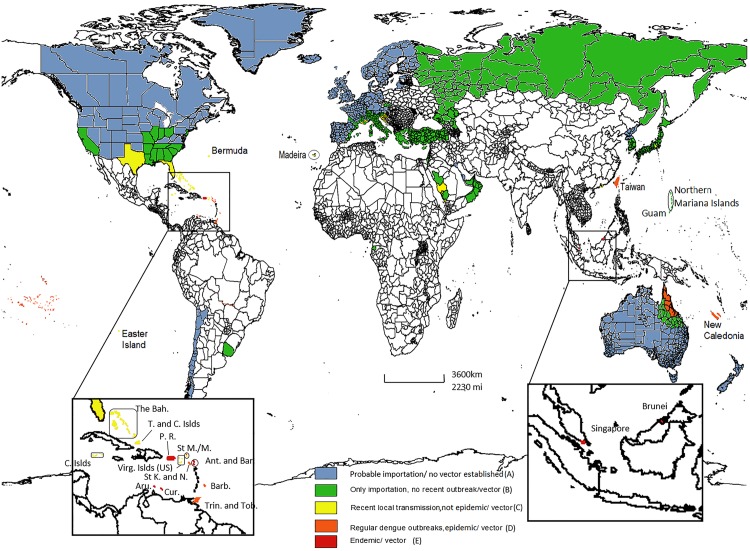
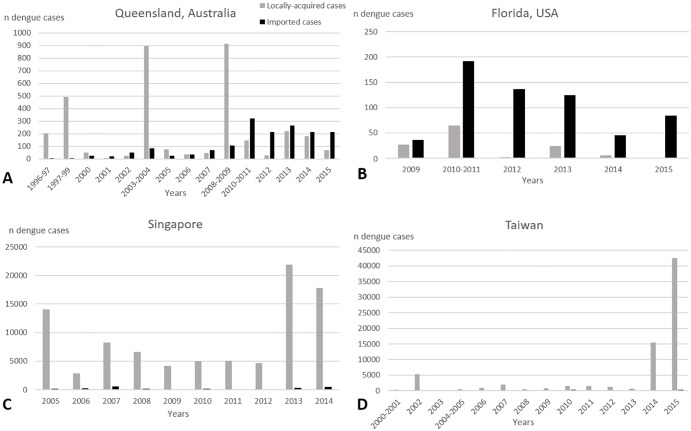
Dengue has a negative impact in low- and lower middle-income countries, but also affects upper middle- and high-income countries. Despite the efforts at controlling this disease, it is unclear why dengue remains an issue in affluent countries. A better understanding of dengue epidemiology and its burden, and those of chikungunya virus and Zika virus which share vectors with dengue, is required to prevent the emergence of these diseases in high-income countries in the future. The purpose of this review was to assess the relative burden of dengue in four high-income countries and to appraise the similarities and differences in dengue transmission. We searched PubMed, ISI Web of Science, and Google Scholar using specific keywords for articles published up to 05 May 2016. We found that outbreaks rarely occur where only Aedes albopictus is present. The main similarities between countries uncovered by our review are the proximity to dengue-endemic countries, the presence of a competent mosquito vector, a largely nonimmune population, and a lack of citizens' engagement in control of mosquito breeding. We identified important epidemiological and environmental issues including the increase of local transmission despite control efforts, population growth, difficulty locating larval sites, and increased human mobility from neighboring endemic countries. Budget cuts in health and lack of practical vaccines contribute to an increased risk. To be successful, dengue-control programs for high-income countries must consider the epidemiology of dengue in other countries and use this information to minimize virus importation, improve the control of the cryptic larval habitat, and engage the community in reducing vector breeding. Finally, the presence of a communicable disease center is critical for managing and reducing future disease risks.
登革热在低收入和中低收入国家有负面影响,但也影响中高收入和高收入国家。尽管在控制这种疾病方面做出了努力,但尚不清楚为何登革热在富裕国家仍然是个问题。为防止这些疾病未来在高收入国家出现,需要更好地了解登革热流行病学及其负担,以及与登革热共享病媒的基孔肯雅病毒和寨卡病毒的流行病学及其负担。本综述的目的是评估四个高收入国家登革热的相对负担,并评估登革热传播的异同。我们使用特定关键词在PubMed、ISI科学网和谷歌学术上搜索截至2016年5月5日发表的文章。我们发现,仅存在白纹伊蚊的地方很少发生疫情。我们的综述发现,各国之间的主要相似之处在于靠近登革热流行国家、存在有能力的病媒蚊子、大部分人群没有免疫力,以及公民在控制蚊子繁殖方面缺乏参与。我们确定了重要的流行病学和环境问题,包括尽管进行了控制努力但本地传播仍在增加、人口增长、难以找到幼虫滋生地,以及来自邻国流行国家的人员流动增加。卫生预算削减和缺乏实用疫苗导致风险增加。为取得成功,高收入国家的登革热控制项目必须考虑其他国家的登革热流行病学,并利用这些信息尽量减少病毒输入、改善对隐秘幼虫栖息地的控制,并促使社区参与减少病媒繁殖。最后,传染病中心的存在对于管理和降低未来疾病风险至关重要。