Tvarijonaviciute Asta, Ceron Jose J, de Torre Carlos, Ljubić Blanka B, Holden Shelley L, Queau Yann, Morris Penelope J, Pastor Josep, German Alexander J
Departament de Medicina i Cirugia Animals, Universitat Autónoma de Barcelona, 08193, Barcelona, Spain.
Interdisciplinary Laboratory of Clinical Pathology, Iterlab-UMU, Campus of Excellence Mare Nostrum, University of Murcia, Murcia, Spain.
BMC Vet Res. 2016 Sep 20;12:211. doi: 10.1186/s12917-016-0839-9.
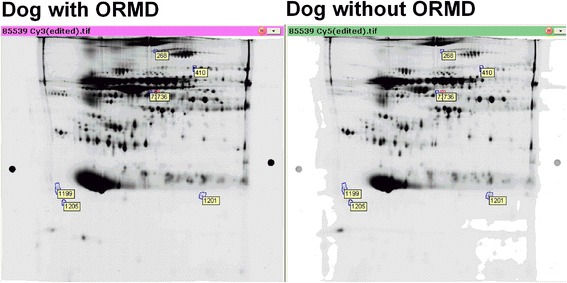
Approximately 20 % of obese dogs have metabolic disturbances similar to those observed in human metabolic syndrome, a condition known as obesity-related metabolic dysfunction. This condition is associated with insulin resistance and decreased circulating adiponectin concentrations, but clinical consequences have not been reported. In order to define better the metabolic changes associated with obesity-related metabolic dysfunction (ORMD), we compared the plasma proteomes of obese dogs with and without ORMD. A proteomic analysis was conducted on plasma samples from 8 obese male dogs, 4 with ORMD and 4 without ORMD. The samples were first treated for the depletion of high-abundance proteins and subsequently analysed by using 2-DE DIGE methodology.
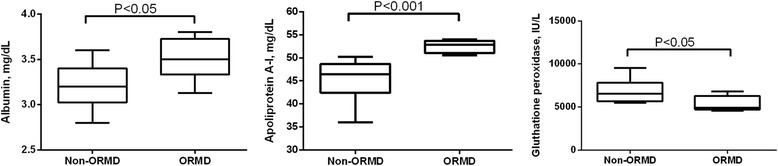
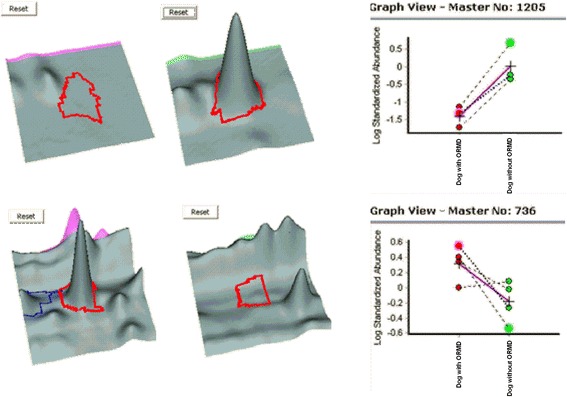
Using mass spectrometry, 12 proteins were identified: albumin, apoliprotein A-I, C2, C3, C5, C4BPA, A2M, Uncharacterised protein (Fragment) OS = Canis familiaris, fibrinogen, IGJ, ITIH2, and glutathione peroxidase. In obese dogs with ORMD, the relative amounts of ten proteins (albumin, apoliprotein A-I, C2, C3, C5, C4BPA, A2M, Uncharacterised protein (Fragment) OS = Canis familiaris, fibrinogen, and ITIH2) were increased and two proteins (IGJ and glutathione peroxidase) were decreased, compared with obese dogs without ORMD. Specific assays were then used to confirm differences in serum albumin, apoliprotein A-I and glutathione peroxidase in a separate group of 20 overweight dogs, 8 with ORMD and 12 without ORMD.
The current study provides evidence that, in obese dogs with ORMD, there are changes in expression of proteins involved in lipid metabolism, immune response, and antioxidant status. The clinical significance of these changes remains to be defined.
约20%的肥胖犬存在与人类代谢综合征中所见类似的代谢紊乱,这种情况被称为肥胖相关代谢功能障碍。该病症与胰岛素抵抗及循环脂联素浓度降低有关,但尚未见临床后果的报道。为了更好地界定与肥胖相关代谢功能障碍(ORMD)相关的代谢变化,我们比较了有和没有ORMD的肥胖犬的血浆蛋白质组。对8只肥胖雄性犬(4只患有ORMD,4只未患ORMD)的血浆样本进行了蛋白质组分析。样本首先进行高丰度蛋白去除处理,随后采用双向荧光差异凝胶电泳(2-DE DIGE)方法进行分析。
通过质谱鉴定出12种蛋白质:白蛋白、载脂蛋白A-I、C2、C3、C5、C4BPA、A2M、未鉴定蛋白质(片段)OS = 家犬、纤维蛋白原、IGJ、ITIH2和谷胱甘肽过氧化物酶。与没有ORMD的肥胖犬相比,患有ORMD的肥胖犬中,10种蛋白质(白蛋白、载脂蛋白A-I、C2、C3、C5、C4BPA、A2M、未鉴定蛋白质(片段)OS = 家犬、纤维蛋白原和ITIH2)的相对含量增加,2种蛋白质(IGJ和谷胱甘肽过氧化物酶)的相对含量降低。然后在另一组20只超重犬(8只患有ORMD,12只未患ORMD)中使用特定检测方法确认血清白蛋白、载脂蛋白A-I和谷胱甘肽过氧化物酶的差异。
当前研究提供了证据表明,在患有ORMD的肥胖犬中,参与脂质代谢、免疫反应和抗氧化状态的蛋白质表达存在变化。这些变化的临床意义仍有待确定。