Hodo Carolyn L, Goodwin Chloe C, Mayes Bonny C, Mariscal Jacqueline A, Waldrup Kenneth A, Hamer Sarah A
Department of Veterinary Pathobiology, Texas A&M University College of Veterinary Medicine and Biomedical Sciences, 4467 TAMU, College Station, TX 77843-4467, United States.
Department of Veterinary Integrative Biosciences, Texas A&M University College of Veterinary Medicine and Biomedical Sciences, 4458 TAMU, College Station, TX 77843-4458, United States.
Acta Trop. 2016 Dec;164:259-266. doi: 10.1016/j.actatropica.2016.09.013. Epub 2016 Sep 16.
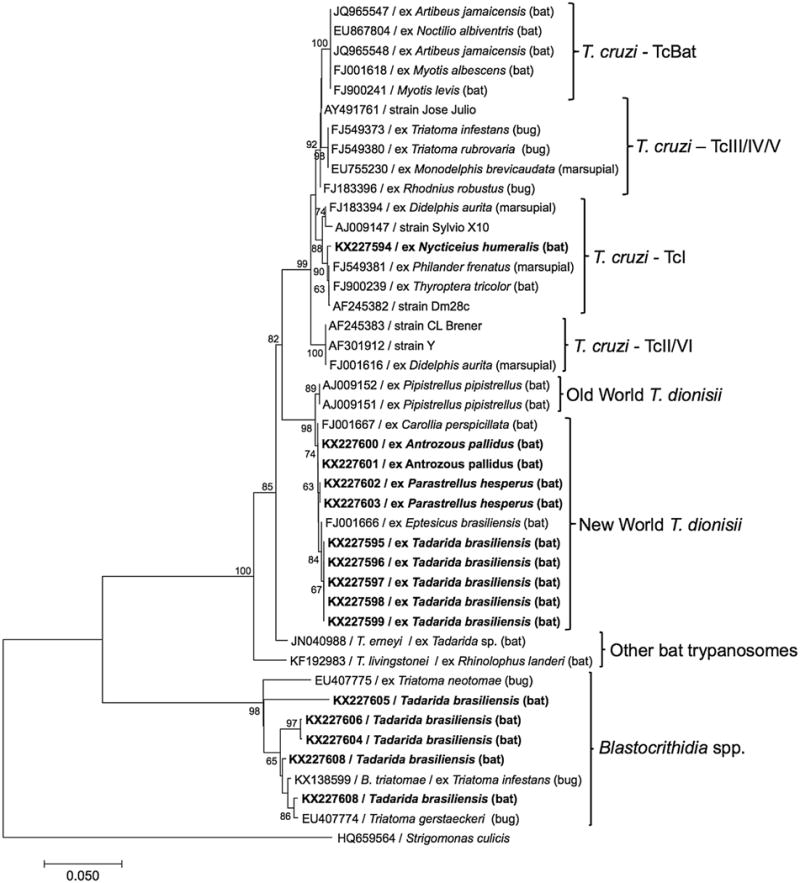
In contrast to other mammalian reservoirs, many bat species migrate long-distances and have the potential to introduce exotic pathogens to new areas. Bats have long been associated with blood-borne protozoal trypanosomes of the Schizotrypanum subgenus, which includes the zoonotic parasite Trypanosoma cruzi, agent of Chagas disease. Another member of the subgenus, Trypanosoma dionisii, infects bats of Europe and South America, and genetic similarities between strains from the two continents suggest transcontinental movement of this parasite via bats. Despite the known presence of diverse trypanosomes in bats of Central and South America, and the presence of T. cruzi-infected vectors and wildlife in the US, the role of bats in maintaining and dispersing trypanosomes in the US has not yet been reported. We collected hearts and blood from 8 species of insectivorous bats from 30 counties across Texas. Using PCR and DNA sequencing, we tested 593 bats for trypanosomes and found 1 bat positive for T. cruzi (0.17%), 9 for T. dionisii (1.5%), and 5 for Blastocrithidia spp. (0.8%), a group of insect trypanosomes. The T. cruzi-infected bat was carrying TcI, the strain type associated with human disease in the US. In the T. dionisii-infected bats, we detected three unique variants associated with the three infected bat species. These findings represent the first report of T. cruzi in a bat in the US, of T. dionisii in North America, and of Blastocrithidia spp. in mammals, and underscore the importance of bats in the maintenance of trypanosomes, including agents of human and animal disease, across broad geographic locales.
与其他哺乳动物宿主不同,许多蝙蝠物种会进行长距离迁徙,有可能将外来病原体引入新的地区。长期以来,蝙蝠一直与裂锥属血源原生动物锥虫有关,该属包括人畜共患寄生虫克氏锥虫,即恰加斯病的病原体。该亚属的另一个成员,迪氏锥虫,感染欧洲和南美的蝙蝠,来自两大洲的菌株之间的遗传相似性表明这种寄生虫通过蝙蝠进行了跨大陆传播。尽管已知中美洲和南美洲的蝙蝠体内存在多种锥虫,且美国存在感染克氏锥虫的媒介和野生动物,但蝙蝠在美国维持和传播锥虫方面的作用尚未见报道。我们从得克萨斯州30个县的8种食虫蝙蝠中采集了心脏和血液。使用聚合酶链反应(PCR)和DNA测序,我们对593只蝙蝠进行了锥虫检测,发现1只蝙蝠感染克氏锥虫呈阳性(0.17%),9只感染迪氏锥虫(1.5%),5只感染芽生短膜虫属(0.8%),这是一组昆虫锥虫。感染克氏锥虫的蝙蝠携带的是TcI,这是与美国人类疾病相关的菌株类型。在感染迪氏锥虫的蝙蝠中,我们检测到与三种受感染蝙蝠物种相关的三种独特变体。这些发现代表了美国蝙蝠中克氏锥虫、北美迪氏锥虫以及哺乳动物中芽生短膜虫属的首次报道,并强调了蝙蝠在维持包括人类和动物疾病病原体在内的锥虫在广泛地理区域传播中的重要性。